41 Must-Have Medical Assistant Skills: Clinical, Administrative, and Interpersonal
- Medical Assistant
-
 Authored by
Denisse Adams
Authored by
Denisse Adams
-
 Reviewed by
Dr. Thomas Kenny
Reviewed by
Dr. Thomas Kenny
- Updated August 24, 2026
- 642 views
Medical assistant (MA) skills refer to the set of inherent and learned abilities a medical assistant possesses and develops to perform medical assistant duties in large hospitals, clinics, diagnostic centers, outpatient care centers, physicians’ offices, and laboratories. Skills of a medical assistant fall under three major 3 categories: clinical, administrative, and interpersonal. Clinical skills involve tasks directly related to patient care, such as drawing blood, taking vitals, and infection control. Administrative skills are front office duties required to ensure smooth organizational workflow, such as appointment scheduling, billing and coding, and electronic health records (EHR) management. Interpersonal skills, also called people skills or soft skills, refer to an MA’s behavior and interaction, such as active listening, empathy, and clear communication in a fast-paced environment.
Medical assistant skills are important to meet industry requirements, optimize a CV for high employability, align with national certification requirements, gain workplace confidence, and advance to long-term, higher-earning career opportunities. According to the U.S. Bureau of Labor Statistics, employment of medical assistants is projected to grow 12% from 2024 to 2034 — much faster than the average for all occupations — which makes skill development one of the strongest levers on your long-term earning potential. To develop MA skills, enroll in an MA program, join an externship, earn national certification, continue your education, and keep practicing your clinical, administrative, and interpersonal skills.
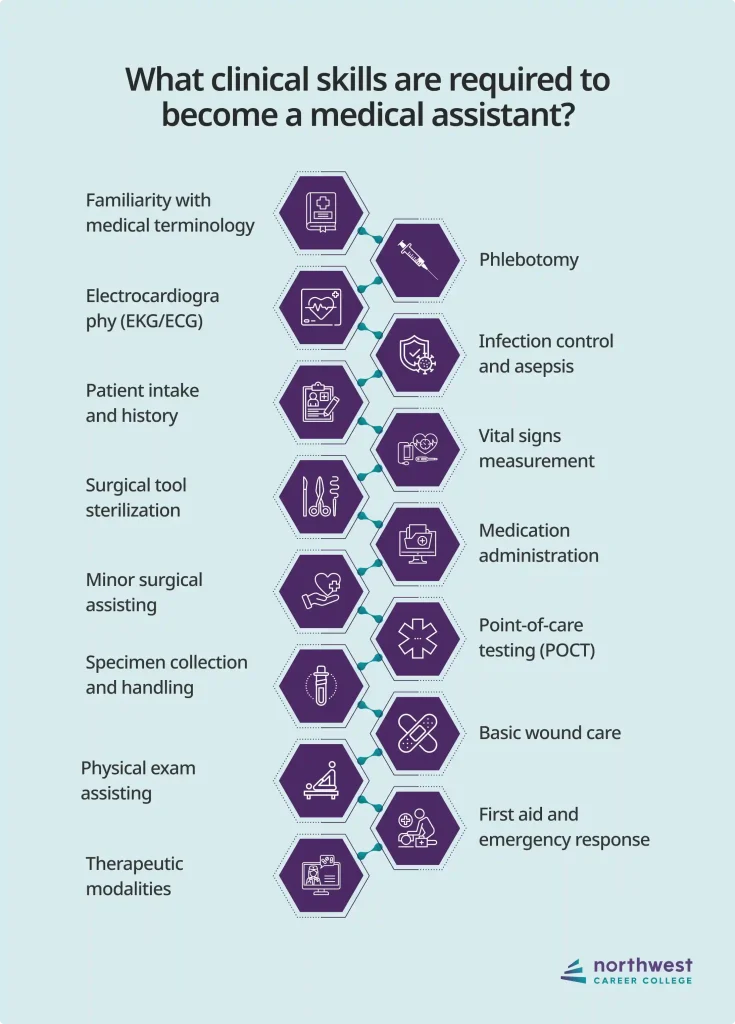
What clinical skills are required to become a medical assistant?
Clinical skills required to become a medical assistant include familiarity with medical terminology, phlebotomy, EKG/ECG, infection control and asepsis, and patient intake and history. These skills differ from administrative tasks such as scheduling and billing, and mastering them qualifies a medical assistant to work directly with patients in physician offices, outpatient clinics, and urgent care centers.
The 15 most common clinical skills for medical assistants are as follows.
- Familiarity with medical terminology: Recognizing and correctly using the prefixes, suffixes, and root words that make up standard healthcare vocabulary. You will rely on this vocabulary to read physician orders accurately, document symptoms precisely, and avoid clinical communication errors.
- Phlebotomy: Collecting blood samples for diagnostic laboratory testing. You will master venipuncture vein-stick techniques, perform capillary skin punctures, and follow the strict color-coded order of draw.
- Electrocardiography (EKG/ECG): Tracking and recording the electrical activity of a patient’s heart. You will place a 12-lead electrode configuration on the patient’s limbs and chest while checking the machine for recording artifacts.
- Infection control and asepsis: Applying strict sanitation methods to prevent germ transmission. You will wash your hands thoroughly, wear personal protective equipment (PPE), and disinfect exam room counters and treatment tables between patient appointments.
- Patient intake and history: Gathering primary health background data before the healthcare provider enters the room. You will document the patient’s chief complaint, current active medications, and known allergies.
- Vital signs measurement: Obtaining basic physical health baselines to track patient well-being. You will measure, verify, and document blood pressure, heart rate, respiration rate, and core body temperature.
- Surgical tool sterilization: Preparing instruments for minor surgical procedures. You will manually scrub contaminated tools, wrap them in sterilization pouches, and safely operate a high-pressure steam autoclave machine.
- Medication administration: Safely delivering medications ordered by a physician. You will calculate correct dosages and inject vaccines or therapeutic medications via intramuscular, subcutaneous, or intradermal routes.
- Minor surgical assisting: Helping the physician perform outpatient surgical operations. You will set up a sterile field tray, prep the patient’s surgical skin site, and hand instruments like forceps or scissors.
- Point-of-care testing (POCT): Performing rapid diagnostic laboratory tests right inside the examination room. You will process quick chemical screenings, including rapid strep swabs, urine dipstick tests, and finger-prick blood glucose readings.
- Specimen collection and handling: Collecting non-blood biological samples for laboratory diagnostic analysis. You will instruct patients on clean-catch urine midstreams, collect throat swabs, and label biohazard transport containers.
- Basic wound care: Managing minor external skin injuries to encourage healing and stop infection. You will cleanse minor wounds, apply sterile dressings, and perform surgical staple or suture removals.
- Physical exam assisting: Supporting the physician during routine checkups or specialty assessments. You will position the patient properly, drape them for personal privacy, and pass diagnostic tools like otoscopes.
- First aid and emergency response: Recognizing and responding to sudden medical crises within the ambulatory clinic. You will perform Cardiopulmonary Resuscitation (CPR), apply first aid, and retrieve emergency supplies from the crash cart.
- Therapeutic modalities: Providing supportive physical treatments to assist patient recovery and comfort. You will apply localized hot or cold packs, set up ultrasound devices, and teach basic range-of-motion movements.
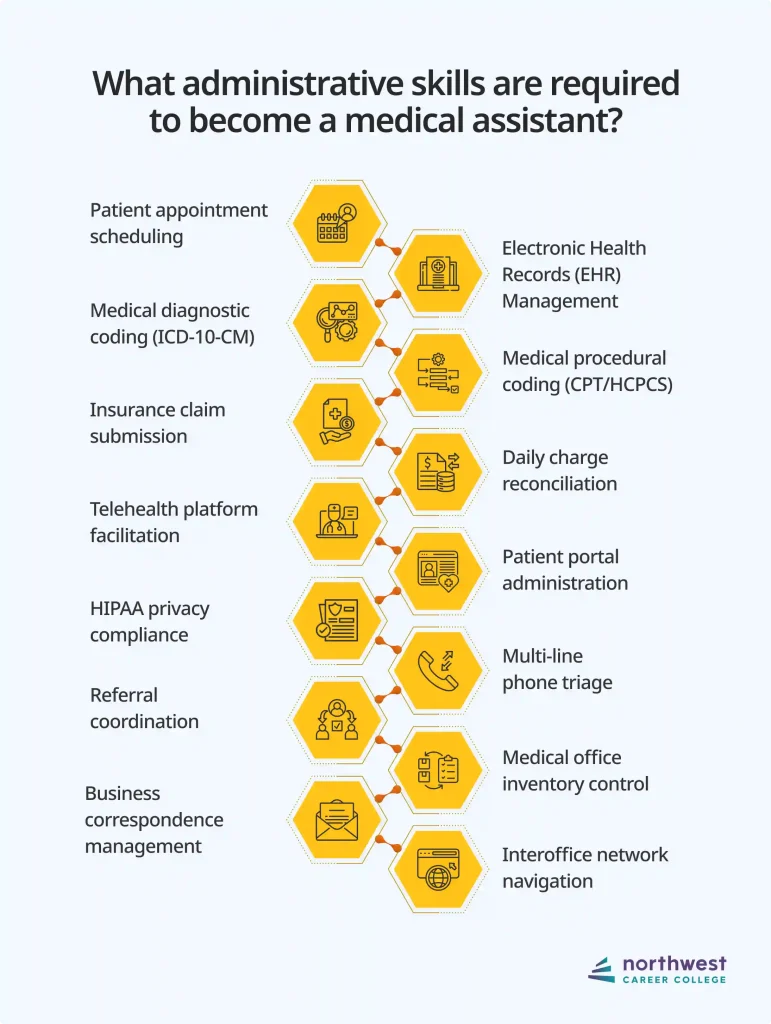
What administrative skills are required to become a medical assistant?
Administrative skills that are required to become a medical assistant include patient appointment scheduling, EHR management, medical diagnostic coding, medical procedural coding, and insurance claim submission. These skills differ from clinical tasks such as phlebotomy and EKGs, and mastering them qualifies a medical assistant to work on the administrative or front-office side of healthcare facilities, including physician practices, hospitals, and billing departments.
The 14 most common administrative skills for medical assistants are as follows.
- Patient appointment scheduling: Organizing provider calendars to optimize daily patient flow. This involves booking appointments, managing cancellations, and utilizing specific scheduling methods like wave, cluster, or modified-wave scheduling.
- Electronic Health Records (EHR) Management: Navigating digital charting software to manage patient files. You will update medical histories, enter provider notes, and securely route electronic laboratory results within systems like Epic or NextGen.
- Medical diagnostic coding (ICD-10-CM): Translating patient illnesses and symptoms into standard alphanumeric codes. You will analyze provider documentation to assign precise codes required for insurance reimbursement and public health tracking.
- Medical procedural coding (CPT/HCPCS): Coding the specific services, treatments, and supplies provided during an office visit. Accurate entry of these codes on insurance claim forms directly impacts clinic billing and revenue cycle tracking.
- Insurance claim submission: Preparing and sending medical billing claims to clearinghouses or third-party payers. This involves auditing digital claim forms for errors to prevent structural rejections or payment delays.
- Daily charge reconciliation: Balancing the clinic’s daily financial transactions at the close of business. You will cross-reference collected cash, checks, and credit card copayments against the electronic health record log.
- Telehealth platform facilitation: Managing virtual patient appointments through encrypted video software. You will check patients into digital waiting rooms, troubleshoot connection issues, and guide them through virtual consent forms.
- Patient portal administration: Managing secure online communication channels between patients and providers. This involves helping patients set up accounts, resetting passwords, and routing digital message requests to clinical staff.
- HIPAA privacy compliance: Enforcing federal regulations regarding Protected Health Information (PHI). This requires verifying patient identities, securing computer screens, and ensuring proper authorizations are signed before releasing records.
- Multi-line phone triage: Handling incoming clinic phone traffic professionally. You will screen patient inquiries, take detailed messages, and direct emergency or clinical calls to the appropriate nurse or physician.
- Referral coordination: Managing the logistical transfer of a patient to an outside specialist. You will compile necessary medical records, send them to the receiving clinic, and notify the patient of their scheduled date.
- Medical office inventory control: Tracking and ordering administrative and clinical supplies. This involves auditing supply closets, monitoring expiration dates on items, and logging purchase orders while staying within the clinic’s operational budget.
- Business correspondence management: Drafting professional communications for the healthcare facility. You will write official referral letters, compose interoffice emails, and sort incoming mail while protecting sensitive patient data.
- Interoffice network navigation: Using local administrative software interfaces to securely run a healthcare facility. You will back up daily administrative data, navigate internal staff portals, and log equipment maintenance requests on protected facility databases.
What interpersonal skills are required to become a medical assistant?
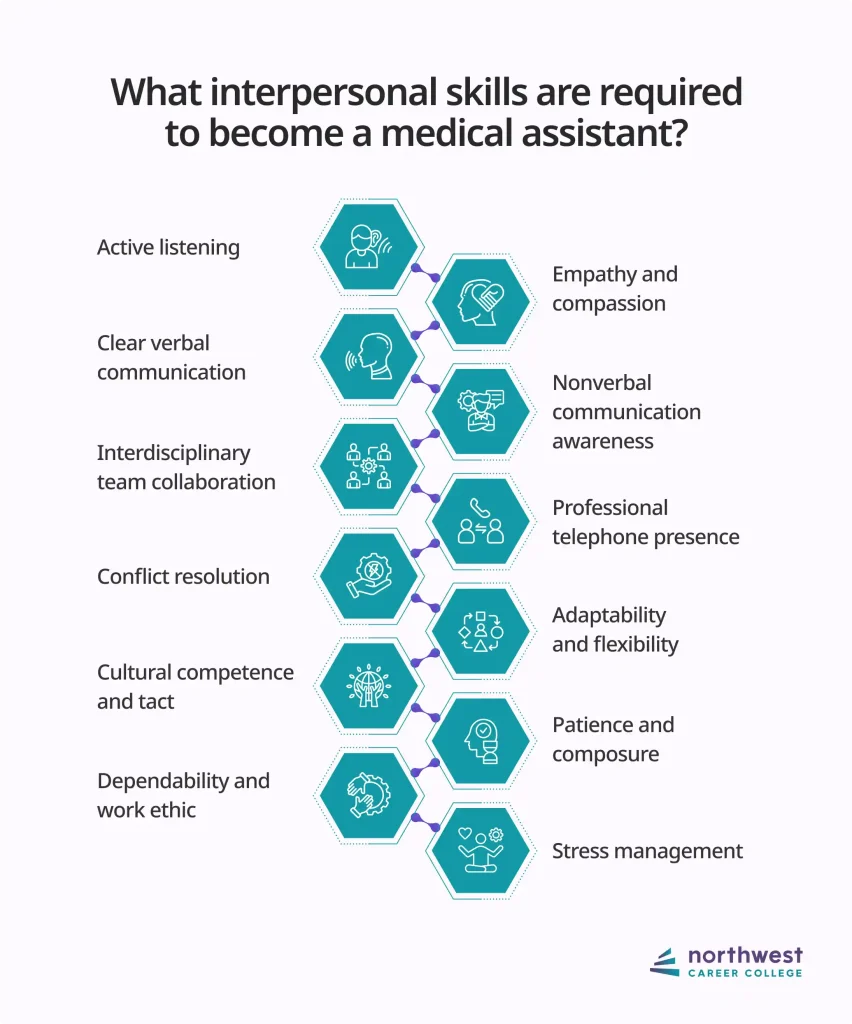
Interpersonal skills required to become a medical assistant include active listening, empathy and compassion, clear verbal communication, nonverbal communication awareness, and interdisciplinary team collaboration. Unlike clinical or administrative skills, interpersonal skills apply to every medical assistant regardless of specialization, since both clinical and front-office duties depend on how well you communicate with patients and coworkers.
The 13 most common interpersonal skills for medical assistants are as follows.
- Active listening: Giving undivided attention to a patient or provider. You will focus completely on what is being shared, ask targeted clarifying questions, and document the exact symptoms reported without making assumptions.
- Empathy and compassion: Demonstrating authentic kindness toward individuals who are sick, anxious, or in pain. You will validate patient worries, maintain a supportive attitude, and create a safe environment during stressful procedures.
- Clear verbal communication: Translating complex clinical instructions into everyday language. You will avoid confusing medical jargon, explain procedures step-by-step, and verify that the patient understands their post-visit instructions.
- Nonverbal communication awareness: Managing personal body language, posture, and expressions during patient interactions. You will maintain consistent eye contact, display a calm demeanor, and monitor the patient’s body language for unvoiced pain.
- Interdisciplinary team collaboration: Working cohesively alongside physicians, nurses, and administrative front-desk colleagues. You will step in to help during high-volume shifts, respect diverse personalities, and maintain unified patient care goals.
- Professional telephone presence: Balancing mechanical telephone routing with welcoming communication. You will handle high call volumes, speak clearly, place callers on hold respectfully, and route accurate messages to the nursing staff.
- Conflict resolution: De-escalating tense situations with upset or frustrated patients calmly. You will listen without taking complaints personally, remain strictly objective, and find immediate solutions for scheduling or billing friction.
- Adaptability and flexibility: Shifting priorities seamlessly as the daily ambulatory clinic schedule changes. You will adjust smoothly when emergency walk-ins disrupt the workflow or when moving between clinical and front-office duties.
- Cultural competence and tact: Interacting respectfully with diverse patient demographics, age groups, and backgrounds. You will respect personal space, eliminate communication barriers, and adapt your approach to accommodate special patient populations.
- Patience and composure: Maintaining a steady, unhurried focus in high-stress clinical environments. You will give distracted, elderly, or pediatric patients the necessary time to process information without showing frustration or rushing the encounter.
- Dependability and work ethic: Demonstrating consistent accountability, punctuality, and respect for workspace standards. You will show up prepared for shifts, complete clinical checks thoroughly, and safeguard sensitive data to maintain practice integrity.
- Stress management: Keeping personal emotions and workplace exhaustion completely separate from patient care. You will handle heavy workloads calmly, prevent personal burnout, and project an approachable, steady presence on the clinic floor.
Why are medical assistant skills important?
Medical assistant skills are important for meeting the healthcare industry’s requirements, optimizing your CV to ensure employability, meeting national examination certification, gaining workplace confidence, and advancing to long-term and lucrative career opportunities.
- Meeting the healthcare industry’s requirements
Medical assistant skills meet modern healthcare facilities’ heavy regulation and fast-paced demand. Medical assistant professionals possess skill versatility and multitasking abilities to reduce patient safety risks. Hiring managers value your comprehensive clinical and administrative training because it minimizes operational errors, reduces diagnostic processing mistakes, lowers patient wait times, and reduces clinic liability risk.
- Optimizing your CV to ensure employability
Medical assistant skills strengthen your job search by giving you verifiable, listed competencies such as phlebotomy, Current Procedural Terminology (CPT) coding, and electronic health records (EHR) management to include on your CV. Healthcare employers use automated applicant tracking systems to screen applications for high-demand technical keywords. These skills help you pass software filters, set you apart from uncertified candidates, and secure interviews with the healthcare employers you want to work for.
- Meeting national examination certification requirements
National credentialing boards such as the American Association of Medical Assistants (AAMA) and the National Healthcareer Association (NHA) evaluate clinical safety protocols, administrative legal compliance, and baseline medical knowledge. Mastering these core competencies prepares you to demonstrate your skills on exams like the NHA Certified Clinical Medical Assistant (CCMA) or the AAMA Certified Medical Assistant (CMA). These credentials prove that a nationally recognized authority has approved your skills to join the workforce.
- Gaining workplace confidence
Medical assistant skills prepare you for ambulatory clinical environments that move at high speed, leaving no time for hesitation or second-guessing. Hands-on skill proficiency builds the self-assurance you need to perform invasive procedures, communicate clearly with physicians, and handle unexpected medical emergencies on the clinic floor without performance anxiety.
- Advancing to long-term and lucrative career opportunities
There are 3 types of medical assistants — clinical, administrative, and specialized — each offering opportunities to develop skills and experience in different areas of healthcare. Your medical assistant experience can serve as a stepping stone toward higher-tier medical professions. Developing your skills builds the clinical hours and professional network many advanced programs require, while increasing your practical knowledge in specialized fields and your long-term salary potential.
How to develop skills as a medical assistant?
To develop skills as a medical assistant, enroll in a medical assistant program, join an externship, take the national exam and get certified, continue education even after graduation, and continue practicing soft skills. Skill development is a continuous process — systematic education and national certification prove you are ready to work as a beginner and to build advanced skills from there.
Here are the steps to develop skills as a medical assistant.
Step 1: Enroll in a medical assistant program
Enrolling in a medical assistant program gives you a structured education that employers prefer. Choosing a program accredited by the Commission on Accreditation of Allied Health Education Programs (CAAHEP) or the Accrediting Bureau of Health Education Schools (ABHES) ensures your training curriculum meets the standards Nevada employers expect, as well as the standards required for national certification exams like Certified Clinical Medical Assistant (CCMA).
Medical assistant programs prepare you for entry-level employment by providing theoretical knowledge through classroom and online instruction, practical knowledge through hands-on lab training, and applied clinical skills through simulation-based learning. As a result, you develop a well-rounded skill set across three core areas — clinical, administrative, and interpersonal — that healthcare employers look for.
Step 2: Join an externship
A medical assistant externship is a supervised, hands-on training placement in an actual clinic or hospital that connects your classroom learning to real-world experience. You boost clinical expertise and workplace readiness, and build a professional network, by working under seasoned professionals during this immersive training — all before formally graduating. In most cases, a medical assistant externship is part of an accredited training program; if your program doesn’t offer one, seek an externship independently through local clinics or hospitals.
Step 3: Take the national exam and get certified
Earning a medical assistant certification proves to employers that you have met an established, job-ready standard of competency. According to a 2025 data analysis by the National Healthcareer Association titled “Exclusive Trends About In-Demand Allied Health Professions,” 85% of employers prefer candidates with nationally recognized certifications. Passing a national exam demonstrates that your skills meet rigorous safety requirements that Nevada’s employers prefer and that you are competent to step into a live clinical setting.
The major national certification exams and the skills each one prioritizes are as follows.
| Certifications | Skill priority in question |
| Certified Medical Assistant (CMA) by the American Association of Medical Assistants (AAMA) | Requires clinical workflows and vital signs, safety and infection control, oral and parenteral medication administration, and billing with insurance coding. |
| Certified Clinical Medical Assistant (CCMA) by the National Healthcareer Association (NHA) | Requires direct patient care, phlebotomy procedures, EKG and cardiovascular testing, and point-of-care laboratory testing. |
| National Certified Medical Assistant (NCMA) by National Center for Competency Testing (NCCT) | Requires medication-related calculations, surgical asepsis with minor surgical assisting, CDC infection control precautions, and electronic medical data maintenance. |
| Registered Medical Assistant (RMA) by American Medical Technologists (AMT) | Requires therapeutic modalities, first aid and emergency responses, professional human relations, and laboratory diagnostic processing. |
| Certified Medical Administrative Assistant (CMAA) by the National Healthcareer Association (NHA) | Requires patient appointment scheduling, insurance verification workflows, daily charge reconciliation, and compliance with HIPAA privacy laws. |
Step 4: Continue education even after graduation
Pursuing continuing education after graduation keeps your clinical and administrative skills current as healthcare technology and regulations evolve. As you gain experience, you build technical expertise that specialized clinics value. You also keep your national credential active by earning Continuing Education Units (CEUs) at intervals set by your certifying body — typically every 2 to 3 years — which keeps you current on changing compliance laws, EHR software updates, and advanced clinical protocols.
Step 5: Continue practicing soft skills
Using soft skills in everyday interactions helps you improve the skills required to perform medical assisting jobs. Technical abilities get you hired, but your people skills dictate how well you perform on the floor. Soft-skill development doesn’t end with classroom learning — it continues throughout your career. Treat every patient and coworker interaction as an opportunity to practice these skills with different types of people.

What are good skills to put on a resume for a medical assistant?
Good skills to put on a resume for a medical assistant include soft skills such as empathy and compassion, adaptability, and time management; hard skills such as drawing blood, EHR management, and patient preparation; and digital skills such as telehealth and virtual support. Highlight whichever of these you perform best, such as multitasking, and mirror the exact skill keywords used in the job description you’re applying to. The strongest resumes balance clinical, administrative, and interpersonal skills rather than listing only one category.
What are soft skills for a medical assistant?
The soft skills checklist for medical assistants includes:
- Teamwork
- Bilingual skill
- Active listening
- Problem solving
- Critical thinking
- Attention to details
- Empathy and compassion
What are hard skills for a medical assistant?
The hard skills checklist for medical assistants includes:
- Drawing blood
- EHR management
- Patient preparation
- Specimen collection
- Instrument Sterilization
- Wound care and dressing
- Medical coding and billing
What are the strongest skills for a medical assistant?
The strongest skills for a medical assistant are adaptability, interpersonal communication, tech literacy, and multitasking; however, it varies from person to person. A medical assistant’s strongest skill depends on the traits that drive them to perform a specific task better and faster than others and seamlessly switch between administrative and clinical tasks. Strongest skills can be personal traits such as empathy or learned skills such as clinical proficiency, or both, such as punctuality.
What digital skills do employers expect from medical assistants?
Digital skills that employers expect from medical assistants include Electronic Health Records (EHR), telemedicine software, telehealth and virtual support, digital data security in compliance with the Health Insurance Portability and Accountability Act (HIPAA), digital communication and scheduling, and medical billing software. Medical employers prefer employees with digital skills because they ensure secure, error-free data logging, efficient virtual scheduling, and smooth communication between patients and healthcare providers.
What future skills should medical assistant students learn?
Future skills that medical assistant students learn include using AI-driven administrative tools, managing remote patient monitoring systems, facilitating video visits, and guiding patients through complex digital health ecosystems. These emerging competencies help students stay competitive as healthcare technology evolves.
What should you expect from a medical assistant’s skill learning journey?
You should expect to go through three distinct career phases in your medical assistant skill-learning journey: beginner-level expertise, mid-level expertise, and professional-level expertise. As a beginner, you master fundamental skills in a medical facility, such as maintaining communication, taking vital signs, and basic EHR tracking. During mid-level learning, your skills expand to specialized clinical procedures such as performing phlebotomy and handling patient education. At a professional level, you demonstrate advanced clinical and administrative expertise along with multitasking skills. A medical assistant career is rewarding, and skill development is one of the factors that can raise a medical assistant’s salary as high as $51,933 annually in Nevada.