Medical Assistant: Duties, Types, Salary, Certification, and Career Path
- Medical Assistant
-
 Authored by
Denisse Adams
Authored by
Denisse Adams
-
 Reviewed by
Dr. Thomas Kenny
Reviewed by
Dr. Thomas Kenny
- Updated August 21, 2026
- 623 views
Medical assistants refer to medical employees working with physicians and patients to support operational and organizational workflow. They perform clinical and administrative duties inside ambulatory care centers, hospitals, clinics, and urgent care facilities.
Depending on the performed duties, medical assistants (MAs) are categorized into clinical, administrative, and specialized. They earn between $27,000 and over $56,500 per year in the US and $24,000 to over $50,000 per year in Las Vegas, Nevada. MAs working in specialized fields such as oncology, cardiology, and neurosurgery earn the highest.
Becoming a medical assistant requires developing clinical and administrative skills through hands-on training in fast-paced medical settings. Enrolling in a medical assistant training program is a good option, as it trains you through theory, hands-on training, and externship, aiming for national certification exams such as Certified Clinical Medical Assistant (CCMA), which medical employers prefer. Consider the programs’ accreditation, curriculum details, externship opportunities, and career support when choosing the right program. Having a national certification proves your competency at the industry level and opens doors for high-salary and diverse career opportunities.

What is a medical assistant?
A Medical Assistant (MA), also called a healthcare assistant or clinical assistant, is an allied healthcare professional who performs clinical and administrative duties to assist licensed healthcare providers such as physicians and nurse practitioners. Common duties include drawing blood (phlebotomy), taking vital signs, and billing and coding in hospitals, private and specialty clinics, physician offices, diagnostic centers, outpatient care facilities, and urgent care facilities.
Medical assistants connect healthcare service providers with patients by working in the front-office and clinical roles. Their administrative (front-office) tasks include scheduling appointments, billing and coding, and updating EHR. Their clinical duties include administering injections, assisting in minor surgical procedures, and drawing blood.
What does a medical assistant do?
A medical assistant (MA) does both clinical (back-office) duties and administrative (front-office) work. MAs’ clinical duties include taking vital signs, drawing blood for lab tests, administering injections, and assisting with minor surgical procedures. Their administrative duties include scheduling patient appointments, updating electronic health records, processing insurance authorizations, and answering patient phone inquiries in private physicians’ offices, urgent care centers, and outpatient hospital clinics.
MAs’ job roles are diverse and vary by state. They also perform specialized, advanced duties in specific clinics such as running cardiac stress tests and performing EKGs in cardiology, or setting sterile biopsy trays and preparing skin excisions in dermatology.
Where do medical assistants work?
Medical assistants work in private physicians’ offices, urgent care centers, outpatient hospital clinics, and outpatient specialty clinics. MAs’ scope of practice differs by their credential and competence; for example, in Washington, California, Nevada, and Louisiana, medical assistants aren’t allowed to draw blood without a separate, state-specific phlebotomy credential. Certified medical assistants can work in most of the states and enjoy more career flexibility than non-certified MAs because of employers’ preference.
Other workplaces where medical assistants are hired to work include the following.
- Hospitals and medical centers: Coordinate overnight patient admissions, manage floor logistics, and assist nursing staff with patient transfers.
- Diagnostic laboratories: Process clinical specimens, match lab orders with patient records, and perform low-complexity diagnostic tests.
- Medical research facilities: Support clinical trials by tracking patient compliance, scheduling follow-up monitoring, and preparing biological samples for shipment.
- Public health agencies and community clinics: Conduct community health screenings, document patient epidemiologic data, and distribute vital preventive healthcare education.
What are the different types of medical assistants?
Medical assistants are primarily divided into 3 main categories: clinical medical assistant, administrative medical assistant, and specialized medical assistant, based on their core job responsibilities, the daily tasks they perform, and the specific healthcare settings where they operate. In many smaller practices, these roles overlap, but as medical assistants hone their skills over time, they become true experts in their chosen field.
The specific occupational tasks and employment settings for each category are as follows.
- Clinical Medical Assistant
Clinical medical assistants perform tasks directly related to patients, including taking patient vital signs, recording medical histories, preparing patients for physical examinations, drawing blood, administering injections, and assisting physicians with minor surgical procedures. They get hired in urgent care centers, outpatient hospital wards, family medicine practices, and multi-specialty group clinics.
- Administrative Medical Assistant
Administrative medical assistants perform front-office tasks, manage electronic health records, schedule patient appointments, answer phones, handle medical billing, process insurance pre-authorizations, and greet arriving patients at the front desk. Their work settings include private physician offices, healthcare corporate headquarters, hospital reception units, and medical billing agencies.
- Specialized Medical Assistants
Specialized medical assistants work in several highly focused areas of medicine, expanding their career into various fields as follows.
- Cardiology Medical Assistants: Focus on heart health by placing electrodes for electrocardiograms (EKGs), monitoring patients during cardiac stress tests, and tracking Holter monitor data.
- Ophthalmic Medical Assistants: Assist eye doctors by administering diagnostic vision tests, teaching patients how to insert contact lenses, and maintaining delicate eye surgical instruments.
- Dermatology Medical Assistants: Help skin care specialists by setting up sterile trays for skin biopsies, preparing rooms for surgical excisions, and assisting with cosmetic laser procedures.
- OB/GYN Medical Assistants: Assist in women’s health clinics by preparing patients for pelvic exams, setting up sterile instruments for prenatal biopsies, and providing education on routine prenatal care.
- Chiropractic Medical Assistants: Assist chiropractors by positioning patients for skeletal adjustments, applying hot or cold therapeutic packs, and demonstrating rehabilitative stretching exercises.
How much do medical assistants make?
Medical assistants make $27,000 to over $56,500 per year in the US, according to a 2026 ZipRecruiter report. It is equivalent to approximately $19.89 an hour, $795/week, or $3,447/month. The national median salary of a medical assistant in the US is $41,370. Medical assistants make $24,000 to over $50,000 per year in Las Vegas, Nevada, which is equivalent to an average of $17 to $21 per hour, $700 to $900 per week, and more than $3000 per month.
According to the U.S. Bureau of Labor Statistics, the lowest 10 percent of medical assistants in the US earn less than $35,020, and the highest 10 percent earn more than $57,830. The earnings of MAs vary depending on several factors, including candidates’ knowledge, certification, experience, employer type, employment type, bilingual skills, specialization, location, and shift differences. Top-paying industries for medical assistants include Offices of Physicians, Outpatient Care Centers, General Medical and Surgical Hospitals, and Offices of Other Health Practitioners.
What type of medical assistants make the most money?
Medical assistants working in specialized fields, including oncology, cardiology, and neurosurgery, make the most money because of their intensive duties; oncology MAs coordinate chemo cycles and manage complex lab reports; cardiology MAs perform EKGs and run cardiac stress tests; and neurosurgery MAs prepare complex neurological imaging and document highly precise care plans.
In Las Vegas, Nevada, medical assistants who earn higher wages have some factors in common; they have graduated from an accredited program with an externship, acquired a national certification such as CMA and CCMA, have bilingual skills, or have prior experience as medical assistants.
How to become a medical assistant?
To become a medical assistant, you need hands-on clinical and administrative skills with nationally approved accreditation that employers recognize. The initial process begins with you completing a high school diploma or GED and enrolling in an accredited MA training program. Then complete your externship and sit for the national exam. Once you pass the exam, you become a certified medical assistant, eligible in both skills and qualifications that healthcare employers prefer. Make sure to continue your education to stay up to date with trends in the MA profession.
The steps to becoming a medical assistant are as follows.
1. Meet basic educational requirements: Get your high school diploma or a GED certificate. This is the baseline entry requirement for all accredited training programs and medical employers.
2. Complete an accredited MA training program: Enroll in a CAAHEP- or ABHES-accredited certificate, diploma, or associate degree program to avoid exam application rejection by major credentialing boards (like the AAMA).
3. Complete a clinical externship: Work hands-on in a real clinic or physician’s office to practice blood draws, injections, and EKG placement under professional supervision.
4. Earn a nationally recognized professional certification: Pass your preferred national credentialing exam such as the CCMA — it serves as proof that a national credentialing body has verified your competency.
5. Apply for medical assistant jobs: Build a resume highlighting your clinical hours, externship location, and active certifications. Apply through online job platforms and visit nearby clinics, diagnostic centers, and hospitals to search for vacancies.
6. Continue your education: Maintain your active employment status by completing Continuing Education (CE) credits. Also, maintain your certification by renewing it every two to five years, depending on the credentialing body.
How long does it take to become a medical assistant?
To become a medical assistant, it takes 8 weeks to 2 years, depending on programs and institutions; accelerated programs will take 8 weeks to 6 months, as they are short-form programs designed for faster entry to the job. A diploma program takes 9 to 12 months; it offers theoretical knowledge following the national exam’s structure, hands-on training, and externship opportunities to build students’ experience as per employers’ preference. An associate degree program (AAS/AS) takes 18 to 24 months. This long-form and in-depth curriculum prepares students for advanced careers.
The duration to become a medical assistant also varies by institution; a community college takes 6 to 24 months, and a trade school takes 9 to 12 months. When choosing a program with the right timeline, consider factors like credential type, enrollment status, program format, medical assistant training, institution type, externship opportunity, and certification preparation.
What is a medical assistant certification?
A Medical Assistant Certification is a nationally recognized professional credential that an accredited or authorized body offers to eligible MAs, approving their skills, competence, and clinical training experiences through a scheduled exam.
The most popular medical assistant certifications include the following ones.
- Certified Medical Assistant (CMA): CMA is issued by the American Association of Medical Assistants (AAMA). It is considered the gold standard and highly favored by large hospital networks.
- Certified Clinical Medical Assistant (CCMA): CCMA is issued by the National Healthcareer Association (NHA). It focuses heavily on clinical skills and is popular for fast-track employment.
- Registered Medical Assistant (RMA): RMA is issued by American Medical Technologists (AMT). It includes different eligibility pathways, such as military training or work experience, and is widely respected by private practices and clinics.
- National Certified Medical Assistant (NCMA): NCMA is issued by the National Center for Competency Testing (NCCT). It offers students more flexible, affordable eligibility pathways than some other major boards.
Consider your educational background, career goals, and regional employer preferences to choose the right certification.
Medical Assistant Certification is often used interchangeably with a medical assistant certificate, but the difference between a medical assistant certificate and MA certification includes their nature, issuing authorities, and expiration rules. A certificate is an educational credential earned by completing a training program offered by an academic institute (for example, Northwest Career College), and it never expires. Meanwhile, a certification is a professional credential earned by passing an exam administered by a national certifying body (for example, the CMA exam by AAMA), and it requires renewal through continuing education units (CEUs) every 2 to 5 years.
What jobs can you get with a medical assistant certification?
The jobs you can get with a medical assistant certification include medical assistant, medical administrative (office) assistant, medical clinical assistant, EKG technician, medical office manager, patient service representative, and nursing assistant.
Medical assistant job responsibilities vary by their earned credentials; a medical assistant with a school certificate is considered non-certified and can work in smaller private practices and is restricted to entry-level administrative or basic clinical support roles. A medical assistant with certification is considered a certified medical assistant; they get hired by hospital networks, emergency centers, and specialty groups because employing certified staff helps these organizations manage legal liability and compliance requirements.
In most US states, medical assistants don’t need certification to work, except in Washington. But not being certified limits hiring opportunities, employers’ trust, and earning potential. Earning a national certification (such as CMA or CCMA), however, builds healthcare employers’ confidence in your competence, gives you a nationally recognized credential, and leads to better pay and long-term career growth.
How much is a medical assistant program?
A medical assistant program costs between $900 and more than $38,000 in the US and $3,950 to $20,106 in Nevada, depending on program types (online certificate, diploma program, or associate degree program), duration, institution type (online programs, trade/vocational school, community college, or private schools), and campus location.
Completing a medical assistant program online costs between $500 and $5,000; a community college program costs $3,000 to $5,000, and $15,000 to $20,000 or more in private schools. Some MA programs include additional costs ($1,000 to $5,000) for lab fees, books, supplies, uniforms, and certification exam fees. Medical assistant certification exam fees range between $119 and $250.
When choosing the best medical assistant program for you in terms of cost, consider the following factors.
- Accreditation: CAAHEP or ABHES accreditation ensures eligibility for national certification exams.
- Clinical training: Availability of comprehensive hands-on medical assistant training.
- Externships: Placement in structured clinical externship programs.
- Supplies and fees: Total cost of required study materials, books, and uniforms.
- Exam preparation: Costs associated with sitting for a recognized national exam.
How to choose the right medical assistant training program in Las Vegas?
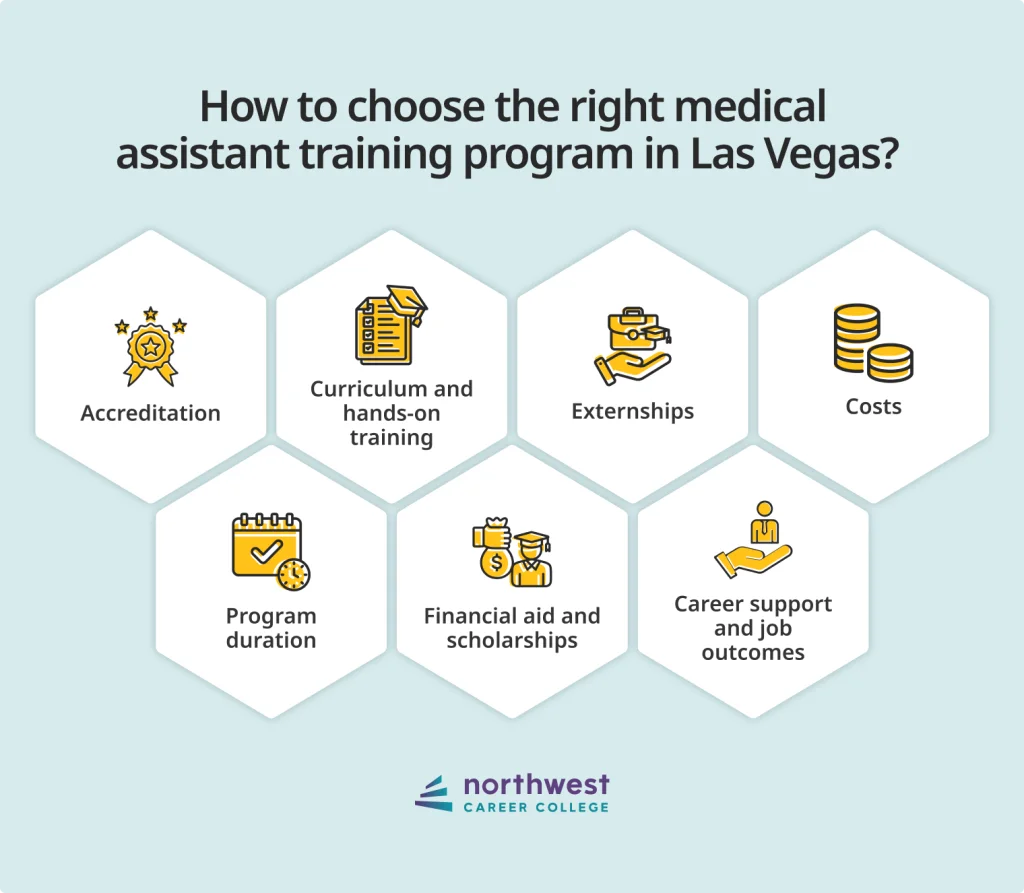
To choose the right medical assistant training program in Las Vegas, consider the programs’ accreditation (ABHES or CAAHEP), curriculum depth (clinical and administrative skills), externship opportunities, total costs, duration, financial aid, and available career placement support.
Here’s why each factor matters.
- Accreditation: Choose a program approved by ABHES or CAAHEP, which ensures stronger training standards and guarantees your eligibility for national certification exams like the CCMA, CMA, or RMA.
- Curriculum and hands-on training: Ensure the curriculum balances administrative duties with clinical tasks, such as phlebotomy, EKG placement, and vital signs, and includes supervised lab practice.
- Externships: Look for programs offering structured clinical externships (typically 160 to 200 hours) and school-assisted placement to transition smoothly into the workforce.
- Costs: Evaluate the total cost against the program format and what it includes; many programs include study materials, externship, and first exam fees along with the fee.
- Program duration: Shorter time allows you to learn basics and faster entry to jobs; but with limited growth. 9-month to 2-year programs build your career for both professional growth and job advancement. Accelerated programs take 2 to 6 months, diplomas take 9 to 12 months, and associate degrees last 18 to 24 months.
- Financial aid and scholarships: Ask the schools about their available financial aid and scholarship options, and whether they accept federal Pell Grants, student loans, or flexible payment plans. Evaluate your final out-of-pocket costs after aid is applied rather than the sticker price.
- Career support and job outcomes: Learn about your school’s career counseling systems, to what extent they support you with resume coaching, local clinic partnerships, and strong job placement data. Make sure to find programs that focus on certification readiness as you require.
What do you learn in medical assistant school?
You learn clinical and administrative tasks split between theory and hands-on training in your medical assistant school. You can attend the theoretical classes online, but medical assistant training requires you to learn in-person and hands-on instruction for the clinical components. The medical assistant curriculum includes mastering hands-on skills like taking vital signs, phlebotomy (drawing blood), EKG operation, and administering injections under physician supervision. Administrative courses teach essential desk operations, including electronic health records (EHR) management, medical billing, coding, and patient scheduling. This training builds the exact technical skills healthcare employers prefer to hire, serving as an ideal career step toward earning national certification and securing a fast-paced role in healthcare.
What does a medical assistant do on a daily basis?
On a daily basis, a medical assistant performs clinical and administrative duties to ensure smooth organizational operation. For the front-desk work, they answer phone calls, schedule patient appointments, update electronic health records (EHR), verify insurance, handle billing, and restock medical supplies throughout the facility to maintain a smooth, safe clinic workflow. Clinically, they bring patients to exam rooms, measure vital signs, record medical histories, administer vaccines, draw blood, and conduct routine tests like EKGs to assist the doctor. They mostly face a hectic schedule in the fast-paced medical environment.
Why are medical assistants important?
Medical assistants are important to bridge the gap between doctors and patients and support healthcare facilities to operate smoothly while maintaining safety and compliance. The need for skilled and qualified medical assistants continues to rise; one of the main reasons is the 65-and-older population being double in size, 95 million by 2060, according to the U.S. Census Bureau. Medical assistants are the backbone of medical settings, balancing both clinical care and administrative duties to ensure business operations and proper patient care.
Other necessities of medical assistants are as follows.
- Enhancing patient experience
- Optimizing organizational workflow
- Accelerating patient triage and flow
- Ensuring sterile safety standards
- Mitigating physicians’ burnout
- Preventing administrative delays
- Reducing healthcare operating costs
- Maintaining clinical regulatory compliance
What is the career path for a medical assistant?
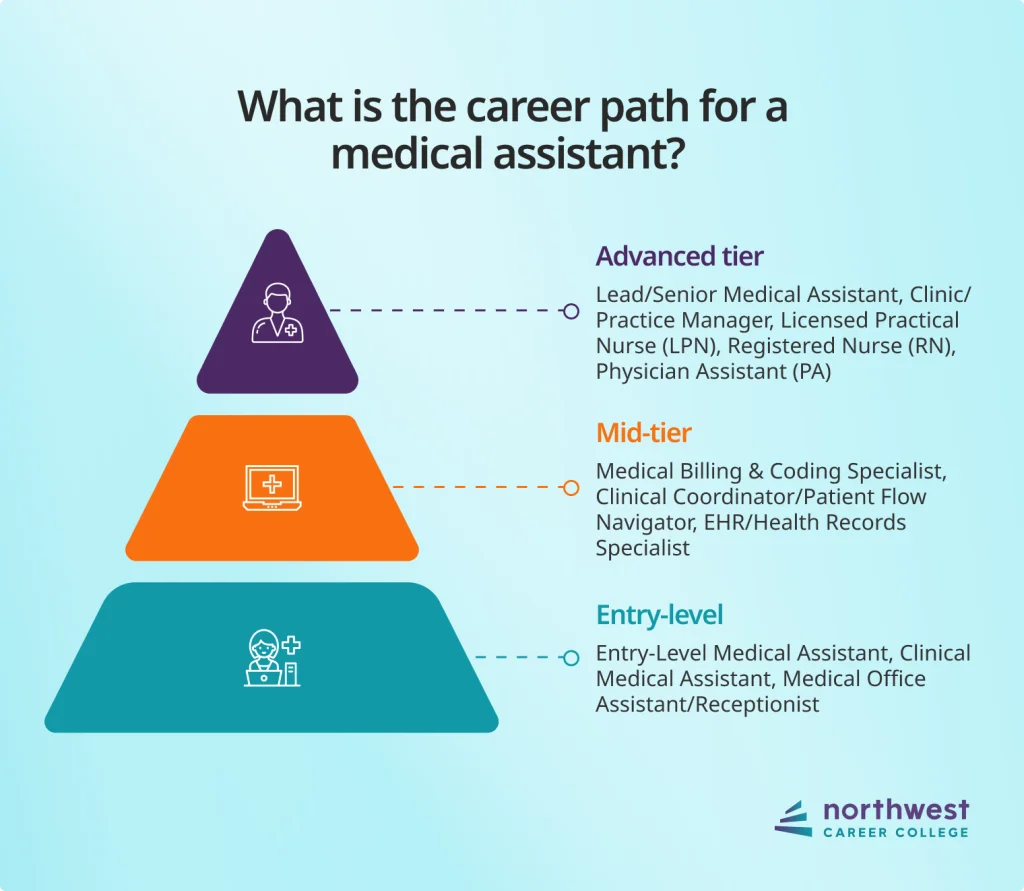
The career path for a medical assistant is the whole journey toward long-term professional goals — including learning, experience, job roles, and promotions. A medical assistant’s career path begins with training and certification and can lead to senior and leadership roles, or advanced and specialized positions with higher pay and stronger benefits.
The trajectory of a medical assistant career from entry-level to advanced-level is as follows.
Phase 1: Entry-level
- Target roles: Entry-Level Medical Assistant, Clinical Medical Assistant, Medical Office Assistant/Receptionist
- Responsibilities: Taking vitals, blood draws (phlebotomy), basic EKGs, scheduling, and updating electronic health records (EHR).
- Requirements: High School Diploma/GED + 9–12-month accredited MA diploma or certificate.
Phase 2: Mid-tier
- Target roles: Medical Billing & Coding Specialist, Clinical Coordinator/Patient Flow Navigator, EHR/Health Records Specialist
- Responsibilities: Translating physician diagnoses into ICD-10/CPT codes, processing insurance claims, and handling reimbursements.
- Requirements: Medical Coding Certificate or AAPC/AHIMA professional certification.
Phase 3: Leadership, specialized, and advanced clinical tier
- Target roles: Lead/Senior Medical Assistant, Clinic/Practice Manager, Licensed Practical Nurse (LPN), Registered Nurse (RN), Physician Assistant (PA)
- Responsibilities: On the leadership track — supervising MA staff and managing clinic budgets and floor operations. On the advanced clinical track (LPN/RN/PA), evaluating patients, administering complex clinical care, diagnosing illnesses, and assisting in surgical procedures.
- Requirements: 2–5 years of MA experience with CMA/CCMA certification, a degree in Healthcare Administration, or an advanced clinical credential (LPN, RN, or PA degree).
Is being a medical assistant worth it?
Yes, being a medical assistant is worth it, especially for high-school/GED graduates looking for a fast, reliable, and affordable entry to join the healthcare workforce. Certified medical assistants earn higher and enjoy more benefits as they gain experience.
The benefits of becoming a medical assistant include strong job security due to a shortage of staffing and growing demand in the medical industry, a fast and flexible training path to learn the work, structured schedules, and opportunities for career growth and building a network.
The challenges of being a medical assistant are a moderate starting salary, high emotional and physical demand, and limitations in scope of practice.
Weigh your options; choose to become a medical assistant if you need a fast track to steady income, often-predictable daytime hours in the outpatient settings, or a paid starting point toward nursing or physician assistant training.
What are some statistics and facts about medical assistants?
Some statistics and facts about medical assistants are as follows.
- A medical assistant’s job is highly physical and active, so no, AI will not replace medical assistants.
- Medical assistants generally have a narrower scope of practice than nurses and cannot perform certain clinical tasks nurses are licensed to do.
- Medical assistants typically take a comprehensive training program that acts as a stepping stone to an advanced career.
- According to a 2025 industry outlook by the National Healthcareer Association, 32% of employers said that it’s difficult to find qualified medical assistants.
- According to a 2025 industry outlook by the National Healthcare Association, 85% of employers state they would prefer hiring candidates with nationally recognized certifications over those without. The same data states that 74% of healthcare employers increase pay when an employee earns professional certification.
- According to the 2026 data by the U.S. Bureau of Labor Statistics, medical assistants’ employment is projected to grow 12% from 2024 to 2034, creating about 112,300 openings per year on average over the decade.
Can you become a medical assistant online?
Yes, you can become a medical assistant online, since it offers flexibility, but a medical career requires hands-on work experience, which short-form online programs often miss. Enrolling in a hybrid program is a better option; it combines online courses for theory with mandatory in-person labs and externships for clinical skills.
Can medical assistants be trained on the job?
Yes, medical assistants are trained on the job (OTJ); due to staffing shortages, many hospitals, clinics, and urgent care centers often hire candidates and teach them the necessary skills directly in the workplace. OTJ is popular among uncertified MAs looking to enter the field faster, though they typically earn less. Certified MAs also use on-the-job training to learn specialized tasks, such as cardiology or oncology procedures.
Can a medical assistant give shots?
Yes, a medical assistant can give shots under the supervision or direction of a licensed healthcare provider, provided they have completed the necessary clinical training and competency assessments. In some states, such as New York, California, and Washington, you need a specific state-recognized credential and must graduate from an accredited program to start a career as a medical assistant and to give shots.
Can medical assistants draw blood?
Yes, medical assistants draw blood, also called Phlebotomy, as part of their medical assistant job responsibilities. After receiving proper training, medical assistants routinely perform venipuncture (drawing blood) to collect laboratory specimens, update patient charts, and prepare samples for testing. In Washington, California, Nevada, and Louisiana, however, MAs need a separate, state-specific phlebotomy credential to do this.
Can medical assistants give an injection?
Yes, a medical assistant can give non-intravenous injections such as vaccines and immunization shots, medication injections such as Vitamin B-12, antibiotics, & hormones, and diagnostic testing injections such as TB skin tests. A clinical medical assistant cannot administer IV medications, give anesthesia, or perform cosmetic injections.
Can medical assistants administer medications?
Medical assistants can administer medications in oral (swallowed), topical (on the skin), sublingual (under the tongue), and inhaled (breathed in) forms strictly under the supervision of a licensed professional. They aren’t authorized to independently prescribe or administer intravenous (IV) medications, Schedule II controlled substances, or chemotherapy.
Can a medical assistant work as a phlebotomist?
Yes, a medical assistant can work as a phlebotomist in most states in the US if they complete the medical assistant program. It covers drawing blood during the clinical assistant training, so employers of special clinics, hospitals, private practices, and diagnostic centers hire an MA to perform phlebotomy. Medical assistants living in Nevada, California, Washington, and Louisiana are required to earn a state-issued Phlebotomy license certificate.
Are medical assistants first responders?
No, medical assistants are not first responders like traditional Emergency Medical Technicians (EMTs) or paramedics. They do not operate in the field or respond to emergency scenes. Medical assistants focus on providing routine administrative and clinical support in fast-paced healthcare settings.
Can medical assistants perform an EKG?
Yes, a medical assistant can perform an EKG, which is part of the standard MA training program. They check heart rhythms, place electrodes on the patient, run the machine, and deliver the printed readings to the physician.
Do you need certification to be a medical assistant?
No, you don’t need certification to be a medical assistant by law in most states, except Washington. But modern healthcare employers consider certification as a critical component for hiring and evaluating candidates. According to the NHA’s Industry Outlook 2025 data, 70% of employers require certifications for Medical Assistants. Not having a certification limits hiring opportunities and reduces earning potential. Achieving a national MA certification proves your competence in the national standard, which healthcare employers prefer, and also contributes to higher pay, diverse job opportunities, and long-term career advancement.
What disqualifies you from being a medical assistant?
4 factors disqualify you from being a medical assistant as follows.
- Failure or fraudulent credentials: Lacking a high school diploma or GED, failing an accredited program required by the 4 main MA certifying bodies (AAMA, AMT, NHA, and NCCT), or falsifying graduation certificates.
- Health and immunization issues: Failing standard medical exams or drug screenings, or being unable to provide proof of required immunizations and health screenings, such as MMR, annual TB tests, and Hepatitis B.
- Having a criminal record: Felonies or misdemeanors involving violence, abuse, sexual misconduct, or drug diversion.
- Showing incompetency in the job: Inability to perform back office duties due to legal restrictions, having a record of patient abandonment, or confidentiality breaches.