Medical Assistant Externship: Definition, Benefits, and Finding One
- Medical Assistant
-
 Authored by
Denisse Adams
Authored by
Denisse Adams
-
 Reviewed by
Dr. Thomas Kenny
Reviewed by
Dr. Thomas Kenny
- Updated August 21, 2026
- 521 views
A medical assistant externship refers to a short educational program that medical assistant students participate in to learn the workload in medical settings. It includes clinical and administrative tasks such as patient care, specimen collection, billing and coding, and customer service. A medical assistant externship allows students to gain experience and insight, build networks, and become work-ready candidates for medical assistant roles.
To find a medical assistant externship, enroll in an accredited program where your institution takes care of everything, or search through online externship platforms or visit local clinics and hospitals directly. During your externship, prepare to move from newcomer to field-tested professional as you face the real clinical environment.
A medical externship takes 160 to 240 hours, or 4 weeks to 4 months, depending on the accredited program, special field requirements, or national certificate exam requirements. Externships are mostly unpaid and not mandatory in many states, but having one opens an opportunity to participate in major national exams such as CMA and RMA, fulfills the healthcare employers’ preference for knowledgeable candidates, and introduces you to more career benefits.
What is a medical assistant externship?
A medical assistant externship, also called practicum, field experience, or clinical rotation, is a short-term, hands-on, unpaid training program that provides students with real job experience under professional supervision. It is the final stage of a medical program and serves as a qualifying point for major national credentialing examinations, including the Certified Medical Assistant (CMA) by the American Association of Medical Assistants (AAMA) and the Registered Medical Assistant (RMA) by the American Medical Technologists (AMT).
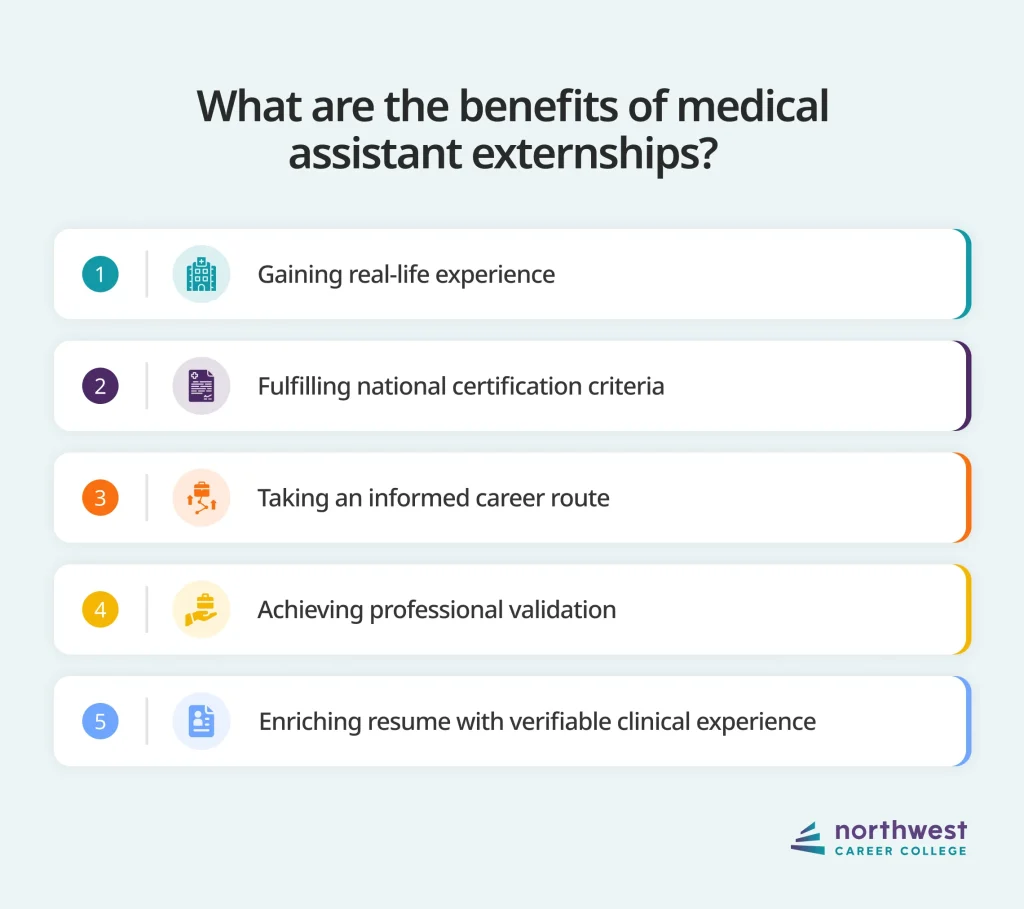
The benefits of a medical externship are real-life experience, national certification criteria fulfillment, the opportunity to take an informed career route, and getting professional validation with verifiable clinical experience. Prospective medical assistant externs can either enroll in an accredited program where the externship is built into the course, or arrange one independently.
During an externship, medical externs shadow and observe a professional medical assistant and perform clinical and administrative tasks such as drawing blood, specimen collection, and EHR documentation under supervision. They face the same environments as fully hired medical assistants, including large hospitals, outpatient surgical centers, private medical practices, diagnostic imaging centers, and pathology laboratories. Once this supervised clinical experience is complete, the once-unlicensed extern emerges as a fully job-ready candidate prepared to start their professional career.
What are the roles of an extern during a medical assistant externship?
The roles of an extern during a medical assistant externship are observing senior medical assistants and performing clinical and administrative tasks such as patient care, diagnostic testing, scheduling, coordinating, billing, and coding.
Clinical duties of a medical assistant extern during the externship are as follows.
- Patient care support: Greeting patients, recording medical histories, and obtaining baseline vital signs.
- Phlebotomy and specimen processing: Explaining laboratory collection steps to patients, identifying blood tube additives, and performing safe venipunctures.
- Diagnostic testing: Preparing patients for non-invasive cardiac testing, placing electrodes correctly for clean ECG tracings, and operating diagnostic equipment.
- Sterilization: Adhering to strict CDC standard precautions, implementing comprehensive exam room disinfection protocols, and properly utilizing personal protective equipment (PPE).
The administrative tasks of a medical assistant extern during the externship are as follows.
- Schedule coordination: Managing daily clinic workflows, booking follow-up visits, and handling patient check-in routing.
- Billing and coding execution: Utilizing standard CPT, HCPCS, and ICD-10 codes to document patient encounters and prepare electronic insurance claims.
- Telecommunications: Answering incoming multi-line phone calls, evaluating patient inquiries, and routing critical messages to the appropriate medical staff.
- Compliance and safety: Maintaining strict patient confidentiality under federal HIPAA guidelines, securely managing electronic health records (EHR), and enforcing workplace safety standards.
What are the benefits of medical assistant externships?
The benefits of a medical assistant externship include gaining real-life clinical experience, learning in a job environment, achieving professional validation, and enriching your resume with verifiable clinical experience. It is the first step of a career ladder — the main focus of an externship is helping students comprehend the pressure inside a medical setting, which helps them land real jobs fast because healthcare employers heavily prioritize proven, hands-on clinical competence.
Other advantages of externship for medical assistants are as follows.
- Gaining real-life experience: Externship helps students overcome the challenges of their first job as a new hire. They understand the intensity of hospitals and clinics, observe experts in action, and practice under a preceptor’s supervision. It helps build muscle memory, develop professional competence, critical thinking, and confidence required to perform jobs under pressure.
- Fulfilling national certification criteria: Completing externships allows students to meet the eligibility requirements for prestigious credentials, including CMA (Certified Medical Assistant) and RMA (Registered Medical Assistant) exams.
- Taking an informed career route: Externship allows students a firsthand look at the working environment inside a medical facility, helping them decide on and prepare for their career path.
- Achieving professional validation: Students demonstrate their competence and reliability through externship, which helps them land future jobs — including direct job offers from their externship host site.
- Enriching resume with verifiable clinical experience: An externship gives students verifiable, hands-on experience that stands out to employers evaluating entry-level healthcare candidates.
How to find a medical assistant externship?
There are 2 ways to find a medical assistant externship: enrolling in an accredited program with an externship, and searching for one independently. Enrolling in an accredited MA program is a hassle-free and reliable path, since the externship is built into the course curriculum and designed to cover major national exam requirements, including CMA and RMA. It typically guides you through preparing for the externship and completing the role. If your MA program doesn’t include an externship, you’re responsible for arranging one on your own.
Follow these steps to find an externship through an accredited program.
- Consult your program’s externship coordinator.
- Visit the career services department to discuss clinical placement options that align with your long-term career goals.
- Join your school’s professional network — most accredited schools maintain direct partnerships with local clinics and hospitals for automatic placement.
Follow this checklist to find an externship placement if your program doesn’t offer an externship.
- Create a polished CV and a targeted cover letter. Reach out to your program instructors or directors for a formal reference.
- Directly visit local hospitals, primary care clinics, and urgent care centers. Ask office managers if they are open to hosting medical externs or willing to hire and train on the job.
- Search platforms like LinkedIn and Indeed using specific keywords like “medical assistant externships near me”, “MA externship” or “MA externship opportunities”. Follow up with cold calls and cold emails to nearby healthcare facilities.

What to expect in a medical assistant externship?
You can expect to face 4 specific transitions in a medical assistant externship: gaining familiarity with the real world, changing nervousness to professional resilience, practicing to become professional, and changing status from student to job-ready. Depending on the academic/institutional program, you learn theory and get hands-on training. Doing an externship turns your textbook knowledge into reality, giving insight and practical skills while shadowing a professional.
- Gaining familiarity with the real world: Working as a medical extern gives you a short immersive experience with hospital settings’ complex work, such as patient flows, high caseloads, complex EHR software, etc. You put your knowledge and training into practice under preceptors’ supervision and learn the clinical professionalism required to perform medical assistant jobs in the future.
- Changing nervousness to professional resilience: Facing the real-world medical setting’s workload, you will develop professional competence, confidence, and stress management skills to perform the fast-paced medical assistant job responsibilities. These nerve-wracking situations build strong observational skills, soft skills, and situational awareness through multitasking.
- Practicing to become professional: Observing and working under supervision strengthens your clinical and administrative skills. You learn to take constructive feedback positively and treat mistakes as part of clinical growth. Healthcare employers favor externs who stay proactive and adaptable to fast-paced environments.
- Changing status from student to job-ready: Gaining experience through an externship shapes your future perspectives within healthcare systems. You learn clinical skills, soft skills, and technical competencies. You exit the facility as a fully trained, competitive, and field-tested applicant ready to pursue medical assistant certification and launch your career.
How many hours does a medical assistant externship take?
A medical assistant externship takes 160 to 240 hours, or 4 weeks to 4 months, depending on the accredited program, specialty field, or national exam requirements. A CAAHEP- or an ABHES-accredited medical assistant program typically includes an externship requirement of 120 to 240 hours directly into its curriculum. Special fields such as Phlebotomy require 40 to 120 hours. For national exams such as CMA and RMA, accredited programs must build in a minimum of 160 externship hours to meet eligibility standards. MA externship hours are only calculated in daytime business hours because of direct clinical supervision to evaluate your performance — not during nights or weekends.
You cannot complete your externship before finishing your coursework because it is a part of the program, and your achievement impacts your graduation. However, many hybrid MA programs are designed in a way that allows students to complete an externship concurrently with the program.
Is an externship in a medical assistant program paid or unpaid?
An externship in a medical assistant program is unpaid because it is a part of your school or program course. It is treated as a short, hands-on educational class rather than a regular job. Your performance on the externship earns academic credit, and you learn valuable skills under professional supervision.
Can you get hired from a medical assistant externship?
Yes, you can get hired from a medical assistant externship, as it acts as a working interview. Devoted externs often get a direct job offer from the externship hosts because the host is already familiar with their work and reliability. Medical settings use externships to train and evaluate candidates’ clinical skills, adaptability, and cultural fit before hiring them.
Can you fail a medical assistant externship?
Yes, you can fail a medical assistant externship for several reasons, including being late, unexcused absences, and HIPAA violations. Failing your first attempt doesn’t permanently disqualify you; once you retake and pass the externship and graduate, your CMA/RMA eligibility remains intact. But you can’t sit the exam on a failed, uncompleted externship, since program completion is the eligibility requirement.
Can you become a medical assistant without an externship?
Yes, you can become a medical assistant without an externship, as many states don’t mandate one. But you can access more career opportunities with an externship because large hospitals, clinics, diagnostic centers, and other medical facilities prefer hiring students with real-world experience. Having relevant experience proves you are familiar with the expected work, reduces the likelihood of costly mistakes, and lowers employer training costs.
Is an externship required to earn your NHA CCMA Certificate?
No, an externship isn’t required to earn your NHA CCMA Certificate. NHA’s eligibility criteria require candidates to complete a medical assistant program within 5 years or to have 1-2 years of supervised work experience. However, completing an externship program provides field experience, which healthcare employers prefer when hiring.