


Scholarship Available Now

Hands-On Training

Online And On-Campus Classes

Committed Career Service Team

Laptop For Every Student






Northwest Career College’s Pharmacy Technician program is programmatically accredited by ASHP. Their contact information is listed below for applicants who wish to request additional information regarding the program’s accreditation.
4500 East-West Highway, Suite 900
Bethesda, MD 20814
Phone: 1-866-279-0681
6116 Executive Blvd., Suite 730
North Bethesda, MD 20852
Phone: 301-291-7550
Northwest Career College’s Pharmacy Technician program is programmatically accredited by ASHP. Their contact information is listed below for applicants who wish to request additional information regarding the program’s accreditation.
Northwest Career College is institutionally accredited by the Accrediting Bureau of Health Education Schools (ABHES). Their contact information is listed below for applicants who wish to request additional information regarding the program’s accreditation.
Hear From NCC's Pharmacy Technician Graduates



"This program gave me confidence."
"This program gave me confidence. Basically, I feel that, compared to how I was when I started to now I can say that I believe in myself more."


CPhT-Certified Instructors With Clinical Backgrounds
Every NCC Pharmacy Technician instructor holds national CPhT certification and has practiced in the settings you're training to enter — retail dispensing, institutional compounding, and hospital systems. When a question about sterile prep or a drug interaction edge case comes up in class, the answer comes from someone who has navigated it on a real shift, not reconstructed it from a textbook.
ASHP Programmatic Accreditation
The American Society of Health-System Pharmacists (ASHP) sets the national professional standard for pharmacy practice. Programmatic accreditation means NCC's curriculum, clinical training, and externship have been independently reviewed against those standards — not self-assessed. Employers recognize it. Licensing boards respect it. It's the difference between a credential that carries weight and one that simply exists.
PioneerRx Software Training
PioneerRx is the pharmacy management platform running in independent and specialty pharmacies across the country — prescription processing, inventory management, insurance billing, and controlled substance tracking. NCC trains you on the actual system. By the time externship begins, the workflow is already familiar.

Morning and Weekend Scheduling
On-campus labs and classes are offered in the mornings and on weekends, giving you the flexibility to choose a schedule that fits your routine. Weekly workshops and interactive whiteboard sessions further support your learning, all thoughtfully designed to accommodate your work and family commitments.

PTCE And ExCPT Exam Prep For CPhT Certification
NCC builds prep for both national certification exams into the program: the PTCE, administered by PTCB, and the ExCPT, administered by NHA. Passing either exam earns you the CPhT credential, so you’re not left to prepare on your own after graduation.

Financial Aid, Scholarships, and Career Placement
NCC's Financial Aid office walks you through financial aid eligibility and scholarships of up to $4,500 before you enroll — so you know your actual cost upfront. Career Services team works with you throughout the program on resume development, interview preparation, and direct introductions to pharmacy employers across Las Vegas and Henderson.


PHT101: Introduction to Pharmacy Practice
Module 1 orients you into the system — the technician's role within it, how pharmacy operations are structured, how medications move safely from order to dispensing, and how documentation and recordkeeping protect everyone in the chain. You leave this module understanding why precision is non-negotiable.
- AI-Assisted Documentation
- Customer service in pharmacy settings
- Documentation & recordkeeping basics
- Introduction to pharmacy systems
- Medication safety & error prevention
- Pharmacy terminology & workflow basics
- Pharmacy technician roles & responsibilities
- Professional communication in healthcare
PHT102: Community Pharmacy I
Module 2 puts you in the scene — processing prescriptions, billing insurance, resolving claims, and navigating the legal framework that governs every transaction. Medicare, Medicaid, DEA scheduling, HIPAA, and dosage calculations are not background knowledge here.
- DataScan
- DEA schedules & compliance
- Dosage calculations
- HIPAA & patient confidentiality
- Insurance billing & claim resolution
- Medicare & Medicaid basics
- Medication preparation & dispensing
- Pharmacy laws & regulations
- Prescription processing & workflow
PHT103: Community Pharmacy II
Module 3 adds pharmacology to your operational fluency — drug actions, interactions, nervous system treatments, and the FDA regulatory framework that determines what reaches the shelf. Inventory management and pharmacy software run alongside that study, because a community pharmacy that cannot track its stock cannot serve its patients.
- Dosage calculations & concentrations
- Drug interactions & safety
- FDA regulations & drug approvals
- Inventory management systems
- Nervous system disorders & treatments
- Pharmacology basics & drug actions
- Pharmacy software systems
- Pharmacy workflow & operations
PHT104: Pharmaceutical Compounding
Module 4 teaches the non-sterile compounding techniques (custom formulations), calculations, and hygiene standards that make the work safe and accurate. It also introduces hospital pharmacy operations, laying the groundwork for the institutional environment that comes next.
- Body systems & drug treatments
- Hospital pharmacy basics
- Hygiene & safety procedures
- Medical terminology & abbreviations
- Non-sterile compounding techniques
- Pharmacy calculations
- Preparation of creams, ointments & capsules
PHT105: Institutional Pharmacy I
Module 5 trains you for that environment — aseptic technique, IV medication preparation, cleanroom procedures, and the microbiology knowledge that explains exactly why each standard exists. The technique is a clinical skill.
- Body systems & treatments
- Cleanroom procedures
- IV dosage calculations
- IV medication preparation
- Medication safety
- Microbiology & infection control
- Pyxis Machine Training & KitCheck Software
- Sterile compounding & aseptic technique
- Sterility standards
PHT106: Institutional Pharmacy II
Module 6 moves deeper into the hospital environment. The margin for error in an institutional setting is narrower than anywhere else in pharmacy practice, and this module builds the habits — verification, documentation, and cross-checking that experienced hospital pharmacy technicians carry into every task.
- Accuracy & safety practices
- Automated dispensing cabinets (ADC)
- Body systems & treatments
- Hospital pharmacy operations
- Institutional pharmacy workflows
- Medication reconciliation
- Nutrition & patient wellness
- Patient care support
PHT107: Advanced Pharmacy
Hazardous material handling, immunization concepts, nuclear pharmacy, and hospice pharmacy settings broaden your professional picture. Certification and licensure requirements get direct attention, because leaving this program credentialed and ready to sit for the PTCE or ExCPT exam is the goal.
- Advanced pharmacy settings (nuclear, hospice)
- Cleanroom procedures
- Cost analysis & operations
- Hazardous material handling
- Immunization & vaccine concepts
- Licensure & certification requirements
- Medication safety & error prevention
- OSHA & workplace safety
- Professional communication
PHT201: Pharmacy Technician Professional Externship
The externship places you in a real healthcare setting where the systems are live, the patients are real, and professional accountability replaces a grade. You apply prescription processing, compounding, sterile technique, and institutional workflows in the environment they were built for — developing the speed, judgment, and reliability that classroom simulations can prepare you for but cannot give you.
- Adaptability in pharmacy environments
- Networking & career development
- Patient interaction & support
- Problem-solving & workflow management
- Professional behavior & reliability
- Real-world pharmacy experience
- Workplace communication & teamwork
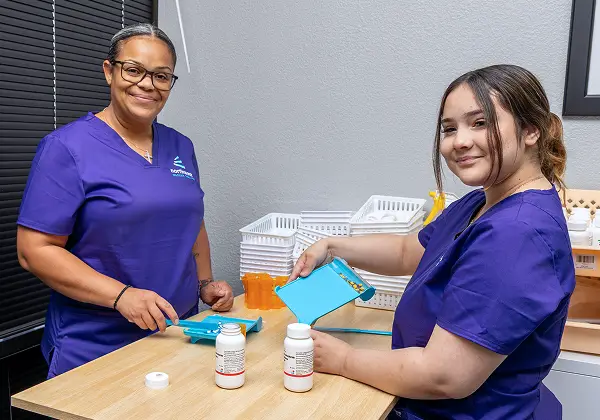

High School Completion
Bring your U.S. high school diploma, GED, or college transcript showing your high school graduation date.

U.S. Government-Issued Photo ID
We need a U.S. government-issued photo ID to verify your identity. You must be at least 18 years old. Written consent from a parent or guardian is needed to enroll if you’re under 18.
Social Security Card
Provide your Social Security Number or Tax Identification Number (TIN) to confirm eligibility to study and work in the U.S.


