National Certified Medical Assistant (NCMA): Duties, Benefits, Salary, Exam, and How to Become
- Medical Assistant
-
 Authored by
Denisse Adams
Authored by
Denisse Adams
-
 Reviewed by
Dr. Thomas Kenny
Reviewed by
Dr. Thomas Kenny
- Updated August 24, 2026
- 587 views
A National Certified Medical Assistant (NCMA) is a healthcare employee whose competence the National Center for Competency Testing (NCCT) approves of. This professional supports front-office medical work, clinical execution, and organizational balance by performing comprehensive duties, including greeting patients, managing provider schedules, executing phlebotomy, administering injections, and handling billing and insurance verification in hospitals, outpatient clinics, and diagnostic centers.
The NCMA exam is a 150-question test, scored on a scaled system that requires a minimum scaled score of 70 to pass. Becoming a national certified medical assistant requires earning a GED, fulfilling NCCT’s eligibility criteria, applying for the certification exam, passing the test, and maintaining the credential.
An NCMA benefits from quick entry into healthcare, a nationally recognized credential, diverse workplace versatility, and high employer credibility. Certified Medical Assistants earn about $23k to over $55k per year in the US and $24K to $57K per year in Las Vegas, NV.
What is a national certified medical assistant?
A National Certified Medical Assistant (NCMA) is an NCCT-certified healthcare professional who performs both clinical and administrative work required to operate healthcare facilities such as physicians’ private practices, large hospitals, outpatient specialty clinics, laboratories, urgent care centers, large hospital systems, and diagnostic centers.
A National Certified Medical Assistant (NCMA) performs 2 main duties in a medical facility: clinical duties directly with patients and administrative duties to maintain regular official workflow. Clinical duties include patient intake, recording medical histories, gathering vital signs, performing venipunctures, and running diagnostic ECG tracings. Administrative duties include managing patient appointments, coordinating provider schedules, verifying medical insurance coverage, and executing billing utilizing ICD-10 and CPT codes.
It takes 4 months to 2 years to become a National Certified Medical Assistant; the exact time depends on your chosen NCCT-approved eligibility pathways: MA-enrolled students, recent graduates, high-school CTE students, experienced workers, and military members.
The benefits of becoming a national certified medical assistant include quick entry into healthcare jobs through short-term training, greater employment flexibility to choose a career between clinical and administrative roles, and creating a solid foundation for career advancement and professional growth.
NCMA certification isn’t mandatory to work, but achieving a nationally recognized certificate is highly preferred by healthcare employers as it assures them of your skills and qualifications to perform medical duties with fewer clinical errors.
What does a national certified medical assistant do?
A National Certified Medical Assistant supports doctors, nurse practitioners, and physician assistants by managing clinical and administrative tasks, including scheduling appointments, drawing blood, administering injections, and updating electronic charts in hospitals, private practices, clinics, diagnostic centers, laboratories, and outpatient surgical centers.
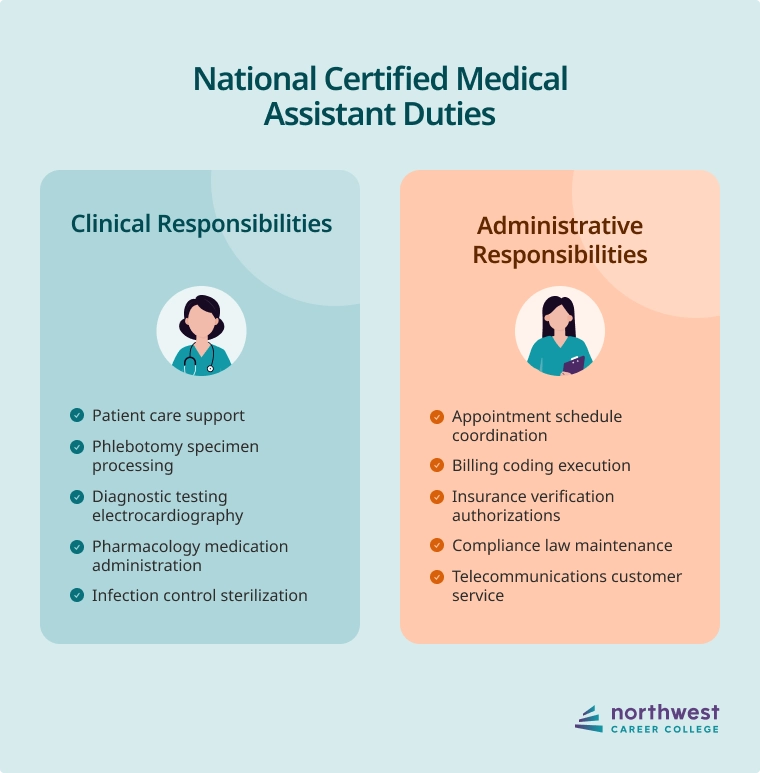
Certified medical assistants handle both front-office and back-office tasks. Their clinical duties are as follows.
- Patient care support: Greet patients, record medical histories, obtain vital signs, and assist physicians during minor surgical procedures.
- Phlebotomy specimen processing: Explain laboratory collection steps, identify blood tube additives, and perform safe venipunctures following the correct order.
- Diagnostic testing electrocardiography: Prepare patients for non-invasive testing, place electrodes for clean ECG tracings, and operate diagnostic equipment.
- Pharmacology medication administration: Perform drug classifications, perform precise medication-related math calculations, and safely administer medications via authorized routes.
- Infection control sterilization: Follow strict CDC standard precautions, implement exam room disinfection protocols, and use appropriate personal protective equipment.
Their administrative responsibilities are as follows.
- Appointment schedule coordination: Manage daily clinic workflows, coordinate provider schedules, book follow-up visits, and handle patient check-in routing.
- Billing coding execution: Utilize standard CPT, HCPCS, and ICD-10 codes to document encounters and prepare electronic insurance claims.
- Insurance verification authorizations: Interface with insurance companies to verify coverage, process referrals, and secure mandatory clinical prior authorizations.
- Compliance law maintenance: Maintain patient confidentiality under HIPAA guidelines, manage electronic health records, and enforce workplace safety standards.
- Telecommunications customer service: Answer incoming multi-line phone calls, evaluate patient inquiries, and direct messages to appropriate medical staff.
What are the benefits of becoming a national certified medical assistant?
The benefits of becoming a national certified medical assistant include quick entry into healthcare jobs, greater employment flexibility, and a solid foundation for professional growth. According to the Bureau of Labor Statistics (BLS), employment for medical assistants is projected to grow 12% from 2024 to 2034, maintaining an average growth pace relative to the overall job market.
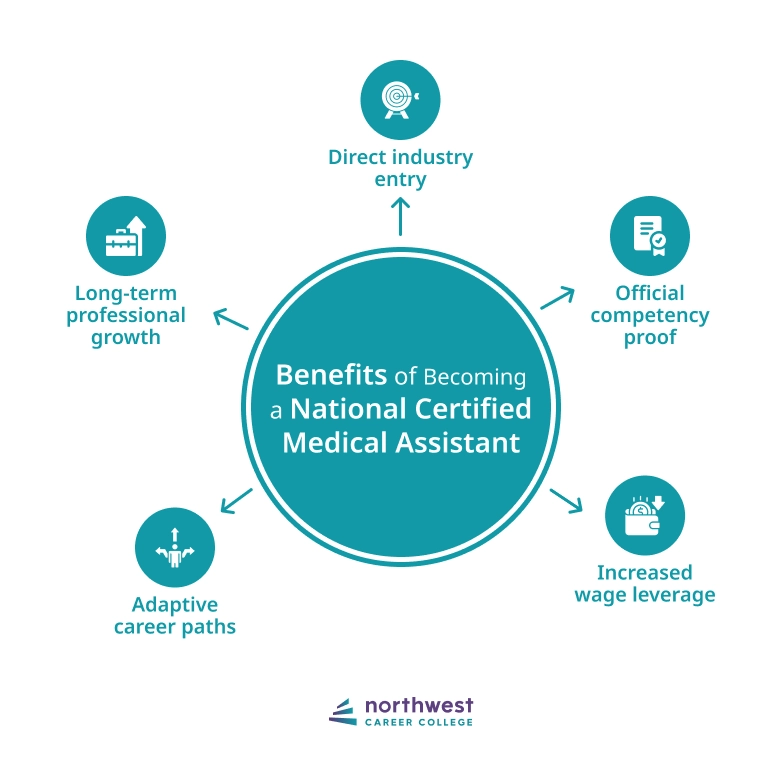
The career advantages of becoming a nationally certified medical assistant are as follows.
- Direct industry entry: NCMA provides a targeted path directly into healthcare, without requiring general education courses, to focus entirely on relevant job training.
- Official competency proof: Earning NCMA certification proves your dual skills in patient care and office administration, clearing the screening hurdles set by hospital hiring teams.
- Adaptive career paths: Certification opens doors for diverse job options, giving you the freedom to work in specialized environments like outpatient centers, children’s clinics, or urgent care.
- Increased wage leverage: Candidates with MA certification secure higher base salaries and better benefit packages compared to non-certified applicants.
- Long-term professional growth: Holding an NCMA credential creates a foundation for superior positions and a permanent career foundation.
How much do national certified medical assistants make?
Nationally certified medical assistants (NCMA) make about $23k to more than $55k per year in the US, which is roughly $1,916 to over $4,583 per month, $442 to over $1,057 per week, and $11.05 to more than $26.44 per hour, according to ZipRecruiter 2026 data. A certified medical assistant in Las Vegas, NV makes $24K to $57K per year, which is equivalent to $2,000 to over $4,750 per month, $461 to over $1,096 per week, and $11.54 to more than $27.40 per hour, according to ZipRecruiter 2026 data. The salary of a medical assistant in Nevada vary by city, with higher-paying locations including Sparks, Reno, Boulder City, and Fernley. In the Las Vegas area, North Las Vegas and Henderson tend to pay more than Las Vegas itself.
An NCMA’s salary varies by a candidate’s accredited program, clinical skill level, bilingual skills, geographic location, years of experience, and advanced healthcare certifications. Having a national certification assures potential employers of the candidate’s competence and credibility in performing specialized duties such as drug administration and precise medication-related math calculations.
How long does it take to become a national certified medical assistant?
It takes 4 months to 2 years to become a national certified medical assistant, depending on the program you choose. An accelerated program takes 4 to 6 months and provides basic knowledge to immediately start a job. A diploma/certificate program takes 9 to 12 months, offering clinical and administrative knowledge with an externship. Associate Degree Programs of 18 to 24 months, providing in-depth knowledge and wider job opportunities for long-term clinical management goals.
The timeline for becoming a medical assistant also varies by the NCCT-approved categories of candidates as follows.
- 7 months to 2 years for students in post-secondary school
- 1 to 2 years for students of high school/CTE
- 1-year for candidates with work experience
- 2-4 months for US military members
How to become a national certified medical assistant?
To become a National Certified Medical Assistant, candidates must complete high school/GED, meet NCCT’s eligibility criteria, register and pass the evaluation exam, and maintain the credential. These steps guide a student from formal foundational education to active working and credential maintenance.
The step-by-step guide to becoming a registered medical assistant is as follows.
Step 1: Earn a high school diploma or GED
Earn your high school diploma, General Equivalency Degree (GED), or an equivalent certificate. These credentials are the mandatory prerequisites for entering any accredited certification program or sitting for national exams.
Step 2: Meet the NCCT eligibility requirements
Confirm your eligibility through NCCT-approved 5 distinct pathways: MA-enrolled students, recent graduates, high-school CTE students, experienced workers, and military members.
- Enrolled Students: You can apply if you are currently admitted to an NCCT-authorized postsecondary Medical Assistant program or school.
- Recent graduates: You can register if you have completed studies from an NCCT-authorized postsecondary Medical Assistant program within the past 5 years.
- High school CTE students: Students who are current high school students or recent graduates of an NCCT-authorized high school Career and Technical Education (CTE) Medical Assistant program can apply.
- Experienced workers: Candidates who possess at least 1 year of verifiable, full-time supervised work experience (minimum 2,080 hours) as a Medical Assistant within the past 5 years can sit for this exam.
- Military members: Military members who have completed a formal medical assistant training program during U.S. Military service within the past 5 years can also register for this exam.
Step 3: Register and apply for the NCMA exam
Submit an official application through the National Center for Competency Testing (NCCT) user portal. Fill out all the required information, upload your qualifying graduation transcripts or employer verification documents, and pay the mandatory exam fee.
Step 4: Pass the formal certification exam
Schedule your exam date at an authorized physical school testing location, an official third-party center, or via live remote proctoring. The exam’s score ranges from 200 to 720, and you need at least 575 to pass. Pass/fail status will be visible immediately on the computer when you finish the exam. Your official scaled score report will be available in your NCCT portal within 24 to 48 hours.
Step 5: Maintain Your Professional Credential Via Continuing Education
Renew your certification annually to keep your active professional status by completing 12 contact hours (CH) of continuing education (CE) credits and paying the standard $89.00 renewal fee before your credential expiration date.
The process is similar for students who want to become a medical assistant in Las Vegas, but prominent local schools often add externship opportunities and career support to help with job placement and career development.

What jobs can you get with a National Certified Medical Assistant certification?
The jobs you can get with a National Certified Medical Assistant certification include clinical medical assistant, medical office receptionist, EKG specialist, phlebotomy technician, patient care coordinator, and medical records clerk. The top 4 highest-paying roles for certified medical assistants in Nevada are Certified Medical Practice Executive, Manager Medical Examiner, Medical Information, and CMA Phlebotomist. According to ZipRecruiter reports, the highest salary for a certified medical assistant is higher than $57k in Nevada.
You can work without a medical assistant certification in several states in the US, but not having a certification leads to severe hiring and career limitations. Most recognized hospitals, large corporate hospital groups, specialty networks, and urgent care systems heavily favor or strictly require examinees to have a national certification to meet clinical safety guidelines and satisfy federal insurance funding compliance standards.
What is the national certified medical assistant exam?
The National Certified Medical Assistant exam is a national-standard assessment exam that the National Center for Competency Testing (NCCT) holds to find candidates having entry-level competency in clinical and administrative tasks to join the healthcare sector.
Candidates can become eligible to sit for the NCMA exam through 5 pathways: enrolled students in an NCCT-authorized MA program/school, recent graduates within five years, high school CTE students, experienced workers with one year of full-time experience within five years, or military members with formal service training within five years.
Eligible students must create an online NCCT portal account, submit verification of their educational or professional eligibility route, and pay the testing fee to take the computerized exam. This exam proves their practical clinical judgment, legal understanding, and administrative knowledge in a single, timed test.
The NCMA exam is a total of 150 multiple-choice questions, of which 125 are scored questions, and 25 are unscored pretest items. This is a 3-hour test, and questions come from 4 core content categories, which are Pharmacology and General Medical Knowledge, Clinical Medical Procedures, Medical Administrative Duties, and Law and Ethics. The marks range from 200 to 720, and students must achieve a minimum of 575 points to pass.
The application fee for the NCMA exam is $119. Unsuccessful candidates can sit for the exam 4 times with mandatory intervals in between. You can take the exam through NCCT-approved school/campus test sites, authorized national testing centers, or online.
Successful candidates’ certificates remain valid for 1 year. To maintain an active status, they must complete 12 contact hours (CH) of annual Continuing Education (CE) credits and pay the standard $89.00 renewal fee before their credential expiration date.
To prepare for the National Certified Medical Assistant exam, analyze the NCCT NCMA exam details, follow a structured review strategy, take a timed practice exam, and review your mistakes.
What is the format of the national certified medical assistant exam?
The National Certified Medical Assistant exam is a fully computerized, linear test that evaluates a candidate’s practical clinical and core healthcare knowledge. It contains 150 multiple-choice questions, of which 125 are scored questions, and 25 are unscored pretest items. The 3-hour exam counts the total number of correct answers with no penalty points deducted for incorrect responses; the passing scaled score is 575.
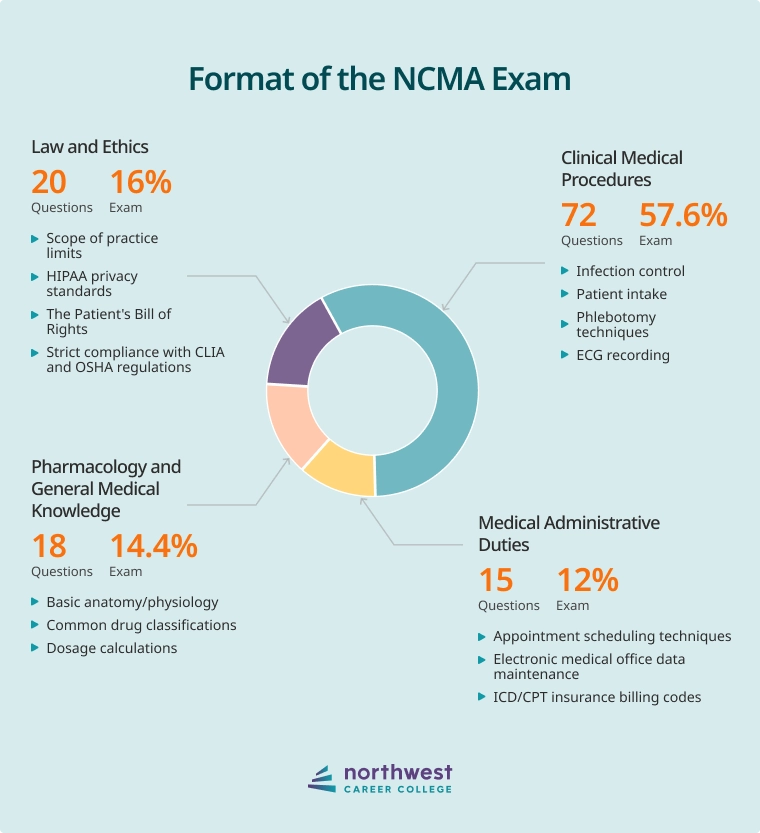
The 125 scored questions are distributed across 4 core categories as follows.
- Clinical Medical Procedures (72 questions, 57.6%) covers infection control, patient intake, phlebotomy techniques, and ECG recording.
- Law and Ethics (20 questions, 16.0% ) covers scope of practice limits, HIPAA privacy standards, the Patient’s Bill of Rights, and strict compliance with CLIA and OSHA regulations.
- Pharmacology and General Medical Knowledge (18 questions, 14.4% )covers basic anatomy/physiology, common drug classifications, and dosage calculations.
- Medical Administrative Duties (15 questions, 12.0%) covers appointment scheduling techniques, electronic medical office data maintenance, and ICD/CPT insurance billing codes.
How much does the NCMA exam cost?
The NCMA exam costs $119, which includes registration, test administration, and your initial certification documentation after passing. Students can apply a maximum of 4 times with a designated waiting time in between: 30 days after the 1st and 2nd attempts, and 90 days after the 3rd attempt. Each additional attempt requires a new application submission and repayment of the full examination fee. You can take the National Certified Medical Assistant exam in an NCCT-approved school/campus test site, at professional physical testing centers, or online.
The NCMA exam is one of the reputed national credentials to approve students’ clinical and administrative skills. You can pass the exam by adhering to strict study habits and practicing with the official exam formats and structure.
How difficult is the national certified medical assistant exam?
The difficulty of the NCMA exam is moderate for those students who sit prepared with dedicated study hours, learned clinical procedures, practiced knowledge of pharmacology calculations, and legal regulations. The examination emphasizes real-world clinical skills. Candidates must show an understanding and demonstrate absolute precision in clinical workflows in daily medical workflows through the exam.
What are the requirements to pass the national certified medical assistant exam?
The requirements to pass the National Certified Medical Assistant exam are familiarity with the exam structure and time, required to demonstrate your skill in achieving a minimum passing scaled score of 70. Once you complete the computerized exam, your score profile testing platform will verify your answers. After verification, your official certificates will be posted directly to your online NCCT account.
Where can I take the national certified medical assistant exam?
You can take the National Certified Medical Assistant (NCMA) exam in an NCCT-partnered vocational school/college/campus test site or a physical testing center. You can also participate in the NCMA exam online via Live Remote Proctoring (LRP), which requires a dual-device camera setup (computer plus a 360° smartphone app) and features a strict no-break policy.
How to prepare for the national certified medical assistant exam?
The study and exam tactics to prepare for the NCMA exam are as follows.
- Analyze the NCMA exam blueprint: Review the official NCCT test plan, practice questions, and content categories to understand the layout.
- Follow a structured review strategy: Set dedicated study blocks for core topics, prioritizing Clinical Medical Procedures, which make up 72 of the 125 scored questions.
- Take timed practice exams: Participate in practice tests to build endurance for the 3-hour, 150-question limit, mastering your pacing for the official NCCT exam.
- Work on the mistakes: Review every incorrect practice answer to fix conceptual gaps. Thoroughly read clinical scenarios before choosing final answers on test day.