Certified Medical Administrative Assistant (CMAA): Duties, Benefits, Salary, Exam, and How to Become
- Medical Assistant
-
 Authored by
Denisse Adams
Authored by
Denisse Adams
-
 Reviewed by
Dr. Thomas Kenny
Reviewed by
Dr. Thomas Kenny
- Updated August 24, 2026
- 766 views
A Certified Medical Administrative Assistant (CMAA) refers to a healthcare employee whose competence the National Healthcareer Association (NHA) approves of. This professional supports front-office medical work and organizational balance by performing administrative duties, including greeting patients, managing provider schedules, routing electronic health records, and handling billing and insurance verification in hospitals, outpatient clinics, and diagnostic centers.
The CMAA exam is a 135-question test, scored on a scaled system that requires a minimum scaled score of 390 to pass. Becoming a certified medical assistant requires earning a GED, fulfilling NHA’s eligibility criteria, applying for the certification exam, passing the test, and maintaining the credential.
A certified medical administrative assistant benefits from quick entry into healthcare, a nationally recognized credential, diverse workplace versatility, and high employer credibility. Certified Medical Administrative Assistants (CMAA) earn about $25k to over $61k per year in the US and $25K to $62K per year in Las Vegas, NV.

What is a certified medical administrative assistant?
A Certified Medical Administrative Assistant (CMAA) is a NHA-certified healthcare professional who handles the specialized front-office administrative tasks required to operate physician private practices, outpatient specialty clinics, urgent care centers, large hospital systems, and diagnostic centers.
They mainly perform front-desk duties and non-clinical tasks, including organizing electronic health records (EHR), scheduling complex medical appointments, coordinating patient check-ins, and managing billing procedures. Their operational presence is critical in modern healthcare settings to maintain patient satisfaction and administrative accuracy, ensuring the practice remains compliant with strict medical laws.
The benefits of becoming a certified medical administrative assistant include rapid entry into the healthcare workforce, extensive employment flexibility across various clinical settings, and a steady platform for professional growth.
It takes 3 months to 2 years to become a certified medical administrative assistant. The accurate duration depends on the structured postsecondary educational pathway you choose to enroll in.
Though not required, achieving the Medical Administrative Assistant Certification is highly preferred by the healthcare industry. The official NHA website states that 75% of employers require or encourage certification for medical administrative assistants.
The American Allied Health (AAH) offers an alternative CMAA certification, which is completely online, with a 75% passing score, and suits fast-tracking experienced or military staff. However, NHA is an industry giant, and its trademark certification, CMAA, holds greater market value, elite accreditation, and higher salary potential.
What does a certified medical administrative assistant do?
A certified medical administrative assistant supports medical doctors, nurse practitioners, physician assistants, and specialized clinicians by performing administrative duties, including scheduling appointments, processing insurance paperwork, and updating electronic charts in private practices, hospital networks, and outpatient surgical centers.
Administrative responsibilities of a certified medical administrative assistant are as follows.
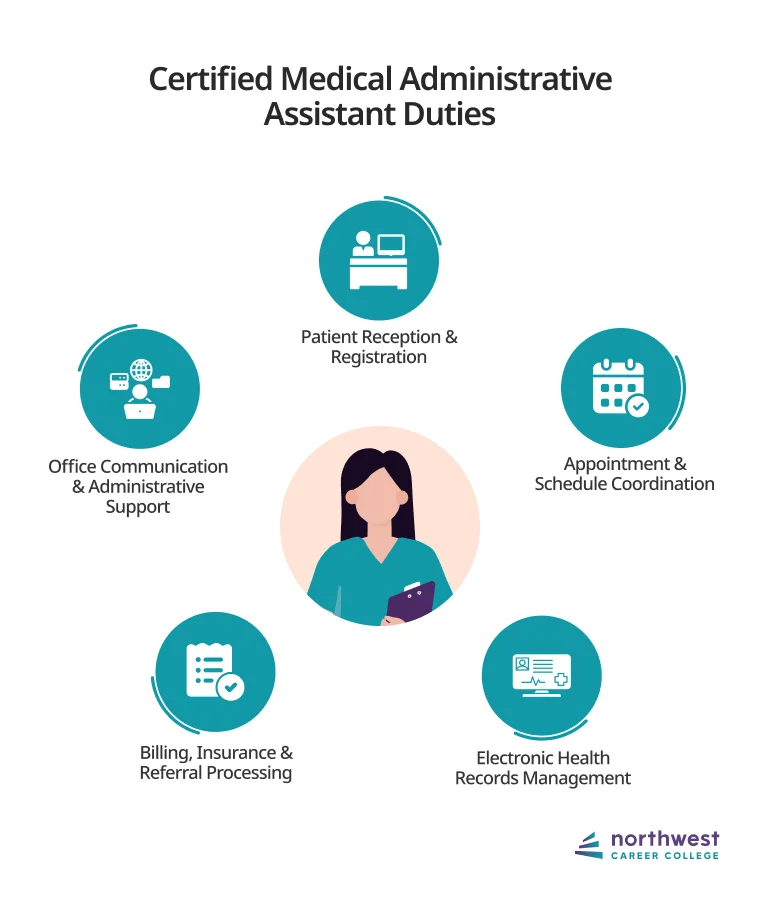
- Patient Reception & Registration: Greeting arrived patients, verifying photo IDs, collecting insurance cards, and obtaining signatures on HIPAA forms.
- Appointment & Schedule Coordination: Coordinating provider schedules, booking follow-up appointments, managing urgent walk-ins, and handling automated confirmation alerts.
- Electronic Health Records Management: Entering patient details into EHR software, reviewing medical records for accuracy, and routing files to clinical staff.
- Billing, Insurance & Referral Processing: Processing patient copays, checking insurance coverage before visits, managing clinic cash, and securing referral approvals.
- Office Communication & Administrative Support: Answering incoming phone calls, sending prescription refill requests to doctors, and keeping office supplies fully stocked.
What are the benefits of becoming a certified medical administrative assistant?
The benefits of becoming a certified medical administrative assistant include rapid entry into the healthcare workforce, extensive employment flexibility across various clinical settings, and a steady platform for professional growth. According to the Bureau of Labor Statistics (BLS), employment for medical secretaries and administrative assistants is projected to grow 3% to 4% from 2024 to 2034, maintaining an average growth pace relative to the overall job market.
The career advantages of becoming a certified medical administrative assistant are as follows.
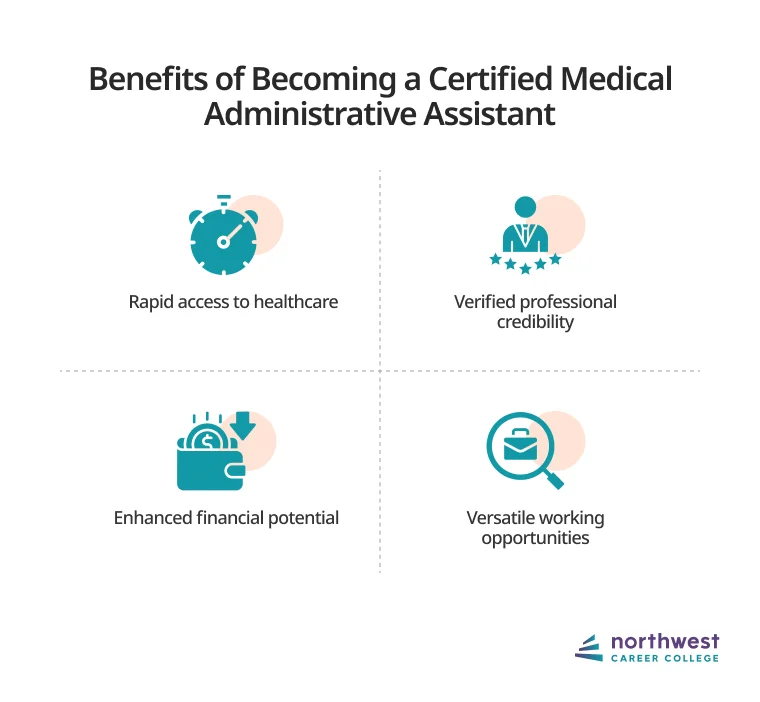
- Rapid access to healthcare: CMAA avoids multi-year academic degrees, allowing students to quickly and simply enter formal institutional employment.
- Verified professional credibility: The national credential acts as proof of your administrative competency, fulfilling compliance standards required by major healthcare systems.
- Versatile working opportunities: Certified MAAs can change and enter into different administrative roles at hospitals, specialist networks, diagnostic centers, and urgent care clinics.
- Enhanced financial potential: CMAAs can earn a better baseline payment model than non-certified entry positions, providing immediate financial returns.
How much do certified medical administrative assistants make?
Certified Medical Administrative Assistants (CMAA) make about $25k to more than $61k per year in the US, which is roughly $2,083 to over $5,083 per month, $480 to over $1,173 per week, and $12.02 to more than $29.33 per hour, according to Ziprecruiter 2026 data. A Certified Medical Administrative Assistant in Las Vegas, NV makes $25K to $62K per year, which is equivalent to $2,083 to over $5,166 per month, $480 to over $1,192 per week, and $12.02 to more than $29.81 per hour, according to Ziprecruiter 2026 data. Medical Assistant salaries in Nevada vary by city, with higher-paying locations including Sparks, Reno, Boulder City, and Fernley. In the Las Vegas area, North Las Vegas and Henderson tend to pay more than Las Vegas itself.
CMAAs’ salary gets influenced by their accredited program, skill level, bilingual skills, location, and years of experience, certifications, etc. Being certified assures potential employers of the candidate’s competence and credibility in administrative tasks.
The statistics point out that Nevada’s average pay is higher compared to the national baseline due to various factors, including labor shortage, aging population, and high value of bilingual staff. The top 5 highest paying cities in Nevada are Fernley, Sparks, Pahrump, Reno, and Carson City.
How long does it take to become a certified medical administrative assistant?
It takes 3 months to 2 years to become a certified medical administrative assistant. The accurate duration depends on the structured postsecondary educational pathway you choose to enroll in. An accelerated program takes 3 weeks to 4 months, which is fast-paced. Instruction focuses strictly on core technical exam objectives, making it the best option for students who want to work faster. A diploma/certificate program takes 9 to 12 months and includes comprehensive administrative coursework alongside hands-on lab training. Students get time to develop deep competency in administrative tasks such as billing systems and patient coordination. Associate Degree Programs of 18 to 24 months cover general education courses combined with foundational healthcare administration training. Students get a broader academic framework ideal for long-term management goals.
The program candidates’ choices must have been completed within the last 5 years. The training must be through an accredited or state-recognized training institution.
How to become a certified medical administrative assistant?
To become a certified medical administrative assistant, an individual must successfully navigate a sequence of educational, administrative, and evaluative milestones. This step-by-step roadmap guides candidates smoothly from foundational education to active credential maintenance.
The step-by-step guide to becoming a registered medical assistant is as follows.
Step 1: Earn a high school diploma or GED
Earn your high school diploma, General Equivalency Degree (GED), or an equivalent certificate. These credentials are the mandatory prerequisites for entering any accredited certification program or sitting for national exams.
Step 2: Complete a medical administrative program
Complete an accredited or state-recognized medical administrative assistant training or education program within the last 5 years. You can alternatively apply if you have 1 year of supervised work experience in a medical administrative assistant field within the last 3 years, or 2 years of supervised work experience in a medical administrative assistant field within the last 5 years.
Step 3: Register and apply for the CMAA exam
Submit an official application through the National Healthcareer Association (NHA) user portal, fill out the required information, submit documents, and pay the mandatory exam fee.
Step 4: Pass the formal certification examination
Schedule your exam date at an authorized physical testing location or via live remote online proctoring. You score a minimum of 390 to pass; results will appear on the screen when you finish your exam.
Step 5: Maintain your professional credential via continuing education
Renew your certification every 2 years by completing 10 continuing education (CE) credits and paying the standard credential renewal fee of $195.
The process is similar for students who want to become a medical assistant in Las Vegas, but prominent local schools often add externship opportunities and lifetime career support to help with job placement and career development.
What jobs can you get with a certified medical administrative assistant certification?
The jobs you can get with a certified medical administrative assistant certification include medical office receptionist, health information clerk, patient coordinator, medical records specialist, front-desk coordinator, and medical billing specialist.
The highest paying roles for certified administrative specialists include specialized or advanced assistant positions, such as Medical Office Manager or Senior Health Information Administrator positions within specialized surgical centers or major hospital networks. According to Ziprecruiter, the highest salary for CMAA goes higher than $62k in Nevada and $61k in the US.
You can work without a medical administrative assistant certification in most of the states in the US, except Washington DC. However, not having medical assistant certification leads to some hiring and career limitations. Large corporate hospital groups, specialty networks, and urgent care systems heavily favor or strictly require national certification (such as NHA CMAA or CCMA) to comply with risk management policies, meet federal insurance funding standards, and ensure institutional compliance.
What is the certified medical administrative assistant exam?
The certified medical administrative assistant exam is a national-standard evaluation exam that the National Healthcareer Association (NHA) administers to assess a candidate’s entry-level competency in administrative tasks in healthcare.
Eligible candidates must create an online NHA portal account, submit verification of their educational or professional eligibility, and pay the testing fee to take the computerized exam. Through this exam, they demonstrate their practical judgment, legal understanding, and administrative knowledge in a single, timed test.
The certified medical administrative assistant exam questions contain a total of 135 multiple-choice questions, of which 110 are scored questions and 25 are unscored. Within 2 hours and 15 minutes, students are to answer questions from 7 core domains, which are Patient Encounter, Communication and Professionalism, Medical Law, Ethics, and Compliance, Scheduling, Medical Practice Administrative Procedures and Logistics, Billing and Revenue Cycle, and Foundational Knowledge. Scoring ranges from 200 to 500, with a passing score of 390.
Application fee for CMAA is $129, with a maximum of 4 times to apply per year. For the first 3 times, there should be a 30-day wait time, and after the 3rd attempt, a 1-year wait time is required. You can take the exam through approved school/campus test sites, physical PSI testing centers, or online.
Successful candidates’ certificates remain valid for 2 years. To maintain an active status, they must pay a recertification renewal fee of $195 ($8 per month) and successfully earn 10 Continuing Education (CE) credits every 2 years before their credential expiration date.
To prepare for the certified medical administrative assistant exam, study the NHA CMAA exam details, establish a targeted review strategy, practice taking full-length simulation tests, and review your mistakes.
What is the format of the certified medical administrative assistant exam?
The certified medical administrative assistant exam questions are a fully computerized, linear test that evaluates both practical administrative task execution and core healthcare knowledge. There are a total of 135 multiple-choice questions, of which 110 are scored questions, and 25 are unscored. It is a 2-hour and 15-minute test. Scores range from 200 to 500, and the minimum passing score is 390.
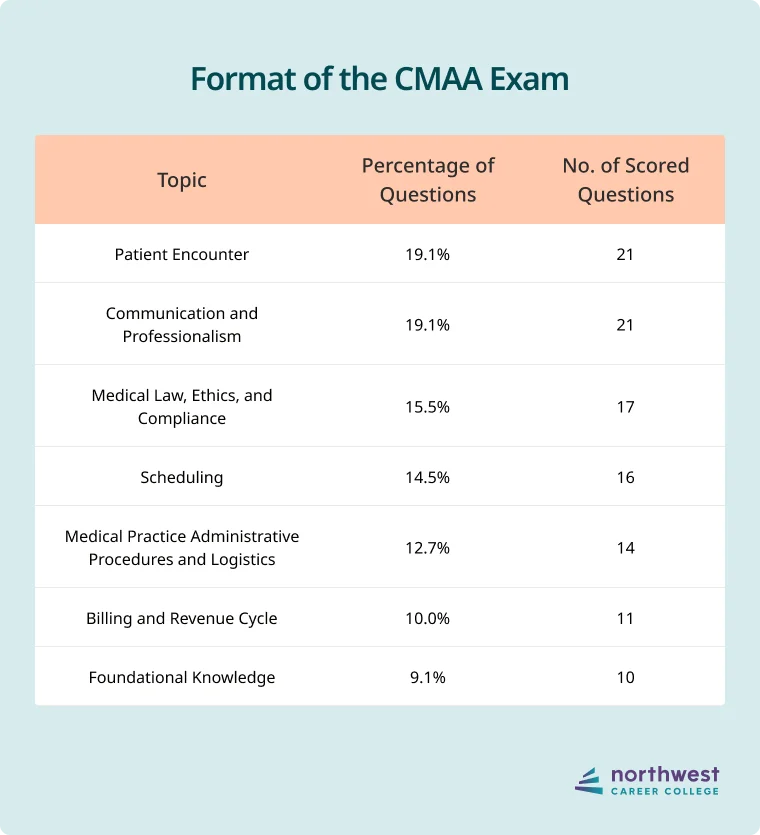
The 110 scored questions are distributed across 7 core domains as follows.
- Patient Encounter (scored 21, percentage 19.1%), covering patient intake forms, insurance verification, and check-out procedures.
- Communication and Professionalism (scored 21, percentage 19.1%), covering active listening, de-escalation strategies, and telecommunications etiquette.
- Medical Law, Ethics, and Compliance (scored 17, percentage 15.5%), covering HIPAA privacy rules, Patients’ Bill of Rights, and OSHA guidelines.
- Scheduling (scored 16, percentage 14.5%), covering appointment types, patient portal registration, and no-show protocols.
- Medical Practice Administrative Procedures and Logistics (scored 14, percentage 12.7%), covering office filing systems, petty cash management, and opening/closing procedures.
- Billing and Revenue Cycle (scored 11, percentage 10.0%), covering revenue cycle phases, healthcare payment models, and charge reconciliation.
- Foundational Knowledge (scored 10, percentage 9.1%), covering medical terminology, basic anatomy/physiology, and healthcare delivery models.
How much does the CMAA exam cost?
The CMAA exam costs $129 for the first-time application fee, which is non-refundable and includes the fees of registration, test administration, and your initial certification fee after passing. Unsuccessful candidates can take the exam after the 1st or 2nd attempt with a 30-day interval in between. Exam attempts after the 3rd time require a 1-year mandatory lock-out period until NHA allows you to apply. Examinees can sit for a maximum of 4 times within a single year, but each additional attempt requires a new application submission and repayment of the full $129 examination fee.
You can take the certified medical administrative assistant exam in 3 secure and protective environments, through approved school/campus test sites, physical PSI testing centers, and live remote proctoring (LRP).
The CMAA exam allows you to gain national recognition for your administrative skills to work in medical settings. Passing the exam is moderately challenging, but achievable as long as you maintain strict study habits and practice with the exam formats and structure. It is a 110-question multiple-choice exam; the score ranges from 200 to 500 points, and the pass mark is 390. Your final score is based on the total number of correct answers, no penalty for incorrect responses.
What are the benefits of taking the certified medical administrative assistant exam?
The benefits of taking the certified medical administrative exam are changing an applicant’s resume to a nationally certified one, having proof of administrative knowledge, and being ready for job skills. Passing the CMAA exam allows you to gain employers’ trust in the hiring process, fulfill compliance requirements for state and federal medical funding, and open opportunities for superior roles, including supervisor and healthcare manager.
How difficult is the certified medical administrative assistant exam?
The difficulty of the CMAA exam is moderate for those students who dedicatedly studies under structural medical office procedures and legal regulations. The examination prioritizes real-world situational scenarios rather than only memorization. Candidates must understand the gravity of administrative rules in daily clinical dilemmas.
What are the requirements to pass the certified medical administrative assistant exam?
The requirements to pass the certified medical administrative assistant exam are familiarity with the exam structure and time limit, which is required to demonstrate your skill in achieving a minimum passing score of 390. Once you complete the exam, a preliminary pass/fail status will immediately appear before the screen, with official certificates posted to your NHA account within two business days.
Where can I take the certified medical administrative assistant exam?
You can take the certified medical administrative assistant exam in 3 secure and protective environments, through approved school/campus test sites, physical PSI testing centers, and live remote proctoring (LRP). In an approved school/campus, officials or instructors directly administer the exam in a classroom or lab. In a physical testing center, you can take the exam in person at a professional, secure national testing facility in your area. You can also remotely sit for the exam from your home or any convenient location by using a web camera, a stable internet connection, and an active online proctor monitoring your session.
How to prepare for the certified medical administrative assistant exam?
To prepare for the certified medical administrative assistant exam, do the following.
- Analyze the CMAA exam
Review the official NHA blueprint, official practice questions, patterns, and topics to understand the exam, imagine the actual scenario, and prepare in mind from the start.
- Establish targeted reviews
Set dedicated specific study blocks to master core topics, for example, prioritize Patient Encounters and Communication and Professionalism, which take up to more than 38% (42 out of 110 scored questions).
- Take timed practice exams
Participate in full-length simulation tests to build exam endurance for the 135-question limit. This helps you master pacing and adjust to NHA’s scenario-based wording.
- Rectify mistakes and proceed
Review every incorrect answer, studying the detailed rationale to fix conceptual gaps. Read exam scenarios thoroughly before choosing your final answer.