13 Medical Assistant Career Paths: Salaries, and Requirements
- Medical Assistant
-
 Authored by
Denisse Adams
Authored by
Denisse Adams
-
 Reviewed by
Dr. Thomas Kenny
Reviewed by
Dr. Thomas Kenny
- Updated October 14, 2026
- 12 views
First, you join entry-level career paths, where you perform both clinical and administrative tasks in a fast-paced environment, following instructions or a senior’s supervision. After 2 years, you move to mid-level careers, building working autonomy and experience. In the final stage, after 5 or more years, you take leadership roles, master advanced specialties, or transition into licensed healthcare practice. You need to earn certifications such as CCMA, CMA, and RMA in the meantime.
The medical assistant career path has different phases that lead you from a beginner to a senior or advanced role in medical assisting, as follows.
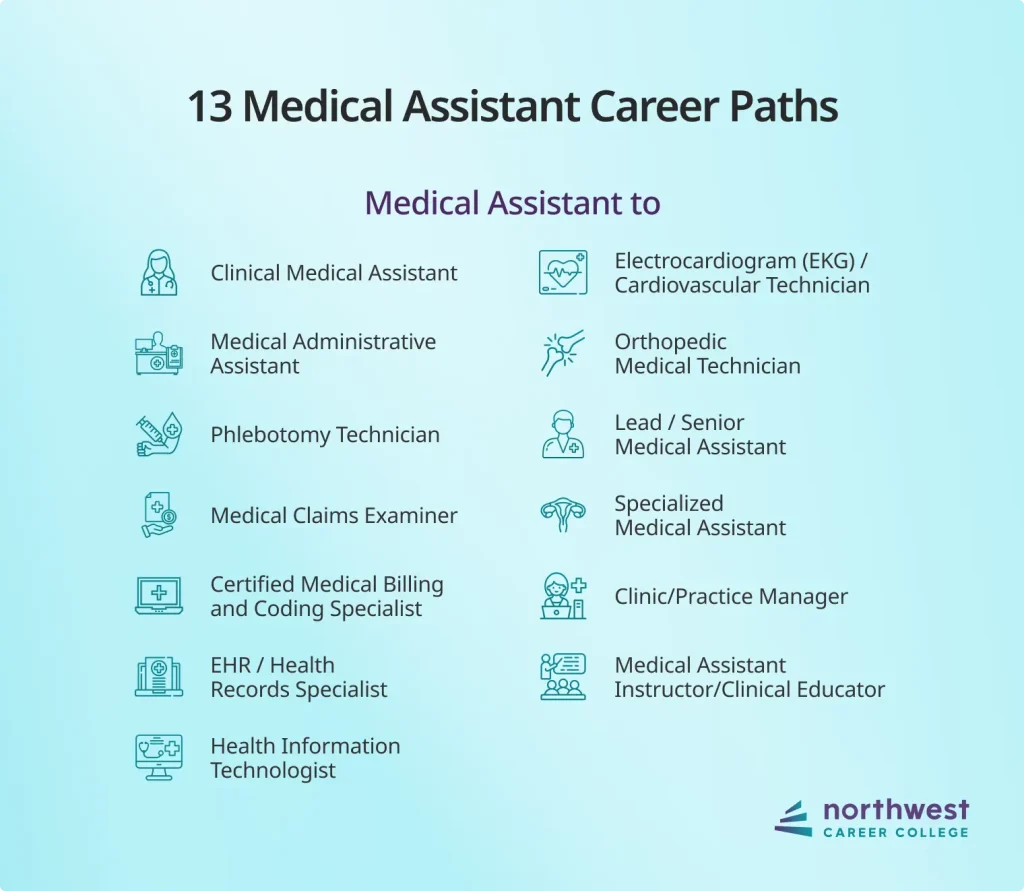
| Phase 1: Entry-level career path for medical assistants – Clinical medical assistant, medical administrative assistant, phlebotomy technician, and medical claims examiner. Phase 2: Mid-tier career path for medical assistants – Certified Medical Billing and Coding Specialist, EHR, Health Information Technologist, EKG Technician, and Orthopedic Medical Technician. Phase 3: Leadership, specialized, and advanced clinical tier for medical assistants – Lead/Senior Medical Assistant, Specialized Medical Assistant, Clinic/Practice Manager, Medical Assistant Instructor/Clinical Educator |
1. Medical Assistant to Clinical Medical Assistant
Clinical medical assistants are frontline healthcare professionals who work directly with physicians and nurses to support patient care and surgeries, performing hands-on clinical duties inside healthcare settings. This job is physically demanding and requires managing a fast-paced workload.
- Duties: Taking and recording patient vital signs, collecting medical histories, preparing patients for examinations, sterilizing equipment, and assisting providers during minor in-office procedures.
- Scope of practice: Allowed to perform basic, low-risk procedures following clear guidelines, under the direct supervision of a licensed medical provider.
- Work domain: Clinical
- Workplace: Outpatient hospital clinics, family practices, urgent care centers, and specialty clinics.
- Salary range: $27,400 to $59,500 per year in Nevada, according to ZipRecruiter 2026 data.
- Prerequisite: Requires completing an accredited medical assistant diploma or certificate program and earning a national credential, such as the Certified Medical Assistant (CMA) by AAMA or Certified Medical Assistant (CCMA) by NHA.
2. Medical Assistant to Medical Administrative Assistant
Medical administrative assistants are front-office healthcare professionals who manage day-to-day clinic operations, coordinate patient flow, and handle administrative communication inside healthcare settings. They can also work in hybrid and remote formats.
- Duties: Handling patient check-in and check-out, answering phone calls, scheduling appointments, updating demographic records in Electronic Health Records (EHR), and verifying insurance coverage.
- Scope of practice: Restricted strictly to non-clinical administrative workflows and cannot provide medical advice or perform physical clinical care.
- Work domain: Administrative
- Workplace: Physician offices, outpatient hospital clinics, dental practices, hospital admissions desks, and specialty clinics.
- Salary range: $25,900 to $62,100 per year in Nevada, according to ZipRecruiter.
- Prerequisite: Requires completing a postsecondary medical assistant diploma program with front-office administrative modules, or earning a national credential such as Certified Medical Administrative Assistant (CMAA) by NHA.
3. Medical Assistant to Phlebotomy Technician
Phlebotomy technicians are specialized diagnostic healthcare professionals who collect blood samples and prepare specimens for medical laboratory testing. This job requires strong attention to detail, physical precision, and a calm approach to ease patient anxiety.
- Duties: Performing venipuncture and capillary punctures, verifying patient identity, preparing samples for laboratory transport, and maintaining strict safety and sanitation protocols.
- Scope of practice: Not permitted to administer intravenous (IV) medications, diagnose conditions, or interpret lab results.
- Work domain: Clinical (diagnostic/laboratory)
- Workplace: Diagnostic laboratories, blood donation centers, and plasma donation facilities.
- Salary range: $25,900 to $58,500 per year in Nevada, according to ZipRecruiter.
- Prerequisite: Requires completing dedicated phlebotomy training within a medical assistant diploma program or obtaining a national credential such as the Certified Phlebotomy Technician (CPT) by NHA.
4. Medical Assistant to Medical Claims Examiner
Medical claims examiners are health data specialists who review medical bills, verify insurance coverage, and approve or deny claims for payment. Medical claims examiners perform desk-based analytical work focused on data precision and regulatory compliance.
- Duties: Reviewing submitted medical claims, identifying billing errors or potential fraud, and approving or denying claim payouts based on policy guidelines.
- Scope of practice: Not permitted to modify medical diagnoses, provide direct patient care, or make clinical treatment decisions.
- Work domain: Administrative
- Workplace: Health insurance agencies, hospital finance departments, and government healthcare organizations.
- Salary range: $32,500 to $96,700 per year in Nevada, according to ZipRecruiter.
- Prerequisite: Requires medical terminology knowledge from a medical assistant program and a billing certification such as Certified Billing and Coding Specialist (CBCS) by NHA or Certified Professional Coder (CPC) by AAPC.
5. Medical Assistant to Certified Medical Billing and Coding Specialist
Certified medical billing and coding specialists translate medical notes, procedures, and diagnoses into standardized codes used for insurance reimbursement and health records. This role relies heavily on desk-based attention to detail and accurate health data.
- Duties: Reviewing provider documentation, assigning ICD-10 and CPT codes, submitting claims to insurance payers, and auditing claim rejections.
- Scope of practice: Cannot edit clinical notes or make treatment decisions.
- Work domain: Administrative
- Workplace: Medical billing companies, outpatient clinics, hospital financial offices, and remote workspace settings.
- Salary range: $29,000 to $61,600 per year in Nevada, according to ZipRecruiter.
- Prerequisite: Requires a medical assistant associate degree (or certificate) and a credential such as Certified Professional Coder (CPC) by AAPC or Certified Billing and Coding Specialist (CBCS) by NHA.
6. Medical Assistant to EHR / Health Records Specialist
EHR/health records specialists manage and organize digital patient files to ensure accuracy, safety, and regulatory compliance across clinical computer systems. You advance your career by being proficient in healthcare software and data protection.
- Duties: Verifying record completeness, auditing entries for HIPAA compliance, training staff on system updates, and fulfilling legal medical record requests.
- Scope of practice: Not allowed to alter provider diagnosis notes or perform direct patient care.
- Work domain: Administrative
- Workplace: Multi-specialty clinics, hospital systems, health information departments, and insurance firms.
- Salary range: $25,200 to $72,500 per year in Nevada, according to ZipRecruiter.
- Prerequisite: Requires a Medical Assistant Associate Degree and a credential such as Certified Electronic Health Records Specialist (CEHRS) by NHA.
7. Medical Assistant to Health Information Technologist
Health information technologists oversee the databases and IT systems that store, secure, and organize clinical data across healthcare networks. Candidates looking to join this profession require knowledge in health data management, medical terminology, and basic health IT.
- Duties: Organizing digital health data, monitoring database security, analyzing clinical data trends, and assisting with software system integrations.
- Scope of practice: Not allowed to make clinical decisions.
- Work domain: Administrative (Health IT)
- Workplace: Hospital networks, health technology companies, outpatient systems, and public health agencies.
- Salary range: $29,000 to $55,000 per year in Nevada, according to ZipRecruiter.
- Prerequisite: Requires a medical assistant associate degree with coursework in health information technology or a Registered Health Information Technician (RHIT) credential by AHIMA.
8. Medical Assistant to Electrocardiogram (EKG) / Cardiovascular Technician
EKG technicians or cardiovascular technicians are specialized clinical diagnostic professionals who operate equipment to record the electrical activity of a patient’s heart to help physicians detect cardiac conditions. Their role involves careful patient positioning and a calm demeanor during diagnostic testing.
- Duties: Attaching electrodes to patients, running 12-lead EKG tests, and performing basic stress testing under provider supervision.
- Scope of practice: Cannot independently diagnose cardiac conditions, interpret complex readings, or prescribe treatment.
- Work domain: Clinical (Diagnostic)
- Workplace: Cardiology clinics, outpatient diagnostic centers, hospitals, and urgent care centers.
- Salary range: $24,000 to $87,000 per year in Nevada, according to ZipRecruiter.
- Prerequisite: Requires a medical assistant associate degree (which includes foundational EKG coursework) paired with a targeted credential, for example, Certified EKG Technician (CET) by NHA.
9. Medical Assistant to Orthopedic Medical Technician
Orthopedic medical technicians work alongside orthopedic surgeons and physician assistants to care for patients with bone, joint, and muscle injuries. You can advance your career from medical assistant by focusing on immobilization techniques, wound care, and mobility support.
- Duties: Applying and removing fiberglass casts and synthetic splints, fitting patients for braces and crutches, and assisting during minor joint procedures.
- Scope of practice: Cannot perform surgical procedures, set broken bones (reduction), or interpret X-rays.
- Work domain: Clinical (Specialized Care)
- Workplace: Orthopedic surgical practices, sports medicine clinics, urgent care centers, and hospital trauma units.
- Salary range: $27,000 to $90,000 per year in Nevada, according to ZipRecruiter.
- Prerequisite: Requires a Medical Assistant diploma or Associate Degree paired with a credential such as Orthopaedic Technologist Certified (OTC) by NBCOT.

10. Medical Assistant to Lead / Senior Medical Assistant
Lead medical assistants or senior medical assistants are senior frontline supervisors who coordinate clinical staff, manage daily patient flow, and assist clinic managers with staff training and operational oversight. Candidates show strong leadership, organizational control, and expertise in back-office workflows.
- Duties: Supervising junior medical assistants, creating daily work schedules, managing clinical inventory, auditing medical chart documentation, and training new hires on clinic protocols.
- Scope of practice: Coordinates clinic operations and performs advanced clinical procedures under provider direction; cannot independently alter medical treatments or give official performance reviews or judge clinical care.
- Work domain: Leadership / Hybrid
- Workplace: Outpatient clinics, primary care centers, specialty practices, and urgent care networks.
- Salary range: $27,000 to $57,500 per year in Nevada, according to ZipRecruiter.
- Prerequisite: Requires 3+ years of clinical MA experience, a national credential such as Certified Medical Assistant (CMA) by AAMA or Certified Clinical Medical Assistant (CCMA) by NHA, and demonstrated leadership skills.
11. Medical Assistant to Specialized Medical Assistant
Specialized medical assistants focus on specific medical branches (such as cardiology, dermatology, or oncology) and perform targeted diagnostic procedures while assisting with specialty care. This job relies on specialized clinical knowledge and high technical precision.
- Duties: Performing specialty-specific diagnostic tests, setting up specialized surgical trays, and educating patients on targeted treatment plans.
- Scope of practice: Cannot independently diagnose conditions or prescribe specialty treatments.
- Work domain: Specialized Care
- Workplace: Specialty medical practices, outpatient surgical centers, academic medical centers, and specialized hospital clinics.
- Salary range: $27,000 to $140,000 or more per year in Nevada, according to ZipRecruiter.
- Prerequisite: Requires a medical assistant diploma or associate degree, extensive clinical experience in a practice setting, and optional specialty micro-credentials (e.g., CET for EKG or CPT for Phlebotomy).
12. Medical Assistant to Clinic/Practice Manager
Clinic practice managers or practice managers are administrative leaders who oversee daily operational, financial, and personnel activities across a healthcare facility. You can advance your career through high-level decision-making, desk-based administration, team management, and financial planning.
- Duties: Managing clinic budgets, handling payroll and billing operations, enforcing HIPAA and OSHA compliance, and improving overall patient satisfaction.
- Scope of practice: Not permitted to deliver direct medical care, diagnose patients, or prescribe treatments.
- Work domain: Administrative (Leadership)
- Workplace: Private physician practices, outpatient healthcare networks, urgent care chains, and specialty clinics.
- Salary range: $37,900 to $110,000 per year in Nevada, according to ZipRecruiter.
- Prerequisite: Requires an Associate Degree in Medical Assisting, 3–5+ years of healthcare operational experience, and credentials like Certified Professional Medical Manager (CPMM) or Certified Medical Manager (CMM).
13. Medical Assistant to Medical Assistant Instructor/Clinical Educator
Medical assistant instructors and clinical educators can further your career as experienced medical assistants who transition into teaching, training the next generation of students in vocational schools, community colleges, or health system onboarding programs.
- Duties: Teaching clinical procedures (phlebotomy, vitals, EKG), grading practical skills labs, evaluating student performance, and updating curriculum to meet accreditation standards.
- Scope of practice: Teaches and evaluates clinical competencies in academic settings; cannot deliver patient care or grant formal certifications independently.
- Work domain: Academic/Clinical Training
- Workplace: Community colleges, vocational schools, technical institutes, and hospital education departments.
- Salary range: $30,000 to $83,500 per year in Nevada, according to ZipRecruiter.
- Prerequisite: Requires a medical assistant associate degree (AAS), 4+ years of practical clinical experience, and active national certification (CMA or CCMA).
How to choose the right medical assistant career path?
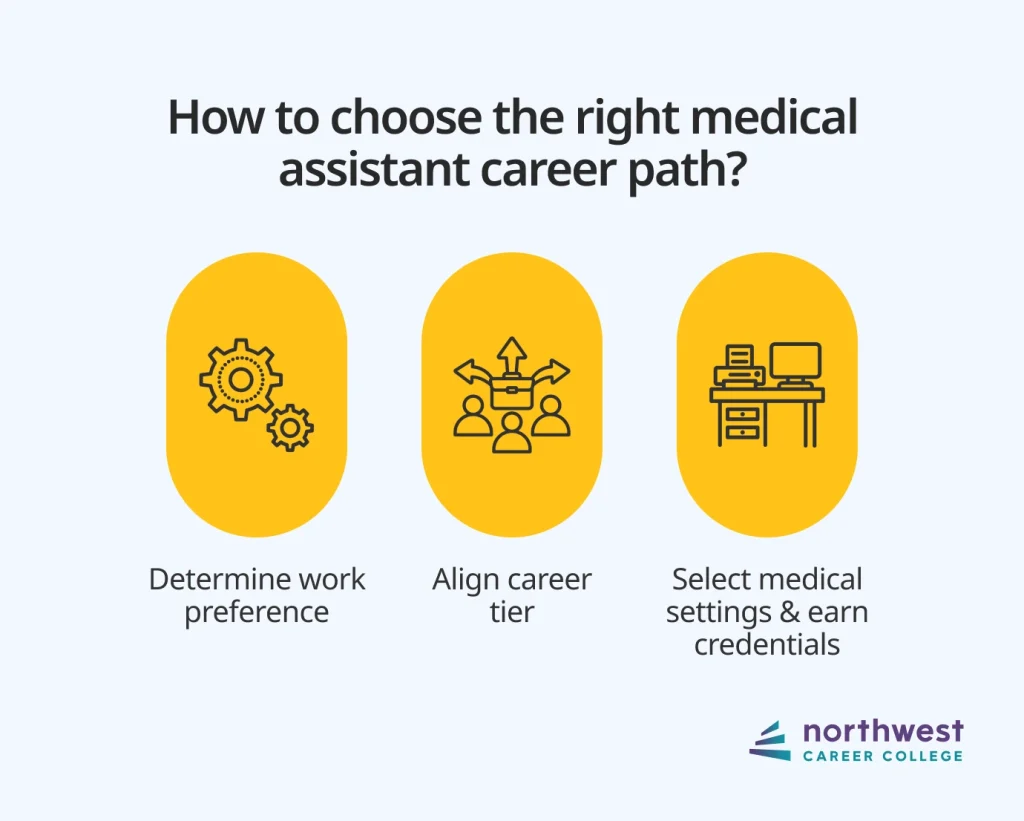
To choose the right medical assistant career path, decide on your work preference, align with your career tier, and select the settings and required credentials.
Step 1: Determine work preference
Focus on your personal strengths and daily work style; for example, empathy and manual dexterity fit hands-on clinical care, organizational and computer skills suit administrative roles, while adaptability is better suited for hybrid, specialty roles such as cardiology.
Step 2: Align career tier
Join a workforce that matches your career tier: entry-level diploma holders start in fast-paced hospitals and perform both clinical and admin tasks, mid-tier specialists focus on predictable specialty-based work, and advanced managers direct operations or medical centers.
Step 3: Select medical settings & earn credentials
Choose your preferred work environment (fast-paced urgent care vs. structured private practices) and earn job-relevant credentials (CMA, CCMA, CPC) to advance.
Why choose medical assisting as your career path?
Choose medical assisting as your career path for the following reasons.
- Fast entry to the job market
You can join the profession by completing an accredited diploma program, allowing you to earn a solid living quickly without completing years of school.
- Flexible work environments
As you advance in your career, you gain access to a wider variety of workplace settings and roles to choose from.
- Clear career mobility
You can use this profession as a foundation to transition into speciality, health IT, or clinic management.
- Increasing demand
An aging population, expanding clinical facilities, and a growing emphasis on preventive care directly influence the job growth for medical assistants.
Is medical assisting a good career for someone switching from a non-healthcare background?
Yes, medical assisting is a good career for someone switching from a non-healthcare background, as it requires no prior medical experience, and students can enter the job market by completing a medical assistant diploma or associate degree program. With employment projected to grow 13 percent through 2035 according to the BLS, medical assisting offers an easy entry point where non-healthcare workers can learn clinical and administrative skills from scratch and thrive in customer service, organization, and communication.
What types of medical career paths can I pursue after starting as a medical assistant?
You can pursue 3 main medical career pathways after starting as a medical assistant: administrative leadership via specialized credentials, advancement to clinical specialties (EKG, dialysis, orthopedics) through targeted short certificates, or switching to nursing through higher education.