What Jobs Can You Get with an HVAC Diploma, Degree, and Certificate?
- hvac technician
-
 Authored by
Raul Ibarra
-
Reviewed by
Dr. Thomas Kenny
- Updated November 5, 2026
- 92 views


The jobs you can get with an HVAC (Heating, Ventilation, and Air Conditioning) diploma, associate degree, or certificate include HVAC Technician, HVAC Installer, Maintenance Technician, HVAC Fabricator, and Duct Installer. HVAC professionals typically work at the intersection of mechanical infrastructure to ensure the systems stay functional and operational. They work in residential homes, commercial buildings, hospitals and medical facilities, supermarkets, and grocery stores. HVAC technicians earn between $41,040 and $89,750.
Here’s a list of HVAC occupations you can get with an HVAC diploma, degree, or certificate.
- HVAC Technician
- HVAC Installer
- Maintenance Technician
- Refrigeration Technician
- HVAC Fabricator
- HVAC Apprentice
- Duct Installer

1. HVAC Technician
HVAC technician, also known as an Air-Conditioning Technician, is a skilled professional who installs, troubleshoots, and repairs heating, ventilation, and air conditioning units across residential, commercial, and industrial facilities. They perform mechanical system diagnostics, electrical controls, and refrigerant management to ensure indoor climate comfort, optimal energy efficiency, and compliance with environmental and building safety codes.
Key facts about HVAC Technicians are as follows.
- Average Salary: According to ZipRecruiter, HVAC technicians in Nevada earn between $29,022 and $91,138 per year, which is roughly equivalent to $4,988/month, $1,151/week, and $28.78/hour. HVAC technicians in the USA earn between $28,500 and $89,500 per year, which is equal to $4,898/month, $1,130/week, and $28.26/hour.
- Occupational Growth Prospects: According to the U.S. Bureau of Labor Statistics (BLS), the projected occupational growth for HVAC Technicians (mechanics and installers) is 11%.
- Required Certification: EPA Section 608 Certification is legally required to handle refrigerants.
- HVAC Technician Job Description: Technicians diagnose electrical issues, replace motors, and execute installations. They also perform preventive maintenance by cleaning coils, replacing air filters, and completing work orders.
- Skills Required: Electrical troubleshooting, schematic reading, mechanical aptitude, refrigerant handling, problem-solving, and clear customer communication.
- Career Prospects: Lead HVAC Technician, Service Manager, Commercial Refrigeration Technician, HVAC Operations Manager, and Independent HVAC Contractor.
2. HVAC Installer
An HVAC Installer is an entry-level technical specialist who focuses on setting up, assembling, and connecting new heating, cooling, and ventilation systems in residential and commercial properties. They ensure equipment is properly mounted, wired, and integrated into existing structures following local building codes and technical specifications.
Key facts about HVAC Installers are as follows.
- Average Salary: According to ZipRecruiter, HVAC Installers in Nevada earn between $29,022 and $88,083 per year, which is equivalent to $4,714/month, $1,087/week, and $27.20/hour. Top earners make $77,900 annually. HVAC Installers earn between $28,500 and $86,500 per year in the US, which is equivalent to $4,629/month, $1,068/week, and $26.71/hour.
- Occupational Growth Prospects: According to the U.S. Bureau of Labor Statistics (BLS), the projected occupational growth for HVAC installers (mechanics and installers) is 11%.
- Required Certification: EPA Section 608 Certification is legally required to handle refrigerants.
- HVAC Installer Job Description: Installers place indoor and outdoor heating and cooling units, run refrigerant lines, connect electrical wiring, attach thermostats, ensure proper drainage, and verify safe initial system startup.
- Skills Required: Mechanical assembly, blueprint reading, duct installation, refrigerant piping, and power tool operation.
- Career Prospects: Lead HVAC Installer, Senior Field Technician, HVAC Inspector, Installation Crew Supervisor, and Independent HVAC Contractor.
3. Maintenance Technician
A Maintenance Technician is a trained technical HVAC professional who oversees the routine upkeep, preventive inspection, and performance optimization of HVAC systems. They focus on preventing system failures, ensuring energy efficiency, and extending the operational lifespan of climate control equipment.
Key facts about Maintenance Technicians are as follows.
- Average Salary: According to ZipRecruiter, Maintenance Technicians in Nevada earn between $27,490 and $68,226 per year, which is equivalent to $3,966/month, $915/week, and $22.88/hour. Maintenance technicians in the US make between $27,000 and $67,000 per year, which is equivalent to $3,895/month, $898/week, and $22.47/hour.
- Occupational Growth Prospects: According to the U.S. Bureau of Labor Statistics (BLS), the projected occupational growth for Maintenance Technician is 11%.
- Required Certification: EPA Section 608 Certification is legally required to work on refrigerants.
- Maintenance Technician Job Description: Maintenance technicians perform scheduled inspections, replace air filters, clean condenser and evaporator coils, check refrigerant pressures, and log system performance.
- Skills Required: Preventive upkeep, basic electrical testing, equipment inspection, organization, and customer service.
- Career Prospects: Senior Service Technician, HVAC Lead Technician, Facilities Maintenance Manager, Building Superintendent, and Commercial HVAC Specialist.

4. Refrigeration Technician
A Refrigeration Technician is a hands-on mechanical specialist who installs, services, maintains, and repairs commercial and industrial cooling equipment. They mostly work in precise low-temperature environments in places like supermarkets, restaurants, cold-storage warehouses, and medical facilities to protect perishable goods and ensure food safety.
Key facts about Refrigeration Technicians are as follows.
- Average Salary: According to ZipRecruiter, Refrigeration Technicians in Nevada earn between $33,260 and $86,379 per year, which is equivalent to $4,986/month, $1,150/week, and $28.77/hour. These professionals in the US make between $33,500 and $87,000 per year, which is equivalent to $5,022/month, $1,158/week, and $28.97/hour.
- Occupational Growth Prospects: According to the U.S. Bureau of Labor Statistics (BLS), the projected occupational growth for Refrigeration Technicians is 11%.
- Required Certification: EPA Section 608 Certification is legally required to handle refrigerants.
- Refrigeration Technician Job Description: Diagnose commercial cooling systems, test pressure lines, repair leaks, replace compressors, and service ice machines.
- Skills Required: System diagnostics, advanced refrigerant handling, electrical wiring, pipe soldering/brazing, and attention to detail.
- Career Prospects: Senior Refrigeration Specialist, Commercial HVAC-R Lead Technician, Industrial Refrigeration Engineer, Service Manager, and Independent Commercial Contractor.
5. HVAC Fabricator
An HVAC Fabricator is a shop-based technical worker who measures, cuts, bends, and assembles sheet metal and structural materials to build custom ductwork and fittings. They work primarily in manufacturing shops or metal fabrication facilities, ensuring air distribution systems fit exact building blueprints before field installation.
Key facts about HVAC Fabricators are as follows.
- Average Salary: According to ZipRecruiter, HVAC Fabricators in Nevada earn between$27,698 and $58,738 per year, which is equivalent to $3,433/month, $792/week, and $19.81/hour. These professionals in the US make between $ 29,000 and $ 61,500 per year, which is equivalent to $3,594/month, $829/week, and $20.74/hour.
- Occupational Growth Prospects: According to the U.S. Bureau of Labor Statistics (BLS), the projected occupational growth for HVAC Fabricators is 11%.
- Required Certification: OSHA 10-Hour certification is standard, along with HVAC Excellence or AWS entry-level credentials. EPA Section 608 is optional for shop-only roles.
- HVAC Fabricator Job Description: Fabricators read blueprints, lay out sheet metal patterns, join seams using rivets or welds, and assemble custom duct fittings for field installation.
- Skills Required: Blueprint reading, precise measurement, metalworking tool operation, pattern layout, welding/soldering, and spatial reasoning.
- Career Prospects: Lead Shop Fabricator, CNC Plasma Operator, Metal Shop Supervisor, HVAC Estimator, and Custom Fabrication Shop Owner.
6. HVAC Apprentice
An HVAC Apprentice is an entry-level field trainee who supports senior technicians while learning the installation, maintenance, and repair of climate-control systems. Working directly on job sites alongside experienced mentors, their focus is on mastering hands-on diagnostic techniques and proper tool handling during on-the-job training.
Key facts about HVAC Apprentices are as follows.
- Average Salary: According to ZipRecruiter, HVAC Apprentices in Nevada earn between $22,403 and $57,534 per year, which is equivalent to $3,400/month, $784/week, and $19.62/hour. These professionals in the US make between $22,000 and $56,500 per year, which is equivalent to $3,339/month, $770/week, and $19.27/hour.
- Occupational Growth Prospects: According to the U.S. Bureau of Labor Statistics (BLS), the projected occupational growth for HVAC Apprentice is 11%.
- Required Certification: EPA Section 608 Certification is legally required to handle refrigerants.
- HVAC Apprentice Job Description: Apprentices assist lead technicians with equipment staging, load service vans, assemble basic ductwork, maintain job site safety and perform basic maintenance tasks, and shadow complex system diagnostics under direct supervision.
- Skills Required: Mechanical aptitude, willingness to learn, basic hand/power tool operation, physical stamina, time management, and active listening.
- Career Prospects: Journeyman HVAC Technician, Senior Installer, Lead Service Tech, Field Supervisor, and HVAC Service Manager.
7. Duct Installer
A Duct Installer is an entry-level system installer who measures, fits, hangs, and seals air distribution systems across residential and commercial job sites. Duct installers work on new construction, remodeling, and system replacement projects to ensure proper airflow, energy efficiency, and structural safety throughout the building.
Key facts about Duct Installers are as follows.
- Average Salary: According to ZipRecruiter, HVAC Apprentices in Nevada earn between $27,220 and $82,615 per year, which is equivalent to $4,421/month, $1,020/week, and $25.51/hour. Duct Installers in the US make between 28, 500 and 86,500 per year, which is equivalent to $4,629/month, $1,068/week, and $26.71/hour.
- Occupational Growth Prospects: According to the U.S. Bureau of Labor Statistics (BLS), the projected occupational growth for Duct Installer is 11%.
- Required Certification: OSHA 10-Hour Safety certification is standard for job-site safety compliance. EPA Section 608 Certification is optional for duct-only roles.
- Duct Installer Job Description: Duct installers review architectural plans, measure installation pathways, assemble metal or flexible duct sections, secure hangers and supports, seal joints with mastic or foil tape, install grilles and registers, and perform airflow leak testing.
- Skills Required: Blueprint reading, accurate measurement, power tool operation, physical stamina, ladder and scaffold safety, and spatial awareness.
- Career Prospects: Lead Duct Installer, Sheet Metal Crew Supervisor, Senior HVAC Installer, Field Superintendent, and HVAC Installation Contractor.
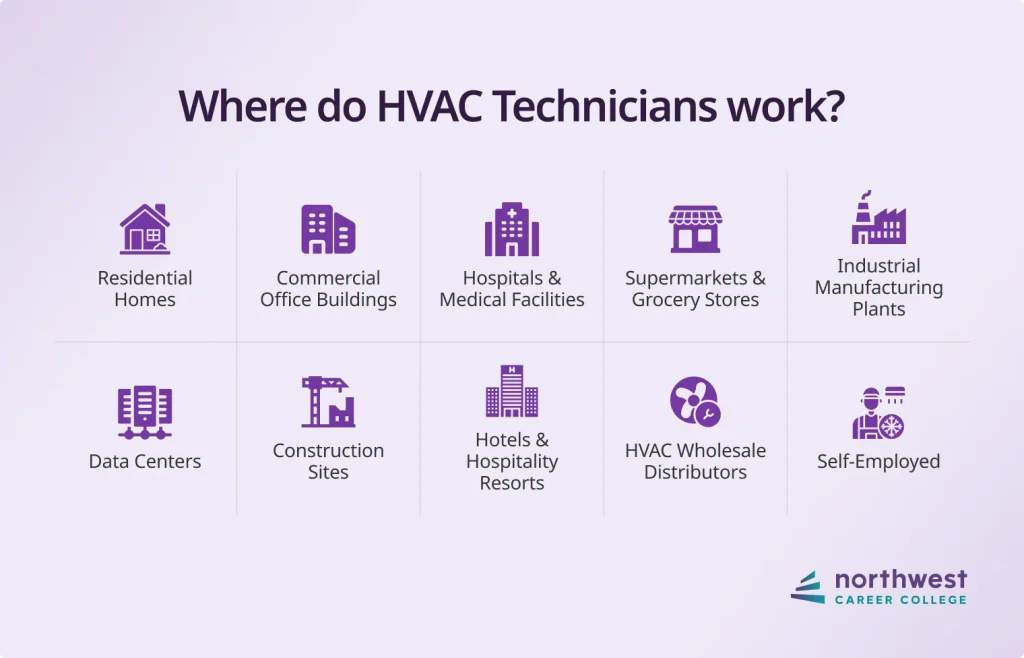
Where do HVAC Technicians work?
HVAC technicians work in residential homes, commercial buildings, hospitals and medical facilities, supermarkets and grocery stores, industrial manufacturing plants, data centers, and construction sites, etc. They handle both physical labor and system diagnostics. With completing an HVAC Technician diploma program, technicians perform essential maintenance, troubleshooting, and installation across a wide variety of indoor, outdoor, and facility environments.
Here is a list of workplaces where a certified HVAC technician can work.
- Residential Homes
HVAC Technicians repair heating and cooling systems during standard daytime hours, but seasonal peak heat and winter freezes cause heavy overtime, weekend on-call shifts, and high call volumes.
- Commercial Office Buildings
HVAC Professionals service climate control equipment during normal business hours, but execute major repairs at night or on weekends to avoid disrupting daily tenant operations.
- Hospitals & Medical Facilities
Field Specialists maintain critical cooling units on rotating 24/7 shifts, managing high-stress emergency repairs where system downtime directly threatens patient health and safety.
- Supermarkets & Grocery Stores
Refrigeration Mechanics fix commercial freezers during irregular, late-night, or 24/7 on-call shifts, preventing massive food spoilage from cooling system failures.
- Industrial Manufacturing Plants
Industrial Mechanics refurbish heavy-duty chillers and process cooling systems on structured facility shifts, handling physically demanding maintenance in hot, noisy environments.
- Data Centers
System Specialists monitor critical cooling infrastructure on continuous 24/7 rotating shifts, ensuring zero downtime for mission-critical IT hardware and servers.
- Construction Sites
Sheet Metal Installers assemble ductwork and set heavy equipment during fixed early-morning schedules, performing strenuous physical labor before buildings are fully enclosed.
- Hotels & Hospitality Resorts
Facility Technicians resolve guest-room climate complaints on flexible 24/7 facility shifts, ensuring prompt response times with minimal noise disruption.
- HVAC Wholesale Distributors
Counter Specialists assist field contractors with parts orders and technical support during consistent Monday–Friday business hours, avoiding physical field labor entirely.
- Self-Employed / Independent Contracting
HVAC Contractors manage client service calls on custom personal schedules, trading flexibility for long workdays that combine emergency field labor with business administration.
What jobs can you get as a certified HVAC Technician?
Jobs you can get as a certified HVAC technician are mainly specialized, high-paying roles such as a commercial HVAC technician or a residential service technician. These employments require legally handling refrigerants, performing independent diagnostics, and operating complex systems safely.
- Commercial HVAC Technician: Fixes and maintains heating, cooling, and ventilation units in businesses, independently troubleshooting and repairing large refrigerant systems.
- Residential Service Technician: Inspects and repairs home AC and heating units, handling refrigerants independently without needing a supervising lead technician.
- Refrigeration Technician: Sets up and repairs walk-in freezers and display cases in supermarkets, legally handling low-temperature refrigerants.
- HVAC Commissioning Specialist: Tests and adjusts newly installed HVAC systems to verify correct operation, using certification to sign off on refrigerant safety.
- Chiller Technician: Services large water chillers in industrial plants, using specialized certification to safely handle high-pressure refrigerants.
- Lead Installation Technician: Installs new HVAC units, charges refrigerant lines, and legally approves final system setups that uncertified installers cannot complete.
Can you get HVAC Technician Jobs with no experience in Nevada?
Yes, you can get HVAC technician jobs with no experience in Nevada. Completing a formal program helps you gain the knowledge you need through hands-on training and an externship. Plus, earning EPA Section 608 certification lets you legally handle refrigerants independently. This gives you the edge with the knowledge and skills Nevada’s employers look for when hiring.
How much do HVAC technician jobs pay?
HVAC technician jobs pay $41,040 to $89,750 in Nevada and $40,050 to $95,210 in the US, according to Onet Online. Beginner-level apprentices generally earn between $38,000 and $45,000 in the US and earn more by gaining experience and expertise, obtaining national certification, and by employer type and field of speciality, making more money than electricians in specialized commercial and industrial HVAC fields.
What is the career path for HVAC technicians?
The career path for HVAC technicians leads to lead technician, service manager, operations manager, or business owner. Besides, they can also move to non-physical roles, including HVAC Estimator and Technical Trainer. With experience, leadership, advanced troubleshooting skills, and national certifications, such as EPA Section 608 Certification), they enjoy higher pay, stable hours, and less physical strain in their roles.
Is HVAC a good career?
Yes, HVAC is a good career as it offers faster entry to the workforce, job stability, and high earning potential. According to the U.S. Bureau of Labor Statistics data, the Heating, Air Conditioning, and Refrigeration Mechanics and Installers job outlook is projected to grow 11% from 2025 to 2035, making the job one of the fastest-growing occupations in the US.
Is HVAC a low-stress job?
No, HVAC isn’t a low-stress job; it’s a moderate-to-high-stress job, though stress levels vary heavily depending on the specific role, season, and company setting. When the peak season comes, such as summer heat waves or winter freezes, workloads are generally intense and rushed. Technicians have to respond to every emergency call and work on complex troubleshooting, regular maintenance work, and tight emergency deadlines. Once you lock in your daily schedule and hands-on problem-solving, you will find the career rewarding.
Will HVAC techs’ jobs be replaced by AI jobs?
No, AI will not replace HVAC techs’ jobs because HVAC work is highly physical. HVAC technicians manually repair, fix, change, or install HVAC systems, which requires real-time physical labor, situation-based decisions in unpredictable environments, and ensuring accurate functionality for optimal client satisfaction.