HVAC Technician: Duties, Benefits, How to Become, and Career Paths
- hvac technician
-
 Authored by
Raul Ibarra
-
 Reviewed by
Dr. Thomas Kenny
- Updated November 4, 2026
- 86 views
HVAC technicians are skilled professionals who repair heating, ventilation, and air conditioning systems to support climate control in residential, commercial, and industrial settings. They perform mechanical, electrical, and diagnostic work in homes, office complexes, hospitals, schools, and industrial manufacturing plants.
HVAC technicians earn between $28,500 and $89,500 per year in the US, and $29,022 and $91,138 per year in Nevada. Technicians working in specialized fields earn between $118,500 and $172,000 per year. HVAC technician salaries depend on several factors, including education and training, professional certifications, experience level, and area of specialization.
To become an HVAC technician, enroll in an HVAC technician school, where you systematically develop electrical and mechanical skills through hands-on training and prepare for mandatory EPA Section 608 certification, which mechanical contractors prefer. While choosing the school, consider the institution’s accreditation, curriculum depth, externship opportunities, and career placement support.
What is an HVAC technician?
An HVAC technician, also called a heating, ventilation, and air conditioning (HVAC) specialist or service mechanic, is a skilled trade professional who installs, diagnoses, and repairs climate-control and refrigeration systems. fall within the MEP (Mechanical, Electrical, and Plumbing) building trades. They install and repair HVAC equipment, troubleshoot electrical circuits, repair airflow components, and maintain safe indoor temperatures.
HVAC technicians are often interchangeably referred to as HVAC/R. The main difference between HVAC and HVACR is “R”, which stands for refrigeration (both commercial and industrial). This addition of refrigeration to HVAC requires candidates to earn advanced training in ultra-low temperature systems.
HVAC technicians rely on specialized mechanical and electrical trade tools, for example, digital manifold gauges, multimeters, vacuum pumps and recovery units, and oxy-acetylene torches. They work on residential split systems, heat pumps, and light commercial rooftop units. Certified technicians can legally braze refrigerant lines and service gas furnace assemblies.
What does an HVAC technician do?
An HVAC technician installs, maintains, and repairs HVAC systems, i.e., heating, cooling, and filtration systems in residential, commercial, and industrial buildings. After gaining work experience and working in senior/advanced roles, they diagnose complex electrical failures and lead job crews. HVAC techs or mechanics maintain systems, while the installers set them up.
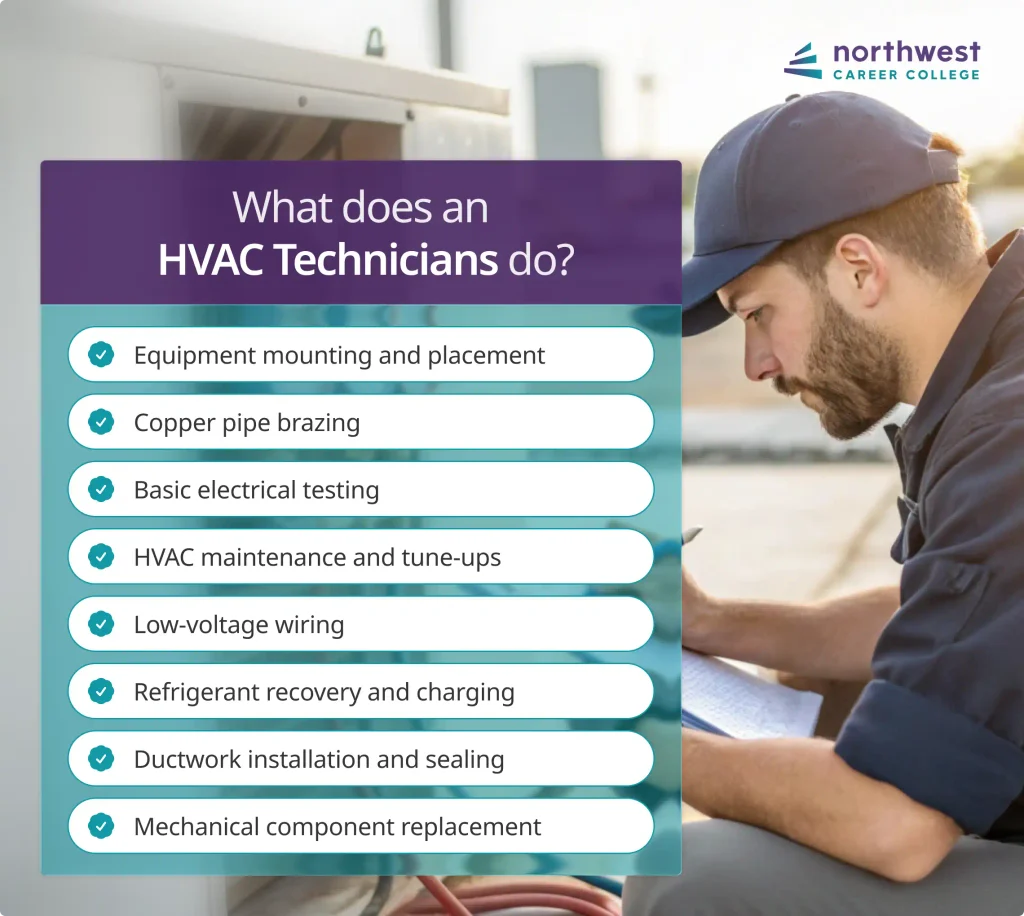
Duties and core responsibilities of an HVAC technician are as follows.
- Equipment mounting and placement: Assist lead installers in setting outdoor condenser pads, hauling air handlers into attics, and hanging ductwork on residential and light commercial jobs.
- Copper pipe brazing: Cut, deburr, and braze copper line sets with a torch to connect outdoor units to indoor coils.
- Basic electrical testing: Test capacitors, contactors, and incoming voltage using a multimeter to spot common power issues.
- HVAC maintenance and tune-ups: Wash condenser coils, clean furnace burners, replace air filters, and flush out clogged condensate drain lines.
- Low-voltage wiring: Wire thermostat cables, connect safety float switches, and set up basic digital or smart thermostats.
- Refrigerant recovery and charging: Hook up manifold gauges, pull vacuums using a vacuum pump, and legally recover or add refrigerant using an EPA Section 608 credential.
- Ductwork installation and sealing: Measure, hang, and seal flexible or sheet-metal ducts with mastic tape to prevent conditioned air loss.
- Mechanical component replacement: Remove and replace worn blower belts, standard fan blades, and faulty limit switches using hand tools.
Where do HVAC technicians work?
HVAC technicians work on residential split systems, heat pumps, and light commercial rooftop units, on residential or commercial contract projects. Their daily work depends on their licenses and skill level; for example, handling refrigerants must be EPA Section 608 certified under federal law.
In Nevada, technicians must also carry local trade cards or contractor licenses before they can pull permits or run major jobs alone. Certified technicians get more work flexibility and higher earning potential because of employers’ hiring preferences.
Other workplaces where HVAC techs work are as follows.
- Hospitals and healthcare facilities: Acute care hospitals, surgical centers, outpatient clinics, and medical research cleanroom labs.
- Cold storage and distribution centers: Food distribution warehouses, refrigerated logistics freight depots, industrial cold-storage lockers, and pharmaceutical storage hubs.
- School districts and universities: K-12 public schools, community college facilities, university research laboratories, and student campus residential halls.
- Supermarkets and grocery stores: Retail grocery stores, wholesale warehouse clubs, corner convenience markets, and meat or seafood processing centers.
- Telecom and data centers: Cloud server data centers, telecom central switching offices, financial web hosting sites, and enterprise network server rooms.
What are the benefits of becoming an HVAC Technician?
The benefits of becoming an HVAC technician include high job security, faster job entry, fast career mobility, dynamic work situations, high-demand skills, high income potential, and positive career impact.
The advantages of becoming an HVAC technician are as follows.
- High job security: Climate control remains essential year-round, generating steady emergency repair work that cannot be automated or outsourced overseas.
- Faster job entry: Short trade programs and paid apprenticeships prepare you for immediate work, bypassing burdensome four-year college debt entirely.
- Fast career mobility: Field experience allows fast advancement into lucrative roles for example, building automation, field supervision, or licensed contracting.
- Dynamic work situations: Technicians solve unique electrical, airflow, and mechanical challenges daily across changing customer sites instead of office desks.
- High-demand skills: A nationwide trades shortage ensures certified technicians enjoy abundant job openings, steady overtime, and strong employer bargaining power.
- High income potential: Hourly wages grow quickly through overtime pay, emergency on-call bonuses, union wage scales, and advanced commercial certifications.
- Positive career impact: Technicians gain daily satisfaction from restoring essential heating, cooling, and clean air, directly protecting occupant health and safety.
How much does an HVAC technician earn?
An HVAC technician in the US makes between $28,500 to $89,500 in the US, which is equivalent to $28.26/hour, $1,130/week or $4,898/month, according to ZipRecruiter. HVAC techs in Nevada earn between $29,022 and $91,138, which is roughly $28.78/hour, $1,151/week, or $4,988/month, according to ZipRecruiter. The US Bureau of Labor Statistics (BLS) has reported an annual median salary for Heating, Air Conditioning, and Refrigeration Mechanics and Installers at $61,010 per year (2025).
The lowest 10 percent earned less than $40,050, and the highest 10 percent earned more than $95,210. The latest data from Indeed shows that HVAC Technicians in the US earn between $44,344 and $153,322. Candidates’ salary ranges vary based on factors such as formal education and training, certification and licensing, experience level, employer type, specialized niche, overtime/on-call availability, and union/non-union status. These factors contributed to heating, air conditioning, and refrigeration mechanics and installers holding about 440,900 jobs in 2025.
What HVAC speciality pays the most?
HVAC specialties that pay the most include commercial HVAC service, commercial chiller mechanics, chiller and large-tonnage mechanics, industrial refrigeration, and building automation controls. Technicians who advance into commercial HVAC service management command the top salaries in the field, earning a median of $118,500 and up to $172,000 annually. This high-level compensation comes from handling complex and critical systems in high-risk environments.
What factors impact HVAC technician salary?
Factors that impact HVAC technician salary are as follows.
- Formal education and training: Completing an accredited diploma program with hands-on labs and externships prepares students to enter the workforce ready to work, earn higher starting pay, and be hired faster.
- Certifications and licensing: Earning the mandatory EPA Section 608 and higher certifications such as NATE credentials significantly increase hourly pay and promotion potential.
- Experience level: Gaining HVAC work experience impacts on salary range, entry-level/beginners earn between $35,000 to $45,000 per year whereas having 5+ years experienced technicians earn over 70,000 per year.
- Employer type and sector: Working for commercial mechanical contractors, industrial facilities, or large corporations pays substantially more than handling standard repairs for small residential shops.
- Specialization niche: Servicing complex technical equipment such as commercial refrigeration, building automation systems (BAS), and geothermal heat pumps commands the highest specialized wages in the industry.
- Overtime and on-call availability: Taking emergency evening calls, working peak weekend shifts, and utilizing company vehicle allowances substantially boosts a technician’s total annual take-home compensation.
- Union vs. non-union status: Joining trade unions, for example, the UA (United Association) and SMART (Sheet Metal, Air, Rail and Transportation Workers), provides workers with higher collectively bargained prevailing wages, scheduled step increases, employer-funded healthcare, and pension plans.
How to become an HVAC technician?
To become an HVAC technician, you need hands-on technical skills and recognized credentials that mechanical contractors value. After earning your high school diploma or GED, enroll in an accredited HVAC training school, where you learn the skills directly from industry experts and complete a supervised externship. Pass the mandatory EPA exam and start applying to entry-level technician roles.
The steps to becoming an HVAC tech are as follows.
- Meet basic educational requirements. Get your high school diploma or a GED certificate. It serves as the baseline requirement for entering trade school programs, union apprenticeships, and entry-level positions.
- Complete an accredited HVAC training program. Enroll in an accredited diploma or certificate program for HVAC. Accredited programs follow national certification standards and prepare you with hands-on training for the job, as per employer’s preference.
- Complete an externship. Work directly with physical heating and cooling units alongside licensed technicians in a field externship. This real-world experience helps you learn and face the work under professional job-site supervision.
- Earn mandatory EPA Section 608 certification. Pass the EPA Section 608 exam to legally buy, handle, and recover regulated refrigerants for work eligibility on residential and commercial systems.
- Apply for HVAC technician jobs. Build a resume highlighting your technical coursework, lab hours, clean driving record, and EPA credentials. Apply for installer helper or apprentice roles with residential service companies, commercial contractors, and facility maintenance teams.
- Maintain your credentials. Keep up with your credentials according to Nevada state and local rules. Federal EPA cards never expire. However, while Nevada licenses HVAC contractors rather than individual technicians, you must still renew any required local municipal trade cards and voluntary credentials (i.e., NATE).
What qualities does it take to become an HVAC technician?
It takes 3 distinctive qualities to become an HVAC Technician: physical stamina and resilience, cognitive curiosity, and emotional composure. Physical stamina includes physical strength to do heavy lifting and physical mobility and flexibility to work in any space. Cognitive curiosity refers to a candidate’s natural tendency to ask why, or the vigilance to notice subtle warning signs, etc. Emotional composure refers to their self-control in situations such as critical emergencies or working with a distressed homeowner. These are inherent personal qualities, but through practice you can build them.
What are the different types of HVAC technician training programs?
There are 4 different types of HVAC technician programs available for students: certificate programs, diploma programs, associate degree programs, and apprenticeship programs. HVAC technician program lengths vary, ranging from 6 months to 5 years depending on your chosen program path, but you can complete it as fast as 6-24 months.
Here are the details of these programs.
- Certificate programs offered by online trade platforms and continuing education divisions: Certification programs are fast-track, and they take 6 to 12 months. They cover the basics of system maintenance and troubleshooting, but don’t include hands-on externships.
- Diploma programs by private vocational and technical institutes: Accredited diploma programs take 9 to 12 months. With built-in field externships, job placement assistance, and preparation for your certification exams, diploma programs train and prepare you for certification exams and getting hired faster.
- Associate Degree programs by community colleges and technical institutes: Associate degree programs take 18 to 24 months. Combining rigorous hands-on mechanical labs with foundational college courses such as math and communications, you prepare for advanced and long-term career growth.
- Apprenticeship programs by trade unions, non-union trade associations, and private mechanical corporations: Apprenticeship programs take 3 to 5 years. They come with paid on-the-job field experience with technical classroom instruction; you prepare for full journeyman licensing and debt-free mastery.
What is HVAC Technician program cost?
HVAC technician program costs vary by program type and institution. Online certificates run $1,200–$6,500, accredited diplomas range from $7,000–$18,000, a 2-year associate degree costs $15,000–$35,000, and paid apprenticeships require $500 to $2,000. The expenses also differ between community colleges and private trade schools. A comprehensive diploma program package often bundles laptops, books, lab gear, externships, and national certification exam fees into the enrollment.
What are the different types of HVAC technician certifications?
There are 4 popular types of HVAC Technician certifications: EPA Section 608, NATE certification, OSHA 10, and A2L refrigerant readiness. EPA 608 certification is mandatory because federal law makes it illegal to handle, recover, or release refrigerants without a license.
Here are the details of the HVAC technician certifications.
1. EPA Section 608 Certification: Administered by approved organizations such as ESCO or ACCA, this mandatory federal credential legally qualifies technicians to purchase, handle, and recover regulated refrigerants.
2. NATE Certification: Offered by North American Technician Excellence, this credential validates field troubleshooting, electrical schematics, and mechanical diagnostic skills across real-world cooling and heating systems.
3. OSHA 10: Administered by authorized trainers, this certification confirms fundamental job-site safety awareness covering electrical hazards, ladder safety, personal protective equipment, and fall protection standards.
4. A2L Refrigerant Readiness: Offered by groups such as ESCO, this certification verifies competency in safely handling modern, mildly flammable refrigerants used in current heating and cooling equipment.
Which certification is best for HVAC technicians?
The EPA Section 608 Certification is the best credential for beginners, required by the U.S. Environmental Protection Agency for any HVAC technician handling, servicing, or recovering regulated refrigerants. This certification acts as the lifetime legal prerequisite for touching equipment, purchasing refrigerant, and getting hired, serving as the universal gateway to every HVAC career path. Students can later pursue other voluntary credentials such as NATE or modern A2L safety training to prove real-world diagnostic mastery, reach higher earning potential, and stand out to employers,
What does HVAC certification cost?
HVAC certification costs vary from $25 to $300 individually, though trade school tuition often includes them. The mandatory EPA Section 608 costs $25 to $150, while A2L readiness testing runs $25 to $50. An OSHA 10-hour safety card costs $60 to $90. Progressive NATE exams range from $50 to $300, whereas manufacturer-specific factory certifications ($200 to $1,000+) are usually fully sponsored by employers.
Can I get certified online?
Yes, you can get certified online by taking the online exams for EPA Section 608, OSHA 10, A2L safety, and NATE entry-level certifications via remote-proctored testing providers. These online credentials are universally valid nationwide and fully recognized across Nevada, though hands-on trade school labs remain critical for mastering physical field diagnostics.
What jobs can you get with an HVAC technician certificate?
Jobs you can get with an HVAC technician certificate include entry-level roles such as residential service technician, HVAC installer, facilities maintenance mechanic, ductwork fabricator, or commercial refrigeration apprentice. With field experience, you can advance to senior or specialized positions, for instance, Lead Technician, BAS Controls Technician, Industrial HVAC Specialist, or Commercial Superintendent.
Do HVAC certifications expire?
HVAC certification expiration depends on the certificate; for example, the federal EPA Section 608 certification never expires, but the safety and professional credentials do have expiration dates. Under Nevada law, your OSHA 10 card must be renewed every 5 years to remain valid for employment. NATE certifications expire every 2 years, requiring 16 continuing education hours or retesting to stay active. Manufacturer certifications require periodic updates as new equipment is released.
What do you learn in an HVAC Technician training school?
You learn mechanical and electrical tasks split between theory and hands-on lab training in your HVAC technician school. You can complete the theoretical coursework online, but HVAC training requires you to attend in-person instruction for the mechanical and diagnostic components.
Completing a formal HVAC education teaches you the technological complexity and safety standards at a foundational level. Employers strongly favor candidates with accredited training, hands-on lab experience, and EPA certification to handle modern heating and cooling systems that rely on complex microprocessors, variable-speed motors, and strict environmental codes.
A summary of what an HVAC technician training curriculum teaches you is as follows.
- Workplace safety
You master personal protective equipment, electrical lockout/tagout, laboratory protocols, and equipment handling to ensure accident-free, code-compliant job-site operations.
- Electrical troubleshooting
You practice using digital multimeters, tracing wiring schematics, and applying Ohm’s law to diagnose circuits, contactors, relays, and motors safely.
- Airflow dynamics
You evaluate air-conditioning performance, fan CFM, static pressures, duct airflow, and operating controls across diverse residential and light-commercial systems.
- Refrigeration cycle
You master thermodynamic cooling cycles, reversing valves, subcooling, superheat calculations, and proper refrigerant charging across varied seasonal conditions.
- Heating systems
You learn furnace installation, burner mechanics, electrical heating elements, venting standards, and critical safety testing for toxic combustion gases.
- Piping fabrication
You practice torch brazing, nitrogen purging, pressure testing, system evacuation, and leak detection across commercial walk-ins, freezers, and split systems.
- System commissioning
You apply systematic diagnostic procedures to identify mechanical and electrical failure symptoms, conduct code-compliant system start-ups, and perform preventative maintenance.
- Field operations
You learn service dispatch documentation, digital work orders, parts inventory management, time tracking, and professional client communication during appointments.
- Practicum experience
You gain real-world job-site experience under licensed technicians, building team collaboration, practical problem-solving, and professional employer connections for immediate hire.
How to choose the right HVAC technician school?
To choose the right HVAC technician school, ensure the program covers theory, hands-on training, and an externship, while also evaluating its accreditation, total costs, duration, financial aid, and career placement support.
The details of how to choose the HVAC program that fits your needs are as follows.
- Accreditation: Choose accredited programs to ensure your education qualifies for federal financial aid and properly prepares you for mandatory certifications.
- Curriculum, theory, and hands-on training: Look for balanced training where you study foundational theory and gain supervised shop practice in brazing pipes and troubleshooting systems.
- Externships and field placement: Prioritize programs offering externships so you can build verified job-site experience under licensed technicians before entering the workforce.
- Costs and financial flexibility: Check total tuition against included necessities like professional tool kits, manifold gauges, safety equipment, and certification exam fees.
- Program duration: Select a program timeline that fits your lifestyle, such as a 9-to-12-month diploma that gets you hired quickly.
- Financial aid and scholarships: Ask schools about financial aid options to lower your out-of-pocket costs with federal Pell Grants and trade scholarships.
- Career support and job outcomes: Pick schools with active career services to get help connecting directly with hiring contractors, campus interviews, and resumes.
What are the HVAC Career Paths?
The HVAC career paths are divided into 3 segments: beginner/entry level, mid-level, and advanced level. The career path trajectory is as follows.
- Phase 1: Beginner/entry-level (0 to 2 years)
Beginners or entry-level career paths include HVAC Apprentice, Helper, Junior Installer, or Preventive Maintenance (PM) Technician. They work under direct supervision, focusing on fundamental maintenance, equipment installation support, and safe handling of tools and refrigerants.
- Phase 2: Mid-level (3 to 5 years)
Mid-Level career paths include Journeyman Service Technician, Lead Installer, or Refrigeration Specialist. They work independently in the field, troubleshooting complex electrical and mechanical failures, brazing and charging refrigerant circuits to factory specs, reading schematics, and commissioning new equipment.
- Phase 3: Advanced level (5 to 10+ years)
Advanced-Level career paths lead to Field Supervisor, Building Automation & Controls (BAS) Specialist, Project Manager, or Licensed Mechanical Contractor. They program automation systems, overhaul large central plants, mentor technicians on tough diagnostics, and manage project bids and code compliance.
Which is a better career path for beginners: residential or commercial HVAC?
Residential HVAC is the better career path for beginners because home heating and cooling systems make basic electrical, airflow, and refrigeration troubleshooting faster and easier for beginners to master. Due to high demand, residential contractors often hire recent graduates with formal education, without prior experience. Residential workflow builds quick diagnostic confidence and customer communication skills. Students can choose commercial immediately if they land a structured union apprenticeship, or they can start in residential to build basic troubleshooting skills and later change to commercial work once they gain experience.
Which career pays more: residential or commercial HVAC?
Commercial HVAC pays more, about 15% to 30% higher wages than residential work. According to ZipRecruiter, residential HVAC technicians earn between $46,800 and $67,700 in Nevada, whereas a commercial HVAC technician earns between $53,900 and $69,200. These pay differences occur because of equipment complexity, risk of system failures, and million-dollar service agreements, as commercial technicians must master massive rooftop units, chillers, boilers, and computerized building automation systems that require advanced diagnostic training.
What are the pros and cons of an HVAC career?
The pros of an HVAC career include an independent work schedule, hands-on problem-solving, personal skill development, building customer relationships, learning specialties, consciousness of green energy, lucrative pay, and company perks. The cons of HVAC careers include physical demand, workplace hazards, long hours, high-pressure situations, and harsh environmental conditions.
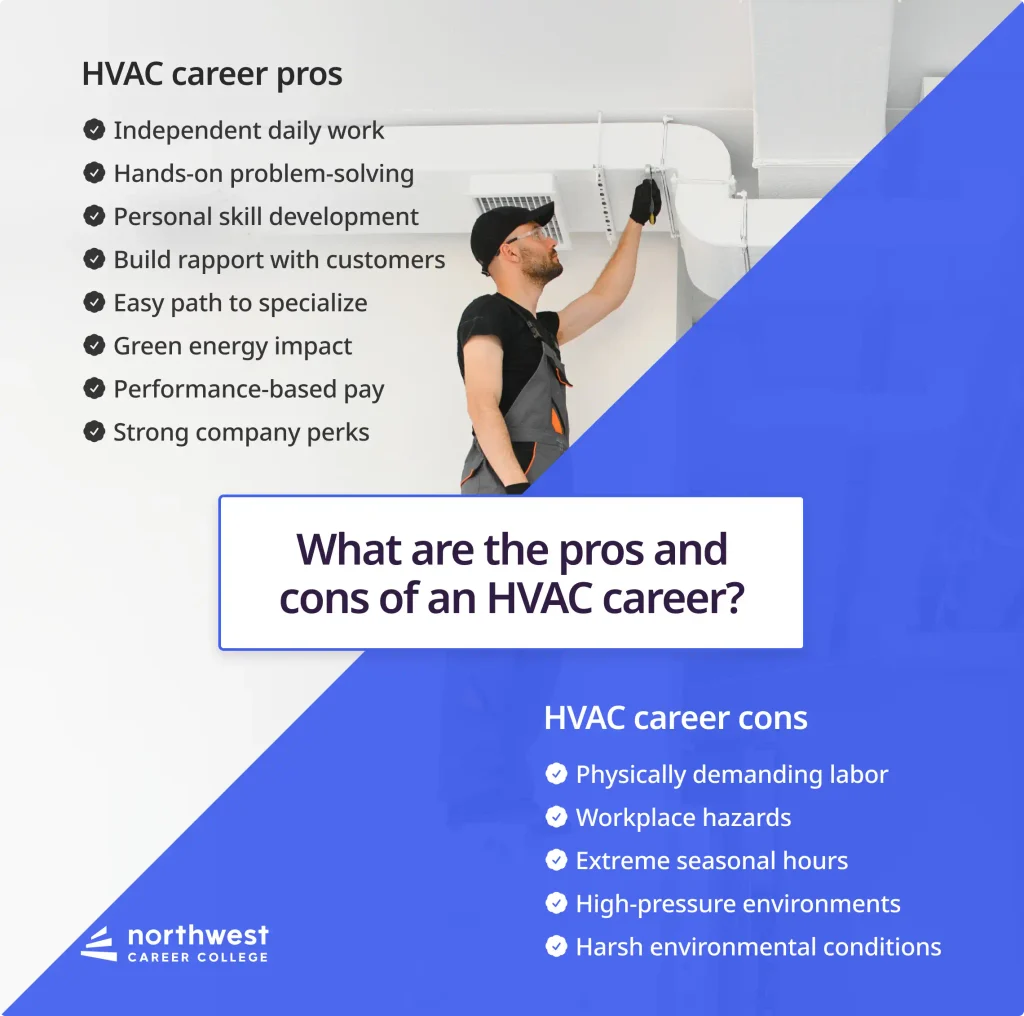
The pros of an HVAC career are as follows.
- Independent daily work: You drive a company van and run service calls alone, working without a boss watching over your shoulder.
- Hands-on problem-solving: Reading wiring diagrams and finding hidden electrical or mechanical faults turns each repair into a rewarding puzzle.
- Personal skill development: Learning electrical wiring, pipe fitting, and heating systems teaches you how to fix your own home equipment.
- Build rapport with customers: Customers are genuinely relieved and thankful when you restore their heat during freezes or air during summer.
- Easy path to specialize: You can transition into focused areas like computer server cooling, supermarket refrigeration, hospital airflow, or large chillers.
- Green energy impact: Proper refrigerant handling and installing modern electric heat pumps directly lowers electric bills and stops chemical leaks.
- Performance-based pay: Many companies offer sales commissions, overtime, and repair bonuses that reward you directly for working faster and harder.
- Strong company perks: Employers regularly provide a take-home work vehicle, paid gas, full health insurance, and good retirement plans.
The cons of an HVAC career are as follows.
- Physically demanding labor: Daily work involves heavy lifting, constant kneeling, awkward bending, and squeezing through cramped, dirty crawl spaces and attics.
- Workplace hazards: Frequent exposure to high-voltage electricity, pressurized chemical refrigerants, open brazing flames, and rotating equipment presents safety risks.
- Extreme seasonal hours: Summer heatwaves and winter freezes trigger long, exhausting workdays, mandatory overtime, and unpredictable 24/7 emergency on-call rotations.
- High-pressure environments: Technicians face intense stress to diagnose urgent system failures rapidly when critical facilities or distressed clients face emergencies.
- Harsh environmental conditions: Service calls require working on scorching commercial rooftops, unconditioned basements, freezing outdoor units, and poorly ventilated mechanical rooms.
Which industries hire HVAC technicians?
Industries that hire HVAC technicians include construction and specialty contracting, commercial real estate and facility management, food service, grocery, and cold storage, healthcare and critical infrastructure, and institutional and public sectors.
Here are the reasons why these industries hire HVAC technicians.
- Construction and specialty contracting: To install new ductwork, braze piping, charge systems, and conduct code-compliant startups.
- Commercial real estate and facility management: To manage central chillers, optimize building automation systems, and maintain tenant comfort.
- Food service, grocery, and cold storage: To service commercial walk-in freezers and protect expensive perishable food from spoiling.
- Healthcare and critical infrastructure: To regulate sterile airflow pressures, manage humidity, and prevent server data center overheating.
- Institutional and public sectors: To maintain multi-building campus central plants, maximize equipment longevity, and ensure indoor air quality.
Is HVAC a low-stress job?
No, HVAC isn’t a low-stress job; rather a demanding job considering the urgency, handling high-voltage wiring, unpredictable worktime etc. The workload stays heavy during summer, winter, and the rainy season; to support the clients, the technicians have to work long hours and weekends as well. But the profession offers job security, freedom from sedentary work, and chances to work independently in maintenance roles.
Is HVAC a high-risk job?
Yes, HVAC is a high-risk job as tasks involve high-voltage electricity, toxic gases, extreme attic heat, heights, and physical strain. To manage these everyday trade risks, HVAC technicians ensure safety by wearing mandated personal protective equipment, following strict OSHA and EPA certification procedures, and utilizing lockout protocols to prevent electrical accidents.
Is HVAC Technician a good choice?
Yes, HVAC is a good career choice because of its fast entry path, high job security, and strong earning potential. While the work demands heavy physical labor, job-related risk, and seasonal overtime, the career suits candidates who are active problem-solvers, independent workers, mechanical detectives, and aspiring entrepreneurs.
Will HVAC techs be replaced by AI?
No, HVAC technicians will not be replaced by AI because the job is highly dependent on manual labour. AI acts as a digital diagnostic tool to help predict equipment breakdowns. But solving or fixing an HVAC system to make it functional requires an HVAC professional’s dexterity.
Is HVAC hard to learn?
HVAC is not hard to learn, but it is moderately challenging. Entry-level concepts and maths are learnable. It blends electrical circuitry, refrigeration cycles, and airflow dynamics with physical labor. In your HVAC program, you learn basic math skills, perform hands-on training, and continue to practice; you will understand the essentials.
Do I need a license or certificate to work as an HVAC technician in Nevada?
You don’t need a state license to work as an HVAC technician in Nevada because technicians work under a licensed contractor. However, you must obtain a federal EPA Section 608 certification to handle refrigerants, earn an OSHA 10-Hour card within 15 days, and meet local municipality requirements.
Can I become an HVAC technician with no experience in Nevada?
Yes, you can become an HVAC technician with no experience in Nevada by earning a formal HVAC education (a trade school diploma) to learn technical systems in a lab and gain access to diverse career opportunities. Or, you can do on-the-job training (starting as an installation helper), where Nevada contractors train you directly on live job sites.
Can HVAC Technicians Work Anywhere in the US?
Yes, HVAC technicians can work anywhere in the US, but with conditions. Federal EPA Section 608 certification allows you to handle refrigerants nationwide, but many states (Texas, Washington, Kentucky, or Connecticut) and municipalities require additional state journeyman licenses, local trade registrations, or contractor sponsorship before you can legally work.
What tasks do HVAC technicians not legally perform?
HVAC technicians cannot connect main high-voltage service panels from the power grid (an electrician’s scope), install primary city water or sewer mains (a plumber’s scope), or alter load-bearing building framing without a structural engineer’s approval. In Nevada, unlicensed technicians cannot legally purchase or handle regulated refrigerants.
What disqualifies you from being an HVAC Technician?
Factors that disqualify you from being an HVAC Technician include having no high school diploma/GED, failing the EPA exam (legally stops you from handling refrigerants), a criminal background, and a bad driving record (from operating insured company vans).