Registered Medical Assistant (RMA): Duties, Benefits, Salary, Exam, and How to Become
- Medical Assistant
-
 Authored by
Denisse Adams
Authored by
Denisse Adams
-
 Reviewed by
Dr. Thomas Kenny
Reviewed by
Dr. Thomas Kenny
- Updated August 24, 2026
- 545 views
A registered medical assistant refers to a healthcare employee whose competence the American Medical Technologists (AMT) authorizes. They assist doctors, nurses, and physicians and maintain organizational balance by performing clinical and administrative duties, which include evaluating patient vital metrics, sanitizing and preparing treatment spaces, coordinating schedules, and maintaining electronic health databases.
A certified medical assistant enjoys quick entry into healthcare, nationally recognized certification, job versatility, higher pay, and employer credibility. A registered medical assistant makes about $24k to more than $56k per year in the US, and about $42K-$58K per year in Las Vegas, NV.
The RMA exam is a 210-question test, scoring uses a 0–100 scale, requiring a minimum of 70 to pass the examination. To become a registered medical assistant, complete your high-school degree or GED, meet any of the AMT authorized eligibility criteria, apply for the RMA exam, pass the test, and maintain your credential.

What is a registered medical assistant?
A Registered Medical Assistant (RMA) is an AMT-certified healthcare professional who assists physicians and nurses and performs both front-office and back-office work in healthcare facilities such as hospitals, doctors’ offices, outpatient clinics, medical research centers, diagnostic and imaging centers, and laboratories.
Registered MAs perform 2 main duties in a medical facility: clinical and administrative. Clinical responsibilities include direct communication with patients, such as collecting medical histories, measuring vital signs, preparing exam rooms, and assisting with diagnostic procedures. Administrative roles cover front office work, such as coordinating schedules, updating electronic health records, and processing insurance claims.
Registered medical assistants are different from certified medical assistants (CMAs). AMT issues RMA, allows flexible eligibility criteria for school graduates, military personnel, or employees with 5 years of working experience. AAMA issues CMA, and students must graduate from a CAAHEP or ABHES-accredited program.
RMA professionals join the workforce faster, get a handsome pay scale, because of the validation of government organizations and the country’s high demand for clinical staff. According to the U.S. Bureau of Labour Statistics, the US is projected to average approximately 112,300 annual job openings for medical assistants over the coming decade (2024 to 2034). This high number of jobs is required because of an aging population, healthcare services expansion, physician and nurse shortages, and employers’ reliance on MAs to efficiently perform duties, for which registered MAs are the perfect candidates.
What does a registered medical assistant do?
A registered medical assistant supports medical doctors, nurse practitioners, physician assistants, and specialized clinicians by performing both clinical and administrative duties, including managing clinical checks, documenting patient histories, executing laboratory protocols, handling medical processing, and coordinating specialist referrals at hospital networks, diagnostic and imaging centers, outpatient centers, public health clinics, laboratories, research centers, and urgent care facilities.
Registered medical assistants successfully coordinate workflows between patient care and administrative segments. Their clinical duties include the following ones.
- Measure blood pressure, pulse, temperature, oxygen levels, and weight during patient intake.
- Interview patients to document symptoms, medical history, medications, and allergies.
- Sterilize surgical instruments, restock diagnostic tools, and prepare examination rooms.
- Assist healthcare providers during minor surgeries, wound care, and diagnostic testing.
- Instruct patients on post-visit care, prescription instructions, etc.
Administrative responsibilities of a registered medical assistant are as follows.
- Manage provider calendars, urgent walk-in blocks, and patient follow-up appointments.
- Screen incoming calls, relay prescription refills, and route clinical questions.
- Assign accurate ICD-10 and CPT codes to outpatient files for billing.
- Monitor medical inventory, order office supplies, and track equipment maintenance.
- Process patient copays, issue invoices, and balance daily clinic financial logs.
What are the benefits of becoming a registered medical assistant?
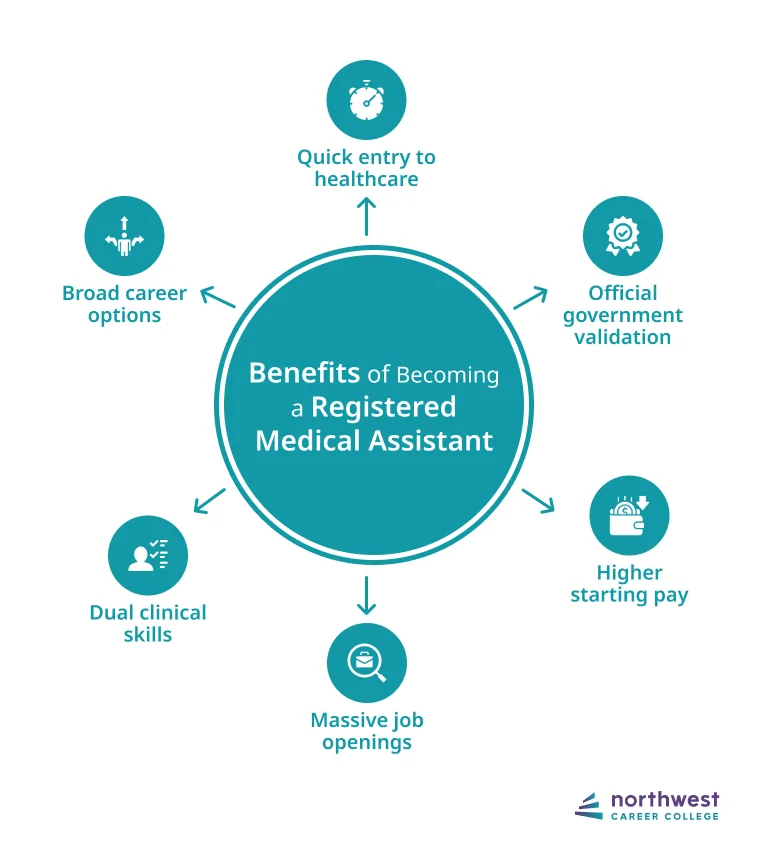
The benefits of becoming a registered medical assistant include faster entry into healthcare, government recognition, expertise, and better earning potential. The U.S. Bureau of Labor Statistics (BLS) projects that medical assistants will grow by 12% from 2024 to 2034.
The benefits and career advantages of becoming a registered medical assistant are as follows.
- Quick entry to healthcare: RMAs complete their courses in shorter periods, bypassing multi-year medical degrees, and enter the clinical workforce much faster.
- Official government validation: Registered medical assistant certificates align with federal and state guidelines, satisfying strict institutional compliance and clinical staffing audits.
- Higher starting pay: RMA earns better baseline payment than a non-certified medical assistant, securing a financial advantage.
- Stronger job opportunities: Medical assistant employment is projected to grow 12% from 2024 to 2034, and NHA reports that 84% of employers require or encourage certification for medical assistants.
- Dual clinical skills: These professionals master both front-office administrative tasks and back-office patient care procedures, making them versatile assets.
- Broad career options: Nationally registered RMAs gain instant employer credibility across hospitals, specialty groups, and urgent care clinics.
How much do registered medical assistants make?
Registered medical assistants make about $24k to more than $56k per year in the US, which is roughly $2000 to over $4000 per month, $460 to over $1000 per week, and $11 to more than $26 per hour, according to a ZipRecruiter 2026 report. A registered medical assistant in Las Vegas, NV makes $42K – $58K per year, which is equivalent to $3500 to over $4800 per month, over $800 to $1110 per week, and more than $20 to $27 per week, according to a Glassdoor 2026 data.
A candidate’s accredited program, clinical and administrative skills, clinical externship, bilingual skills, location, earning national certifications, and knowledge in specialized work impact the medical assistant pay range. An RMA earns more than a non-certified MA because certification signals their skill and builds credibility with potential employers about their clinical and administrative competence.
Medical Assistant salaries in Nevada vary by city, with higher-paying locations including Sparks, Reno, Boulder City, and Fernley. In the Las Vegas area, North Las Vegas and Henderson tend to pay more than Las Vegas itself.
How long does it take to become a registered medical assistant?
It takes 4 months to 2 years to become a registered medical assistant, depending on the program complying with AMT’s requirements of 720 hours (with 160 hours of externship) and a program or school accredited by an agency that the US Department of Education, CHEA, or AMT approves.
An accelerated program of intense 4 months generally covers the 720-hour timeline, offering only the basics needed to join the workforce. Certification or diploma programs require 9 to 12 months, allowing students to comfortably fulfil the hour requirements and learn core clinical and administrative knowledge. Associate degree programs (AAS/AS) are 18 to 24 months long and offer in-depth knowledge and a clinical foundation for students. Upon passing the RMA exam, you may need up to 4 weeks for the certification.
How to become a registered medical assistant?
To become a registered medical assistant, complete your high-school degree or GED, meet any of the AMT authorized eligibility criteria, apply for the RMA exam, pass the test, and maintain your credential.
The step-by-step guide to becoming a registered medical assistant is as follows.
Step 1: Complete your high school degree or GED
Earn your high school diploma, General Equivalency Degree (GED), or an equivalent certificate to meet the initial educational requirement for all certification tracks and postsecondary programs.
Step 2: Meet AMT’s eligibility criteria
Ensure your eligibility through AMT’s authorized 5 entry pathways, which are education, competency and work-based learning, work experience, military, and instructor.
- Education route
You must graduate within the past 4 years (or be scheduled to graduate) from a medical assisting program accredited by the US Department of Education, CHEA, or AMT. The curriculum must include at least 720 instructional hours and a 160-hour minimum clinical externship. You must submit an official final transcript.
- Competency and work-based learning route
Candidates who completed an AMT-approved hybrid or apprenticeship program within the last 4 years can apply through this route. Training must include a 160-hour minimum externship paired with either 720 total program hours or a 500-hour structured alternative course. Candidates must pass a structured competency evaluation and submit the following documents:
- Official completion documents from the hybrid, vocational, or Department of Labor program.
- A signed Medical Assisting Competency Checklist verifying clinical and office skills.
- The front and back of a valid CPR card from a course with an in-person, hands-on test.
- Work experience route
Candidates must have worked full-time as a medical assistant (at least 36 hours per week, totaling 5,616 hours) for 3 of the past 7 years, performing both clinical and administrative duties, and can apply through this route. They must submit the following documents:
- A copy of a high school diploma or GED equivalent.
- An official RMA Employment Verification Form signed by their employer confirming 3 years of work history.
- The front and back of a valid CPR card from a course with an in-person, hands-on test.
- Military route
Applicants must have graduated, or be scheduled to graduate, from a U.S. Military medical training program within the past 4 years. They must submit an official Joint Services Transcript (JST) and a copy of their DD Form 214 if discharged from active duty.
- Instructor route
Candidates must currently teach in a medical assisting program accredited by the US Department of Education, CHEA, or AMT, and have completed higher education coursework in a related healthcare discipline. They must have either 5+ years of full-time teaching experience or 1 to 4 years of teaching experience combined with 3 years of full-time clinical work within the past 7 years.
They need to submit documents depending on their work experience as follows.
- Candidates with 5+ years of teaching experience: College transcripts showing healthcare coursework and an RMA Employment Verification Form confirming 5 years of teaching.
- Candidates with less than 5 years of teaching experience: College transcripts showing healthcare coursework and an RMA Employment Verification Form confirming at least 1 year of current teaching alongside 3 years of clinical work within the past 7 years.
Step 3: Apply for the RMA exam
Submit your documentation, such as official transcripts, employment verification forms, or military documents, to the AMT portal alongside the processing fee to receive your Authorization to Test (ATT) letter.
Step 4: Pass the RMA certification exam
Schedule your exam at a Pearson VUE center or approved school site. You must score at least 70 to pass; preliminary results appear on your screen immediately upon completion.
Step 5: Maintain your professional credential
Keep your credential active through the AMT Certification Continuation Program (CCP) by earning 30 continuing education points every 3 years and paying a $75 annual renewal fee.
What is the difference between a certified medical assistant and a registered medical assistant?
The differences between a certified medical assistant and a registered medical assistant include their certifying body, examinations, eligibility requirements, passing standard, and professional maintenance steps.
A list of differences between a certified medical assistant and a registered medical assistant is as follows.
| Criteria | Certified Medical Assistant (CMA) | Registered Medical Assistant (RMA) |
| Eligibility | Must graduate from a CAAHEP or ABHES-accredited program | Graduate from an accredited program, or use military, workforce/apprenticeship, or instructor paths |
| Alternative pathways | Allows strict control over who can take their exam. | Allows eligibility via 3 years of full-time work experience, military training, or healthcare instructing. |
| Certifying body | American Association of Medical Assistants (AAMA) | American Medical Technologists (AMT) |
| Questions pattern | 200 multiple-choice questions (180 scored). Topics cover Clinical Competency, General Knowledge, and Administrative Skills. | 210 multiple-choice questions. Topics cover Anatomy & Physiology, Administrative MA, Clinical MA, and Clinical Patient Interaction. |
| Exam duration | 4 hours (divided into four 40-minute blocks) | 2 hours |
| Passing score | Minimum scaled score of 405 on the scale, ranging from 200 to 800. | Minimum score of 70 on a scale ranging from 0 to 100. |
| Certificate verification | Verifiable on the AAMA website. | Verifiable on the AMT website or via digital badges. |
| Certification renewal | Every 60 months (5 years) | Annual fee with CCP compliance review every 3 years |
What jobs can you get with a registered medical assistant certification?
The jobs you can get with a registered medical assistant certification include registered medical assistant, medical office assistant, phlebotomy technician, EKG technician, medical records specialist, patient services representative, medical office manager, nursing assistant, and home health aide. These occupations require nearly similar clinical and administrative skills, so having RMA certification helps you explore different career paths in both front office and back office jobs in the healthcare industry.
The highest-paying registered medical assistant role includes specialized or advanced clinical medical assistant positions, for example, internal medicine, surgical, or bilingual roles. The payment goes higher than $56,500 per year in the US, as per ZipRecruiter statistics.
What is the registered medical assistant exam?
The registered medical assistant (RMA) exam is a national exam that American Medical Technologists (AMT) holds to assess candidates’ clinical and administrative skills, knowledge, and competency to work as a RMA in diverse medical settings.
Becoming eligible for the RMA exam by AMT requires candidates to graduate from an accredited medical assisting program with at least 720 hours of instruction (including 160 internship hours) or meet alternative experience requirements.
Eligible candidates apply through the AMT and schedule the computerized exam. The RMA exam application fee is $150. Candidates who fail can sit for a maximum of 4 times in this exam. Each subsequent application requires a non-refundable retesting fee of $150. Moreover, a 45-day gap is mandatory between attempts.
The RMA exam format is a multiple-choice exam containing 210 questions, to be completed within 2 hours. Scores range from 0 to 100, and the minimum passing score is 70.
Successful candidates’ certificates remain valid for 3 years. They have to pay an annual fee of $75 to maintain an active status and earn 30 Certification Continuation Program (CCP) points every 3 years.
To prepare for the AMT’s RMA examination, study clinical and administrative topics and the official AMT content outline, use targeted study guides, stick to a regular study routine, complete timed mock tests, and learn from your mistakes.
What is the format of the registered medical assistant exam?
The format of the registered medical assistant exam is a multiple-choice, computerized format, which contains 210 questions, of which 180 are scored questions, and 30 are unscored questions. Students have to complete the exam within 2 hours, demonstrating both hands-on patient care skills and office-based support skills.
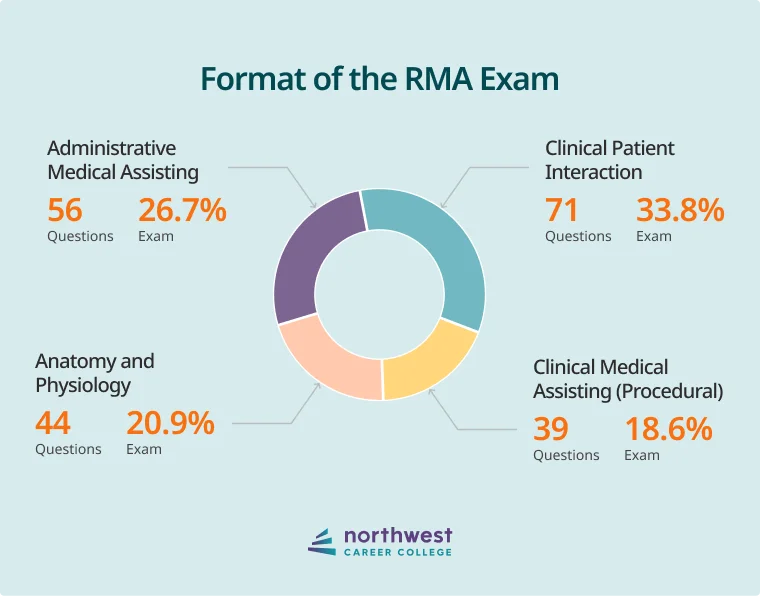
AMT organizes those 210 exam questions into 3 core knowledge domains (Clinical, General, and Administrative). Exam content for precise scoring covers 4 topics as follows.
- Clinical Patient Interaction takes 71 questions (33.8% of the total).
- Administrative Medical Assisting takes 56 questions (26.7% of the total).
- Anatomy and Physiology takes 44 questions (20.9% of the total).
- Clinical Medical Assisting (Procedural) 39 questions (18.6% of the total).
The registered medical assistant exam questions focus on the core duties of a medical assistant, so there will be questions on vital signs, medical terminology, patient preparation, documentation, infection control, communication, ethics, billing, and insurance.
How much does the RMA exam cost?
The RMA (AMT) exam application fee costs $150, which is non-refundable and includes the application, exam, and first annual fee. Candidates who fail the exam can take it a maximum of 4 times, with a 45-day interval between attempts. Retake exam fee costs $150 for each subsequent application.
How difficult is the registered medical assistant exam?
The difficulty of the registered medical assistant exam is moderate as it covers a broad range of clinical, administrative, and general medical topics and is designed to test real job-readiness. In 2025, American Medical Technologists (AMT) observed a pass rate of 71.2%. It is challenging but manageable for most students who have completed an accredited training program, studied diligently, reviewed the exam outline, and taken timed practice tests.
What are the requirements to pass the registered medical assistant exam?
The requirements to pass the registered medical assistant exam are familiarity with the exam structure and time limit, demonstrating entry-level competence, and achieving a minimum passing score of 70. The exam is based on the number of correct responses, and the AMT uses a standardized scoring method to ensure that different test versions are graded consistently.
Where can I take the registered medical assistant exam?
You can take the Registered Medical Assistant (RMA) exam through national organizations like American Medical Technologists (AMT) or American Allied Health (AAH). Candidates whose medical assisting program or instructor serves as an official testing site can take the test at their school or campus. Professional in-person testing can take the exam at a physical Pearson VUE or PSI center, which provides a secure, proctored environment. Examinees can also sit for the exam from anywhere online, and a remote proctoring option is provided by your certification agency.
How to prepare for the registered medical assistant exam?
To prepare for the registered medical assistant exam, learn about the RMA exam details, use study guides, and practice theoretical questions. Maintain a consistent study schedule and take mock exams. Being consistent and familiar with exam content will help you prepare better for the RMA exam.
The study techniques and exam tactics to prepare for the RMA exam are as follows.
- Learn RMA exam format and topics
Prioritize clinical patient interaction, administrative systems, anatomy, and clinical competency during exam preparation. Use official AMT resources to understand the exam structure and content percentages.
- Revise study guides and practice assessments
Review dedicated RMA review manuals, digital study tools, and practice quizzes to build muscle memory on your core healthcare knowledge. Use timed practice tests to find and review weak areas before your test date.
- Stick to a structured study routine
Set up a regular weekly study schedule that evenly divides your time between administrative tasks and patient-facing clinical topics. Monitor your milestones by checking your quiz scores and logging your completed study blocks.
- Complete simulation tests and learn from your errors
Participate in comprehensive practice exams under actual testing limitations to refine your pacing, build your testing endurance, and elevate your confidence by repeatedly solving actual AMT-style multiple-choice questions. Evaluate the questions you missed to gain a deeper conceptual grasp of complex medical topics, actively expanding your administrative and clinical skill sets by correcting mistakes and reviewing the rationale behind the right answers.
- Apply strategic testing methods on test day
Analyze the phrasing of each question and all potential answers carefully before locking in your choice. Combine your clinical knowledge with common sense about office procedures to handle tough questions.