Certified Medical Assistant (CMA): Duties, Benefits, Salary, Exam, and How to Become
- Medical Assistant
-
 Authored by
Denisse Adams
Authored by
Denisse Adams
-
 Reviewed by
Dr. Thomas Kenny
Reviewed by
Dr. Thomas Kenny
- Updated August 24, 2026
- 569 views
A certified medical assistant (CMA) refers to the trained healthcare professionals who support physicians, nurses, and other staff by handling both clinical and administrative work in clinics, physician offices, hospitals, and other outpatient settings. The clinical responsibilities of a CMA include taking vital signs, recording medical histories, preparing exam rooms, assisting with examinations and minor procedures, while the administrative responsibilities include scheduling appointments, greeting patients, and helping with billing and coding.
According to the U.S. Bureau of Labor Statistics, the median annual salary was $44,200 in May 2024. Medical Assistants’ salaries rise with certification, experience, specialization, and location. The benefits of becoming a CMA include faster entry into healthcare, stronger job opportunities, better earning potential, and career mobility.
To become a certified medical assistant, get your high school diploma or GED, complete an accredited medical assisting program with an externship, and pass the CMA exam administered by the AAMA. The exam assesses candidates’ clinical, administrative, and general knowledge competencies essential for medical assistants in healthcare settings.

What is a certified medical assistant?
A Certified Medical Assistant (CMA) is a trained healthcare professional who has completed medical assisting education, earned a CMA credential from the AAMA, and supports physicians in outpatient settings by handling assigned tasks in a healthcare facility. CMAs perform both clinical and administrative tasks; clinical responsibilities are directly related to patient care, such as taking vital signs, recording medical histories, preparing exam rooms, and administrative duties include scheduling appointments, greeting patients, updating medical records, verifying insurance, billing, coding, etc., to keep the regular workflow organized.
According to the AAMA’s official website, there are currently 68,495 active CMAs, with more scheduled to take the exam, and a 69% first-time pass rate. This indicates steady professional demand and growth because of CMAs’ importance in multitasking on both clinical and administrative sides, balancing front and back office functions, forming liaisons among patients, family members, insurance companies, providers, and specialists, and maintaining day-to-day organizational operations.
It takes 2 months to 2 years to become a certified medical assistant, depending on the program path: accelerated programs and diplomas are the fastest and focus on essential clinical and office skills, while an associate degree takes longer and includes general education courses that provide a broader foundation and greater long-term flexibility
What does a certified medical assistant do?
A certified medical assistant supports physicians, nurses, and other healthcare professionals by performing both clinical and administrative duties, including patient intake, vital signs, scheduling, record support, and billing in clinics, physician offices, hospitals, and other outpatient workplaces.
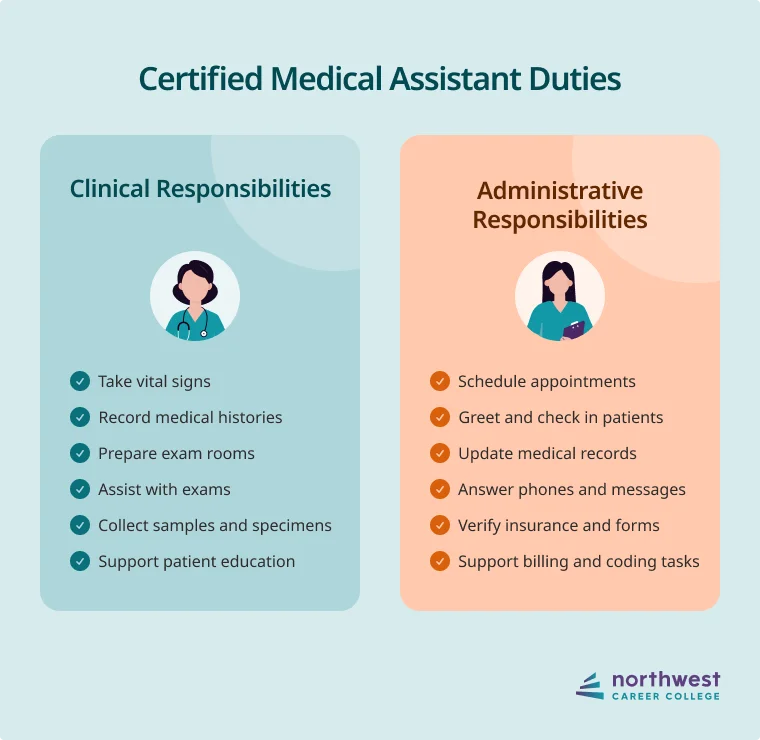
Certified medical assistants perform the following clinical (patient-facing) responsibilities.
- Take vital signs: Measure blood pressure, pulse, temperature, respiration, and weight.
- Record medical histories: Collect information about symptoms, medications, allergies, and prior conditions.
- Prepare exam rooms: Clean, stock, and organize rooms and equipment before patient visits.
- Assist with exams and minor procedures: Help physicians and nurses during checks, tests, and simple procedures.
- Collect samples and basic specimens: Draw blood, collect urine, or gather other samples when allowed by workplace policy and training.
- Support patient education: Explain simple aftercare instructions, appointment preparation, or routine follow-up steps.
Certified medical assistants perform the following administrative (office) responsibilities.
- Schedule and confirm appointments: Manage calendars, patient visits, and follow-up bookings.
- Greet and check in patients: Welcome patients, collect forms, and guide them through intake.
- Update medical records: Enter demographic details, visit notes, and other patient information accurately.
- Answer phones and route messages: Handle calls, relay information, and direct concerns to the proper staff member.
- Verify insurance and handle forms: Review coverage, process referral paperwork, and assist with documentation.
- Support billing and coding tasks: Prepare basic billing information, organize claims, and assist with office paperwork.
What are the benefits of becoming a certified medical assistant?
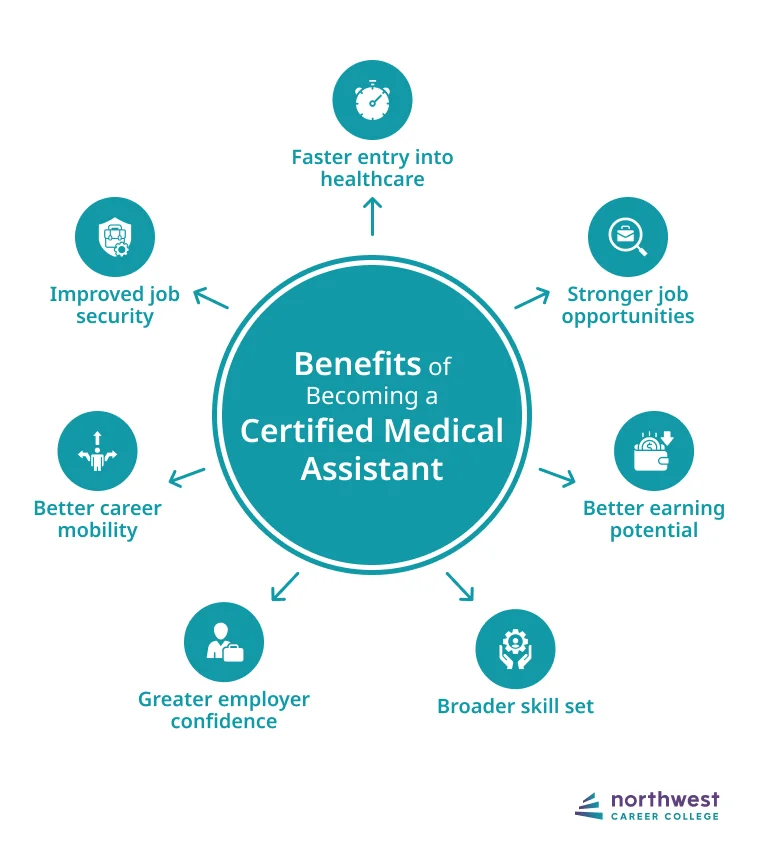
The benefits of becoming a certified medical assistant include faster entry into healthcare, stronger job opportunities, and better earning potential. The U.S. Bureau of Labor Statistics (BLS) projects that medical assistants will grow by 12% from 2024 to 2034. The median annual wage is $44,200, which makes the career path relatively quick and practical.
The benefits and career advantages of becoming a certified medical assistant, as supported by national workforce and certification data, are as follows.
- Faster entry into healthcare: Medical assistants need only short postsecondary training, so certification can help you start working sooner than in many other healthcare roles.
- Stronger job opportunities: According to the BLS, the medical assistant field is expected to add more than 100K openings over the next decade, and employers mostly prefer candidates with medical assistant certification.
- Better earning potential: Certified medical assistants earn more than their non-certified peers, and AAMA’s reported pay data shows that certification is associated with higher wages.
- Broader skill set: Certification validates both clinical and administrative skills, which makes you more versatile in the workplace.
- Greater employer confidence: A recognized credential signals that you have met professional standards and are prepared for handling patient responsibilities.
- Better career mobility: Certified medical assistants qualify for more job settings, including clinics, physician offices, hospitals, and specialty practices.
- Improved job security: Healthcare employers value trained staff who can handle multiple tasks, which makes certified assistants more resilient in changing job markets.
How much do certified medical assistants make?
Certified medical assistants in the USA earn about $29,000 to $67,000 per year on average, which is roughly $2,300 to $6,400 per month, $700 to $1,500 per week, and $15 to $30 per hour. Medical assistants in Las Vegas make about $21,000 and $52,000 a year, or between $1,500 and $4,500 a month, and $10 to $25 an hour. In Nevada, the top-paying cities include Cold Springs, Incline Village, Fernley, Reno, Minden, Gardnerville, Boulder City, and Pahrump, with Reno and Boulder City standing out among larger local markets. Las Vegas metro, North Las Vegas, and Henderson pay more, making them stronger local options for higher CMA earnings.
Certified medical assistant pay is influenced by certification, education, experience, specialization, employer type, location, bilingual ability, and shift differentials. A CMA earns more than a non-certified MA because certification signals verified training and broader clinical and administrative competence, which employers often reward with higher wages.
How long does it take to become a certified medical assistant?
It takes about 2 months to 2 years to become a certified medical assistant, depending on the program path you choose. An accelerated program takes 2 to 4 months, a diploma program takes 9 to 12 months, and an associate degree takes 18 to 24 months. Shorter programs focus on essential clinical and administrative skills for faster job entry, while diploma and associate degree programs include those same skills, plus general education courses, for a broader foundation and greater long-term flexibility.
A diploma program (9 to 12 months) is designed for students who want to enter the workforce quickly with focused training. This timeline includes core clinical and administrative topics such as vital signs, preparing patients for exams, recording medical histories, scheduling appointments, handling billing, and learning basic office procedures. An accelerated program is even shorter, typically 2 to 4 months, and covers the same essential skills in a more intensive format, making it a good option for students who can handle a faster pace and a heavier weekly study load.
An associate degree program usually takes about 18 to 24 months, and it includes medical assistant training along with general education courses such as communication, math, and anatomy or biology. This longer path is a better choice for students who want a broader education, more time to build confidence, and future flexibility to continue in the healthcare field. Shorter programs are best for faster job entry, while diploma and associate degrees offer a deeper academic foundation and open more long-term options.
How to become a certified medical assistant?
To become a certified medical assistant, earn a high school diploma or GED, complete an accredited medical assistant program with any required externship or clinical training, and pass the CMA exam. The AAMA requires certified medical assistants to maintain certification through continuing education. Once certified, you qualify for jobs such as certified medical assistant, medical office assistant, phlebotomy technician, and EKG technician. These roles support both patient care and office operations across the healthcare industry.
According to AAMA, the step-by-step path to becoming a certified medical assistant includes the following: education, training, and certification exam.
- Earn a high school diploma or GED: Meet the basic entry requirement for most accredited medical assistant programs and certification pathways.
- Complete an accredited medical assistant program: Choose an accelerated program, diploma, or associate degree program that includes both clinical and administrative training, including externships.
- Complete a clinical externship: Gain supervised, real-world experience in a healthcare environment that connects classroom learning to patient care.
- Apply for the CMA exam: Meet the AAMA eligibility requirements, including graduation from an accredited program.
- Pass the CMA certification exam: Demonstrate your knowledge and skills in medical assisting and confirm you are ready for professional practice.
- Continue your education and maintain certification: Stay current in healthcare and keep your CMA credential active through ongoing education.
The process is similar for students who want to become medical assistants in Las Vegas, but prominent local schools often add externship opportunities and career support to help with job placement.
What jobs can you get with a certified medical assistant certification?
The jobs you can get with a certified medical assistant certification include certified medical assistant, medical office assistant, phlebotomy technician, EKG technician, medical records specialist, patient services representative, medical office manager, nursing assistant, and home health aide. Many of these medical assistant jobs use the same clinical and administrative skills, so the certification will help you move into both direct patient care and office support jobs.
The highest-paying certified medical assistant role is a specialized or advanced clinical medical assistant position, such as internal medicine, surgical, or bilingual roles, which pay more than general MA roles. In Las Vegas, the highest paying certified medical assistant role can reach over $46,800 per year, while some specialized MA jobs nationwide can go much higher.
You can work as a medical assistant without being certified in most states, including Nevada, because certification is not always legally required. However, employers often prefer certified candidates because certification demonstrates verified competency, so not being certified will limit job opportunities and earning potential.
What is the certified medical assistant exam?
The certified medical assistant (CMA) exam is a national test administered by the American Association of Medical Assistants (AAMA) to measure whether a candidate has the knowledge and skills needed to work as a competent medical assistant. It is designed to verify both clinical and administrative competence, so passing it shows that the candidate is prepared for the healthcare industry.
A candidate must first meet AAMA eligibility requirements to sit for the exam, which include graduating from an accredited medical assisting program and, in many cases, completing required supervised practical training or externship hours. Once eligible, the candidate applies through the AAMA and schedules the computerized exam, which is offered in a timed testing format.
The CMA exam includes 200 multiple-choice questions: 180 scored and 20 unscored pretest questions. It is completed in four timed sections over a 4-hour appointment. A score of 405 is required to pass, and the credential stays valid for 60 months before recertification is needed.
The exam topics focus on the core duties of a medical assistant, so candidates should expect questions on vital signs, medical terminology, patient preparation, documentation, infection control, communication, ethics, billing, and insurance.
The CMA exam costs $125 for AAMA members and qualifying recent graduates, while nonmembers and other eligible categories pay $250. The exam is taken in a multiple-choice, computerized format, and the best way to prepare is to review the AAMA exam outline, study clinical and administrative topics, and practice with sample questions and timed practice tests.
What is the format of the certified medical assistant exam?
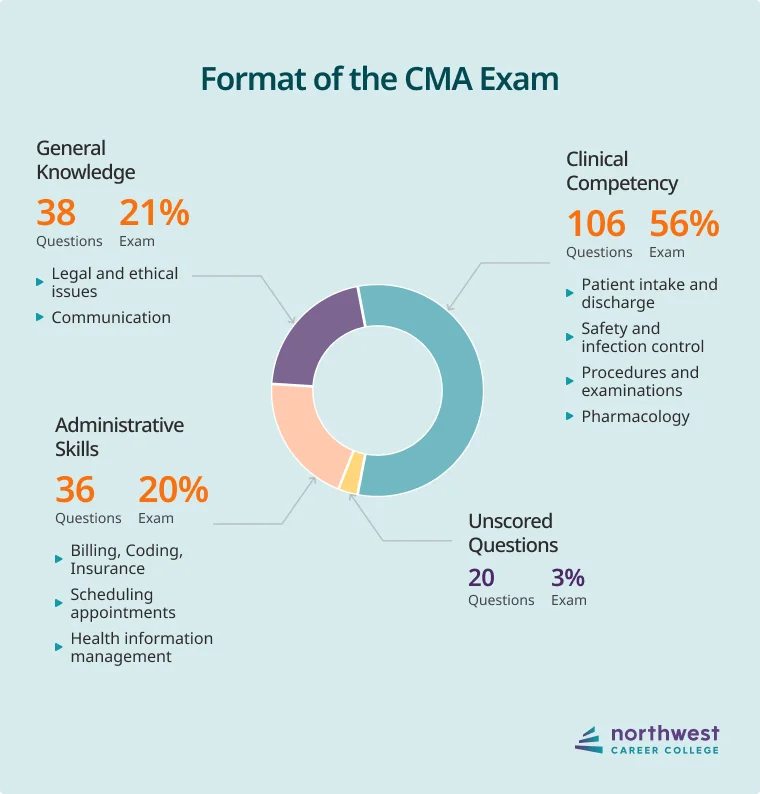
The format of the certified medical assistant exam is a multiple-choice, computerized format, and it contains 200 questions: 180 scored questions and 20 unscored pretest questions. The exam covers three main content areas: clinical competency (106 questions, 56% of the exam), general knowledge (38 questions, 21% of the exam), and administrative skills (36 questions, 20% of the exam).
The exam question pattern consists of 200 multiple-choice questions: 180 scored and 20 unscored pretest questions. The exam has a 4-hour time limit and is delivered as a computerized test divided into four 40-minute segments, with optional breaks available between sections. This setup gives test takers enough time to carefully work through the questions while still keeping the exam standardized and timed. The clinical section is the largest portion of the exam. The minimum passing score is 405. The certification remains valid for 60 months, after which it must be recertified.
The exam structure is designed to measure both hands-on patient care skills and office-based support skills. Clinical competency is the largest section, covering patient intake and discharge, safety and infection control, procedures and examinations, and pharmacology. The general section includes legal and ethical issues plus communication, and the administrative section covers billing, coding, insurance, scheduling appointments, and health information management.
How much does the CMA exam cost?
The CMA (AAMA) exam costs $125 for American Association of Medical Assistants members and recent graduates of accredited programs, while non-members pay $250. Candidates can take the exam up to 6 times within a 12-month period starting from their first attempt, and each retake requires a new application and fee. This structure gives candidates several chances to pass while still encouraging them to prepare carefully before each attempt.
What are the benefits of taking the certified medical assistant exam?
The benefits of taking the Certified Medical Assistant (CMA) exam include stronger job prospects, higher earning potential, and a nationally recognized credential from the American Association of Medical Assistants (AAMA). Medical assistants with certification have greater job prospects, since certification shows verified clinical and administrative competence and opens the door to more roles in the healthcare industry.
How difficult is the certified medical assistant exam?
The difficulty of the certified medical assistant exam is moderate because it covers a broad range of clinical, administrative, and general medical topics and is designed to test real job-readiness. According to the AAMA, the CMA exam has a solid pass rate when candidates prepare well, and it also emphasizes that students who complete an accredited training program and practice with sample questions are much more likely to pass on the first attempt. It can be challenging but very manageable for most test takers with steady study, review of the exam outline, and timed practice tests.
What are the requirements to pass the certified medical assistant exam?
The requirements to pass the certified medical assistant exam are to meet the minimum passing score of 405 on a scaled range of 200 to 800. The exam is based on the number of correct responses, and the American Association of Medical Assistants (AAMA) uses a standardized scoring method to ensure that different test versions are graded consistently. The minimum passing standard can be reviewed periodically, so candidates should prepare using AAMA’s exam outline and official study materials.
Where can I take the Certified Medical Assistant exam?
You can take the Certified Medical Assistant (CMA (AAMA)) exam at a PSI test center or through live remote proctoring, depending on your computer setup and the testing option you choose when you apply. The AAMA states that candidates who cannot meet the remote proctoring technical requirements must test at a physical PSI location, and PSI now offers a nationwide network of testing sites for the exam.
How to prepare for the certified medical assistant exam?
To prepare for the certified medical assistant exam, follow the step-by-step instructions.
- Learn what is on the CMA exam
- Focus on clinical competency, general knowledge, and administrative skills during exam preparation.
- Use official AAMA resources to understand the exam structure and content areas.
- Use study guides and practice questions
- Prepare with CMA study guides, online resources, and practice exams to strengthen subject knowledge.
- Use timed practice modules to identify weak areas before exam day.
- Follow a consistent study schedule
- Follow a structured schedule to balance clinical and administrative review topics.
- Track study progress through practice scores and completed review sessions.
- Take full, timed practice exams
- Take mock exams under real testing conditions to improve pacing and confidence.
- Improve test readiness by repeatedly practicing CMA-style questions.
- Analyze and correct your mistakes
- Analyze incorrect answers to improve understanding of difficult concepts.
- Increase clinical and administrative knowledge through repeated review and correction.
- Use smart test-taking strategies on exam day
- Read every question carefully before selecting an answer.
- Balance memorization with practical understanding of medical assistant duties and procedures.