

What The Mammography Training At NCC Offers You

You already hold ARRT certification in Radiography. NCC’s Mammography training is the next step — a focused 12-week training that delivers the structured education and supervised clinical experience ARRT requires for post-primary certification in Mammography, without asking you to leave the job you already have.

The didactic half runs 6 weeks: one in-person evening class per week on campus, paired with online coursework you complete through Canvas on your own schedule. That is 25 in-person hours and 32 online hours, built on ASRT Breast Essentials modules and Mammographic Imaging: A Practical Guide. Every week includes laboratory learning on mammography equipment under the direct supervision of a qualified mammography technologist, so you practice positioning on a live simulation model before you ever image a patient.

Weeks 7 through 12 place you in a working breast imaging center — Desert Radiology and Pueblo Medical Imaging — for 150 supervised clinical hours, where you build the documented procedure log required by ARRT for certification. NCC’s course is registered with ARRT as RAD290 and carries 36 Category A CE credits—more than double the 16 hours of structured education required by ARRT. As an NCC graduate, you also receive lifetime access to our Career Services team.

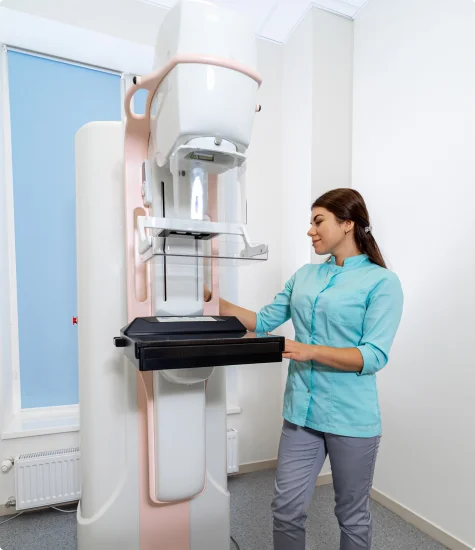
A healthcare professional adjusts a mammography machine in a bright, modern medical room.
median annual salary icon
$82,910
Median Annual Salary in Nevada *1
Icon representing job placement rate statistic at Northwest Career College
23%
Projected Job Growth in Nevada (2022 - 2032) *2

Sources

  • *1 Find the Median Annual Salary Report for Mammographer at O*Net Online.
  • *2 Find the Annual Job Growth Report for Mammographer at O*Net Online.

Mammography ARRT Approval

NCC’s Mammography course is registered with the American Registry of Radiologic Technologists as course RAD290, worth 3 quarter credit hours and 36 ARRT Category A continuing education credits. The current approval is effective August 1, 2023 through July 31, 2028.

Why Choose The Mammography Course At Northwest
Career College?

NCC’s Mammography course helps registered radiographers specialize, earn 36 ARRT Category A CE credits, and boost earnings through flexible hybrid classes and a 6-week clinical externship. We deliver the hands-on training, board prep, and ARRT (M) credentialing Nevada employers demand, without interrupting your current job.
Logo of the American Registry of Radiologic Technologists (ARRT) featuring a stylized design and emblem.

Earn 36 ARRT Category A CE Credits

Course RAD290 carries 36 ARRT Category A CE credits — 3 quarter credit hours — comfortably above the 16 hours of structured education ARRT requires for post-primary certification, with coverage in all three required content categories.

Icon representing the 12-week Mammography program

Finish The Coursework In 12 Weeks

Six weeks of didactic instruction followed by six weeks of supervised clinical training. You complete your structured education and clinical documentation in a single quarter instead of stretching CE modules across two years.

Icon representing hybrid online and evening campus classes

Evening Classes Built Around Your Shift

One in-person class per week, Wednesday, 5:00 pm to 10:00 pm, with the remaining coursework delivered online through Canvas. Keep working days while you earn the credential.

Icon representing 192 supervised clinical externship hours

Supervised Clinical Training At A Working Breast Imaging Center

Your 192 clinical hours are completed at an approved mammography site, where a certified supervising mammographer or MQSA-qualified interpreting physician verifies each procedure you log toward ARRT’s clinical experience requirement.

Icon representing ARRT certification exam preparation

ARRT (M) Certification Exam Preparation

The curriculum maps to ARRT’s Mammography content specifications across all three categories — Patient Care, Image Production, and Procedures — so the material you study is the material the examination covers. Also, the program provides the framework to fulfill your 16 structured education hours and log your 75 clinical exams.

Icon representing hands-on mammography equipment training

Hands-On Positioning Lab Before You See Patients

Every week includes laboratory learning on mammography equipment with a live simulation model under the direct supervision of a qualified mammography technologist. You practice craniocaudal and mediolateral oblique projections, compression technique, and problem-solving positioning before your clinical rotation begins.

3 Steps To Becoming A Mammographer
STEP - 1
1Confirm Your Eligibility
Hold an active ARRT Radiography ARRT(R) license in good ethical standing. Radiography is the mandatory prerequisite discipline for Mammography.
STEP - 2
2Complete Coursework & Clinicals
Finish NCC’s 12-week course to earn 36 Category A CE credits and log 150 supervised clinical hours documenting required procedures.
STEP - 3
3Apply & Take the ARRT (M) Exam
Submit your completed clinical logs through your ARRT online account within 24 months, then schedule and pass your board exam.

What You Will Learn As A Mammography Student At NCC

NCC’s Mammography course combines foundational breast imaging theory, radiation physics, and positioning mechanics with hands-on lab training, preparing you to master 2D and 3D tomosynthesis equipment, meet MQSA standards, and excel in the breast healthcare field.

Week 1: Foundations of Mammography

Start with how mammography evolved and the FDA, ACR, and ARRT standards that govern the profession. Learn the imaging system's components, then practice basic equipment operation in the lab.

  • Basic mammography positioning
  • Compression techniques
  • Equipment safety and quality assurance
  • Image quality fundamentals
  • Mammography equipment operation
  • Understanding MQSA, FDA, ACR, and ARRT standards

Week 2: Patient Care & Communication

Learn to educate patients, collect accurate histories, and recognize breast cancer risk factors while providing compassionate care. Begin practicing standard positioning under supervision.

  • Breast cancer risk assessment
  • Medical history collection
  • Patient communication
  • Patient education
  • Professional bedside manner
  • Standard mammographic positioning

Week 3: Breast Anatomy, Physiology & Pathology

Build a working knowledge of breast anatomy and physiology, and see how development, hormones, and pathology change what appears on a mammogram. Positioning practice continues in the lab.

  • Breast anatomy identification
  • Clinical observation skills
  • Image interpretation fundamentals
  • Mammographic positioning
  • Recognition of normal and abnormal anatomy

Week 4: Positioning for Challenging Patient Presentations

Adapt your technique for patients with anatomical differences, mobility limits, or other challenges. Case studies and lab practice build confidence in producing diagnostic images while keeping patients comfortable.

  • Adapting to challenging anatomy
  • Image quality improvement
  • Patient comfort techniques
  • Positioning modifications
  • Problem-solving in clinical imaging

Week 5: Advanced Imaging & Image Evaluation

Study how findings are evaluated and how added imaging supports diagnosis: post-surgical imaging, breast ultrasound, and quality assessment. You continue refining positioning throughout.

  • Breast ultrasound fundamentals
  • Diagnostic problem solving
  • Digital mammogram evaluation
  • Image quality assessment
  • Post-surgical imaging

Week 6: Advanced Diagnostic Procedures

Close classroom instruction with digital breast tomosynthesis, breast MRI, wire localization, specimen imaging, and treatment planning before moving into supervised clinical education.

  • Digital Breast Tomosynthesis (DBT) acquisition, arc angles, and synthesis
  • DBT clinical advantages, slice thickness, and overlapping tissue reduction
  • Stereotactic vacuum-assisted core needle biopsy mechanics and steps
  • Fine needle aspiration cytology (FNAC) and specimen radiography
  • Breast MRI indications, contrast protocols, and limitations
  • Preoperative wire and seed localization procedural workflows
  • Overview of surgical excision, chemotherapy, and radiation therapy options

Weeks 7–12: Clinical Experience

Put classroom knowledge to work across 150 supervised clinical hours at approved mammography sites, positioning patients and operating equipment alongside experienced technologists.

  • Clinical documentation and recordkeeping
  • Clinical patient care and compassionate patient interactions
  • Confidence in performing mammography procedures in a clinical setting
  • Critical thinking and problem-solving in clinical practice
  • Image evaluation and quality assessment
  • Mammographic positioning for screening and diagnostic examinations
  • Professional communication with patients and healthcare team members
  • Quality control testing and documentation
  • Workflow efficiency and time management
Mammography student practicing patient positioning on a digital mammography unit in the lab

Mammography Career Opportunities In Nevada

Mammographers work in hospital breast imaging departments, dedicated breast centers, outpatient imaging centers, and mobile screening units. Adding the ARRT (M) credential to your Radiography certification qualifies you for roles a general radiographer cannot fill, and gives you a specialty with steady, screening-driven patient volume.
CAREER OPPORTUNITIES FOR MAMMOGRAPHERS
Mammographer
Mammography Technologist
Breast Imaging Technologist
Diagnostic Mammography Technologist
Screening Mammography Technologist
Lead Mammography Technologist
Breast Center Technologist
Mobile Mammography Technologist
Mammography Quality Control Technologist
Stereotactic Biopsy Technologist
Breast Imaging Navigator
Mammography Clinical Instructor

Tuition Information

Cost per Term 1 $3,295.00

More Information about the Profession

  • For information about flexible payment plans at Northwest Career College, please visit our Admission page.

Mammography Course Requirements

The primary requirements for admission to the Mammography course are as follows.

Icon showing active ARRT Radiography certification requirement

Current ARRT Certification in Radiography

Hold an active ARRT(R) credential in Radiography, maintain good ethical standing, and fulfill all primary registry requirements.

Icon representing the Nevada Radiologic Technologist Licensure requirement

Nevada Radiologic Technologist Licensure

Possess a valid Nevada state license authorizing you to practice general radiologic technology across healthcare facilities.

Icon for background check and medical clearance requirements

Clinical Site Clearance

Complete mandatory background checks, drug screenings, and immunization records to meet healthcare facility safety standards before starting clinicals.

Find The Best Mammography Training For You In Clark County

Mammography Course FAQs

How Much Do Mammography Technicians Make?

Mammography technicians make between $40,000 and more than $120,000 per year in the US and $35,000 to $155,000 per year in Nevada. Being a specialized category, mammographers earn more across the states because of expertise, experience, and location. The main reason for the higher payment structure of mammographers in Nevada than the national average is because of severe healthcare provider shortage.
NCC's lab is equipped with a Hologic mammography unit. You'll learn its components, control panel, and operating procedures, then practice positioning on a live simulation model under the direct supervision of a qualified mammography technologist before your clinical rotation begins.
Yes. Both Breast Ultrasound And Breast MRI are covered in the classroom, and you'll encounter them at your clinical site. That exposure matters beyond general knowledge: breast ultrasound and breast MRI both appear on ARRT's list of elective procedures, and you must observe, assist with, or participate in five electives to meet the clinical experience requirement.
No, applicants for this Mammography course don't need to have graduated from the Radiography Program at Northwest Career College, but applicants must be ARRT-certified in Nevada to qualify.
ARRT requires four types of documents for the mammography certification as follows.

Current certification and registration in Radiography

At least 16 hours of structured education earned within the 24 months before you apply

Documented clinical experience including 75 mammograms performed independently on patients, a defined battery of quality control tests, a 10-case image review with an MQSA-qualified interpreting physician, and five elective procedures

A passing score (a scaled score of 75 out of 99) on the ARRT Mammography examination.
Yes. Tomosynthesis is standard practice in breast imaging today, so the curriculum covers DBT principles, image acquisition, reconstruction, and clinical application in full. NCC's on-campus unit is a 2D system — you'll work hands-on with 3D tomosynthesis equipment during your clinical rotation.
On campus, you'll use the full set of compression paddles applied to patients, a magnification stand, and a quality-control phantom. Stereotactic biopsy units, needle localization equipment, and specimen imaging come during clinical rotation — those procedures can only be learned in a live clinical environment.
Yes, an out-of-state technologist can enroll in NCC's Mammography course, but they must get a Nevada state license before they start clinical practice.