How Long Does It Take to Become a Medical Assistant
- Medical Assistant
-
 Authored by
Denisse Adams
Authored by
Denisse Adams
-
 Reviewed by
- Updated August 21, 2026
- 1.7k views
It takes 8 weeks to 2 years to become a medical assistant, depending on the program type; accelerated programs take 8 weeks to 6 months, certifications or diplomas programs require 9 to 12 months, and associate degree programs (AAS/AS) are 18 to 24 months long. Completing a medical assistant course from a community college takes 6 to 24 months, and a trade school takes 9 to 12 months.
To become a medical assistant, you must complete a high school diploma/GED, an accredited training program, gain 160 to 200 hours of practical knowledge under the supervision of experts, and pass national exams such as CCMA-Certified Clinical Medical Assistant, CMA-Certified Medical Assistant, RMA-Registered Medical Assistant, or NCMA-National Certified Medical Assistant. After passing the exam, students will receive their digital or printed results within a 4-week window.
Becoming a medical assistant is achievable by enrolling in an accredited program, receiving hands-on training, and committing to your studies. Graduating from an accredited medical assistant program opens up employment opportunities, even before you complete your certification exam.

How long is medical assistant school?
A medical assistant school is 8 weeks to 24 months long. An accelerated program takes 8 weeks to 6 months, teaching students only the basics. A certification or diploma program requires 9 to 12 months, allowing learners to gain necessary knowledge, skills, and direct training from professionals. An associate degree program (AAS/AS) is 18 to 24 months long, which gives long-term career flexibility.
Here are the key factors that influence the duration of a medical assistant school.
- Credential type: Certificates and degree programs are completed within 1 year. Associate degrees take more than 1 year.
- Enrollment status: Full-time students complete their program within a year, whereas part-time students require 18 to 24 months or more.
- Program format: The online format takes 6 to 8 months, as this provides theoretical knowledge. Hybrid programs take 9 to 12 months for both theoretical and hands-on practice. In-person programs have a fixed schedule, which will require 9 to 15 months to complete.
- Externship requirements: Many programs require candidates to fulfil an externship, which is 160 hours to 200 hours of hands-on clinical work, adding 4 to 8 weeks to the program length.
- Certification preparation: Students are to sit for certification exams such as CMA, RMA, CCMA, and NCMA within 1 to 3 months.
| Program Type | Course Duration | Average Cost | School Type |
| Accelerated Programs | 8 weeks to 6 months | $600 to $10,000 | Online / Private Institutes |
| Certificate/Diploma Programs | 9-12 months | $3,000 – $15,000 | Vocational / Trade Schools |
| Associate Degree Programs | 18-24 months | $8,000 – $32,000 | Community Colleges / Universities |
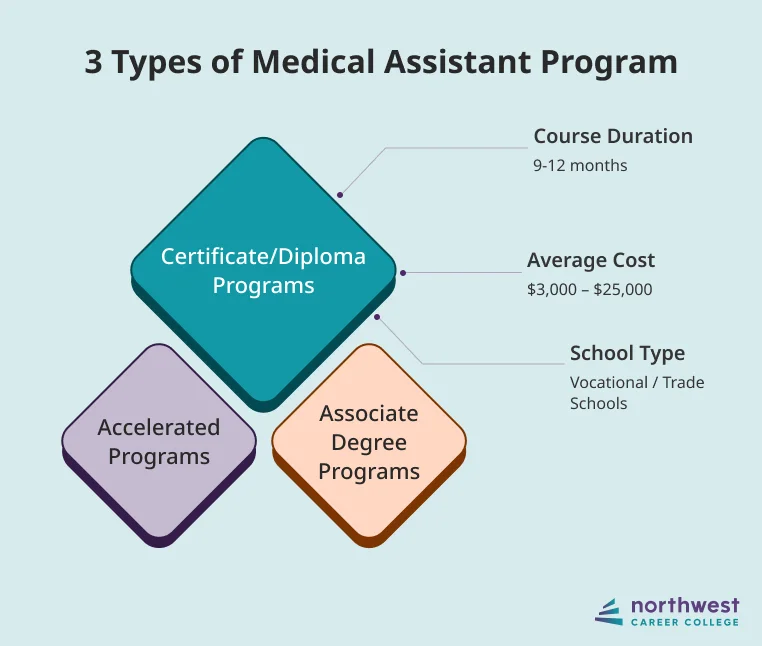
The infographic below showcases the 3 types of medical assistant program and highlights key details for diploma program.
How long does it take to become a medical assistant from a community college?
It takes 6 months to 24 months to become a medical assistant from a community college, depending on whether you earn an associate degree or a certificate. Community colleges provide academic standards education at a lower tuition cost, along with federal financial aid eligibility. You should choose a community college for long-term career growth over immediate, short-term employment.
Key facts about community colleges are as follows.
- Type of program community colleges offer: Community colleges offer 2 types of pathways: a certification and a comprehensive degree.
- Program length: A certification takes 6 to 12 months, and a comprehensive degree takes 18 to 24 months. Upon completion of the medical assistant program, students must complete a 40 to 160-hour clinical externship at a local clinic.
- Tuition cost: The cost of a medical assistant program from a community college varies by state, from $2,000 to $5,000 for in-state students and from $8,000 to $16,000 for out-of-state students.
- Topic coverage: Certifications cover core medical assisting skills. Comprehensive degrees include general knowledge as well as in-depth knowledge of medical assistance skills.
| Pros | Cons |
| – CAAHEP or ABHES-accredited credential or the CMA (AAMA) exam – Costs less than private trade schools – Allows credit transfer to a future RN or BSN degree | – Takes longer than trade schools – Waitlist and GPA requirements might take time |
How long does it take to become a medical assistant from trade school?
It takes 9 to 12 months to become a medical assistant from a trade school. Trade school programs are designed for students looking to enter the medical assistance workforce quickly with a specific skill. Students who want to change careers or need to fast-track should enroll in a trade school. They will get hands-on training along with the necessary materials needed to study.
Key facts about trade school are as follows.
- Type of program trade schools offer: Trade schools offer either certificates or diplomas, mostly in-person or hybrid versions.
- Program length: Programs take 9 to 12 months to complete, along with a 160 to 200-hour clinical externship.
- Tuition cost: The cost of the medical assistant program from a trade school costs 3,000 to 25,000 on average, depending on whether it is a public or private institution.
- Topic coverage: The trade school curriculum teaches students specific duties a candidate will perform, which include Patient Services Representative (PSR) duties such as financial coordination, logistics, and authorizations, and clinical skills such as Phlebotomy and injections, EHR charting, and vitals.
| Pros | Cons |
| – New classes start almost every month – Program completion and joining work within 1 year – Externship Placement | – Expensive than a community college – Specific learning leaves plenty of limitations |
How long does it take to become a medical assistant online?
It takes 8 weeks to 9 months to become a medical assistant through an online or hybrid program. Rural residents, students from working households, or career changers should enroll in these programs for remote learning and fast completion flexibility. Most students choose NHA-aligned programs for fast-track certificates. CAAHEP/ABHES accreditation is also sought after by students looking to enroll in longer hybrid models.
Key facts about online programs are as follows.
- Type of programs online options offer: Online options provide certificates or diplomas. Fully online programs focus only on the PSR side, though lack the hands-on training. Hybrid or blended models combine theoretical knowledge online with a mandatory hands-on externship, a requirement of becoming a certified clinical medical assistant (CCMA).
- Program length: Accelerated online programs take 8 weeks to 12 weeks, and standard online programs take 6 months to 9 months. Many top-tier schools offer a scholarship placement.
- Tuition cost: The cost of online programs varies from $1,500 to $7,000, less than that of physical trade schools.
- Topic coverage: Online curriculum covers intake and documentation, financial coordination, insurance, security, and other PSR duties. High-definition modules cover clinical skills on phlebotomy, injections, and EKG placement.
| Pros | Cons |
| – No commute study – Immediately starting the course – Cost much less than private trade school tuition | – No live or hands-on training – Requires a reliable setup and high-speed internet |
How do you become a medical assistant?
To become a medical assistant, you need a high school diploma/GED, complete an accredited MA training program (certificate or associate degree), gain hands-on experience through an externship, and earn a professional certification (like CMA, RMA, CCMA, NCMA) by passing a certification exam. The general path of becoming a medical assistant is similar across the country. Some states have specific requirements; for example, you need a state license in Washington; but, to become a medical assistant in Nevada, you can work without a license as long as you are supervised.
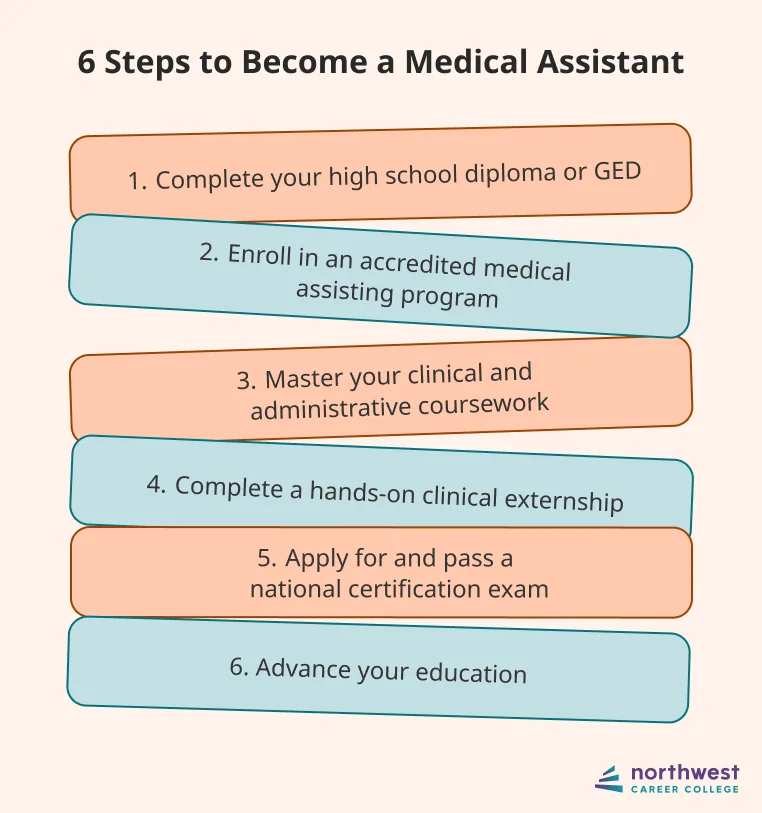
The 6 steps to become a medical assistant are as follows.
1. Complete your high school diploma or GED
First, students have to complete their high school diploma or GED. It is a foundational step nationwide that proves that students have the necessary literacy and mathematical skills to handle medical dosing, PSR documentation, and complicated anatomical terminology.
2. Enroll in an accredited medical assisting program
Find CAAHEP or ABHES programs to ensure receiving national-standard education. Employers from the medical fields prefer graduates from accredited programs as they are automatically eligible for the most respected national certification exams.
3. Master your clinical and administrative coursework
Learn and hone your clinical skills, PSR duties, and administrative skills. Depending on the chosen program and its timeline, you will need to prepare well with theoretical and practical knowledge.
4. Complete a hands-on clinical externship
Complete an externship of 160 to 200 hours in an actual medical facility at the end of your course. It takes 4 to 6 weeks, and a physical or a nurse supervises your work. It gives you practical experiences such as blood drawing, performing injections, and other tasks needed to advance a medical assisting career.
5. Apply for and pass a national certification exam
Select a national exam (such as the CMA, RMA, CCMA, or NCMA) after finishing your program, to earn your credentials as a certified medical assistant. The certification is not legally required in every state, but acquiring one gets you valued higher by employers and results in higher pay with increased job security.
6. Advance your education
Continue your education to specialize in high-demand fields like Cardiology, Phlebotomy, or Dermatology. Advanced certifications can open doors to roles like Clinic Manager, Registered Nurse (RN), or Physician Assistant (PA). Many professionals use flexible programs or employer tuition reimbursement to earn advanced degrees through evening or hybrid courses while working.
The infographic below outlines 6 steps you need to follow to become a Medical Assistant.
How hard is it to become a medical assistant?
It is not hard to become a medical assistant, and enrolling in an accredited medical assistant program will help you manage this challenging journey. The course curriculum focuses on both theoretical knowledge and practical application, including a mandatory 160 to 200-hour clinical externship for field-level experience.
To become a medical assistant, students must complete a high school diploma, master both administrative and clinical tasks, such as Patient Services Representative (PSR) duties and phlebotomy, and earn a national credential like the CCMA, CMA, RMA, or NCMA.
The factors impacting the difficulty of medical assistant programs are as follows.
- Program format and length: Accelerated programs take 8 weeks to 6 months. Traditional programs take 9 months to 24 months.
- Students’ backgrounds: Students with prior customer service experience might get by with the PSR duties but struggle with clinical tasks.
- Topic coverage: Programs covering both clinical and administrative skills are somewhat difficult, as students have to learn 2 different skill sets.
- Externship requirements: The 160 to 200-hour clinical externship might be difficult for students already working.
Prioritizing long-term career goals, income opportunities, and job flexibility makes the learning worthwhile. Active study techniques help students overcome the challenges of becoming a medical assistant while managing their academic learning and gaining clinical experience. Time management, PSR and clinical skills, communication abilities, and clinical accountability enable students to succeed in the medical field.
Does Nevada require medical assistants to be certified?
Naveda doesn’t require medical assistants to be certified, registered, or licensed to work; however, the state’s employers prefer candidates to pass national certifications (CMA or CCMA) to prove they are capable and knowledgeable for the job. Certification helps you secure the job with credibility, earn higher pay, and ensure legal compliance as per the Naveda’s law.
How long does a medical assistant certification last?
Medical Assistant certification lasts 1 to 5 years, CMA for 5 years, RMA for 3 years, CCMA for 2 years, and NCMA for 1 year. These certifications are renewable with a fee between $65 to $185.
- CMA certification stays valid for 5 years (60 months). To maintain it, candidates need to retake the exam or earn 60 continuing units (CEUs). Renewal fee costs $65 (Members) / $130 (Nonmembers) via CEUs.
- RMA certification remains valid for 3 years. To continue the certification, students have to pay an annual fee of $75 and earn 30 Certification Continuation Program (CCP) points every 3 years.
- CCMA certification lasts for 2 years. Continuation of certification validity requires a renewal fee of $185 and 10 Continuing Education (CE) credits.
- The NCMA certificate stays valid for 2 years. Students can continue the certificate’s active status by earning 14 Contact Hours (CE) and paying a $89 renewal fee.
How long does it take to get a medical assistant certification?
It takes a total of 6 months to 3 years to get the medical assistant certification, starting from enrolling in a program to passing the national exam and receiving a certification at hand. An accelerated program takes 8 weeks to 9 months, a certification/diploma takes 9-12 months, and an associate degree takes 18-24 months with an externship. Upon graduation, students must sit for a national exam within 30 days. Results are published instantly; however, an official certificate will arrive within 4 weeks