Medical Assistant Certification: Definition, Types, and How to Get
- Medical Assistant
-
 Authored by
Denisse Adams
Authored by
Denisse Adams
-
 Reviewed by
Dr. Thomas Kenny
Reviewed by
Dr. Thomas Kenny
- Updated March 30, 2026
- 455 views
Medical Assistant Certification refers to the recognition a medical assistant receives as proof of their learned knowledge and hands-on skills through an accredited program or work experience. Candidates get these certificates upon passing any of the 4 main types of Medical Assistant (MA) certificates.
- Certified Clinical Medical Assistant (CCMA), provided by the National Healthcareer Association (NHA)
- Certified Medical Assistant (CMA), administered by the American Association of Medical Assistants (AAMA)
- Registered Medical Assistant (RMA), offered by the American Medical Technologists (AMT)
- National Certified Medical Assistant (NCMA), administered by the National Center for Competency Testing (NCCT)
To become a certified medical assistant, you need to complete an accredited MA program, finish an externship, and apply for the exam you want to get certifications from. Renew the certification every 2 to 5 years to maintain the credential.
You can become a medical assistant without certification, but completing an accredited MA program creates far stronger career opportunities and access to more employer-recognized roles. The CMA by AAMA is the most sought-after credential among the MA certifications due to employer preference, career stability, and higher earning potential.
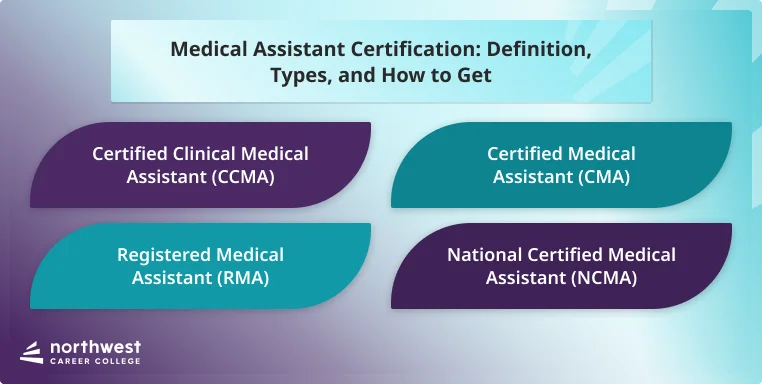
Table of Contents
- What is a medical assistant certification?
- What are the different types of medical assistant certifications?
- How to get a medical assistant certification?
- Which medical assistant certification is the best?
What is a medical assistant certification?
A Medical Assistant Certification is a professional credential which accredited or authorized body awards to acknowledge a medical assistant’s skills, knowledge, learning, and clinical training experiences. The Medical Assistance or MA certificate is a recognition of a candidate meeting the criteria or standards to join the healthcare workforce, both in administrative and clinical duties.
There are four primary certifications recognized across the United States: Certified Medical Assistant (CMA), Registered Medical Assistant (RMA), Certified Clinical Medical Assistant (CCMA), and National Certified Medical Assistant (NCMA). To become a certified medical assistant, candidates typically need to fulfill the following requirements.
- Hold a high school diploma or GED
- Programmatically accredited medical assistant graduation
- Clinical experience (160 to 200 hours)
- Must pass comprehensive national exams covering theoretical, administrative, and clinical parts.
Although it is not a mandatory legal document for every state in the US, it offers the national recognition that many healthcare employers prioritize.
What are the different types of medical assistant certifications?
There are 4 primary types of Medical Assistant Certifications: Certified Clinical Medical Assistant (CCMA), Certified Medical Assistant (CMA), Registered Medical Assistant (RMA), and National Certified Medical Assistant (NCMA). Upon completion of an accredited MA program or having work experience, candidates can take the certification exam to become a certified and authorized professional medical assistant.
The table below compares Medical Assistant certifications by certifying organization, exam cost, and attempt limits.
| Certification | Certifying Body | Exam Cost | Attempt Limit |
| Certified Clinical Medical Assistant (CCMA) | National Healthcareer Association (NHA) | $160 | No limit (1-year wait after 3rd) |
| Certified Medical Assistant (CMA) | American Association of Medical Assistants (AAMA) | $125 – $250 | 3 times |
| Registered Medical Assistant (RMA) | American Medical Technologists (AMT) | $150 (Varies on applicants’ route) | 4 times |
| National Certified Medical Assistant (NCMA) | National Center for Competency Testing (NCCT) | $119 | 4 time |
1. Certified Clinical Medical Assistant (CCMA)
Certified Clinical Medical Assistant (CCMA) is a well-recognized credential that the National Healthcareer Association (NHA) offers. CCMA focuses on the clinical side of medical assistant work, with versatile working opportunities such as Phlebotomy technician, EKG Technician, etc. The certification is especially effective for professionals who want to validate their direct patient care skills.
CCMA Eligibility
A candidate must meet the following criteria to take the CCMA exam.
- Possession of a high school diploma, GED, or equivalent credential.
- Completion of a medical assistant training program within the last 5 years.
- Completion of one year of supervised work experience in the medical assisting field within the last 3 years.
- Enrollment in a medical assistant program within 12 months of graduation.
The table below summarizes CCMA certification details, including the issuing organization, exam cost, exam structure, and certification validity period.
| Category | CCMA Certification Details |
| Issued by | National Healthcareer Association (NHA) |
| CCMA Exam fee | $160 |
| CCMA Exam Overview | Format: 180 multiple-choice questions Length: 3 hours Topics: Clinical Patient Care (56%), Foundational Knowledge (10%), Administrative Assisting (8%), Communication (8%), Anatomy/Physiology (5%), Patient Care Coordination (8%), and Medical Law/Ethics (5%) Scoring: Ranges from 200 to 500; pass mark 390 |
| CCMA Certification Duration | Stays valid for 2 years and requires 10 Continuing Education (CE) credits. Non-members are required to pay a $185 renewal fee. |
2. Certified Medical Assistant (CMA)
Certified Medical Assistant (CMA) is the most esteemed credential offered by the American Association of Medical Assistants (AAMA) to candidates who complete a medical assistant (MA) program. CMA validates a candidate’s professional competency in clinical and administrative duties. The CMA examination evaluates knowledge of clinical procedures, anatomy, and medical law through a standardized assessment.
CMA Eligibility
A candidate must meet the following criteria to sit for the CMA exam.
- Completion of a post-secondary medical assisting program accredited by the Accrediting Bureau of Health Education Schools (ABHES) or Commission on Accreditation of Allied Health Education Programs (CAAHEP).
- Completion of a medical assisting program as a non-recent graduate of an accredited institution.
- Possession of current or previous CMA credential status for recertification.
- Completion of a supervised practicum (externship) of at least 160 hours during schooling.
The table below summarizes CMA certification details, including the issuing organization, exam cost, exam structure, and certification validity period.
| Category | CMA Certification Details |
| Issued by | American Association of Medical Assistants |
| CMA Exam fee | $125 for AAMA members $250 for nonmembers |
| CMA Exam Overview | Format: 200 multiple-choice questions Length: 40-minute segments, 160-minute period Topic: Clinical (59%), General (21%), and Administrative (20%) Scoring: Ranges from 200 to 800. Pass mark minimum 405 |
| CMA Certification Duration | Stays valid for 60 months (5 years), maintenance requires retaking the exam or earning 60 continuing education units (CEUs). Renewal fee: $65 (Members) / $130 (Nonmembers) via CEUs |
3. Registered Medical Assistant (RMA)
Registered Medical Assistant (RMA) is a nationally recognized credential offered by American Medical Technologists (AMT). RMA validates a candidate’s ability to perform clinical and clerical duties in medical settings. RMA certification provides flexible eligibility pathways for military members and individuals with extensive work experience.
RMA Eligibility
A candidate must meet any of the following criteria to sit for the RMA exam.
- Graduated from an accredited MA program (minimum 720 hours, including a 160-hour externship).
- Got at least 3 to 5 years of full-time experience as a medical assistant within the last 7 years.
- Graduated from a US Armed Forces medical services training program (last 4 years).
The table below summarizes RMA certification details, including the issuing organization, exam cost, exam structure, and certification validity period.
| Category | RMA Certification Details |
| Issued by | American Medical Technologists (AMT) |
| RMA Exam fee | $150 (Varies based on application route) |
| RMA Exam Overview | Format: 210 multiple-choice questions Length: 2-hour time limit Topics: Anatomy/Physiology (21.9%), Administrative (35.7%), Clinical Procedural (14.7%), and Patient Interaction (27.6%) Scoring: Range from 0 to 100, passing score 70 |
| RMA Certification Duration | Remains valid for 3 years, requires paying an annual fee, and earning 30 Certification Continuation Program (CCP) points every 3 years. Annual fee: $75 to maintain active status |
4. National Certified Medical Assistant (NCMA)
The National Certified Medical Assistant (NCMA) is a professional credential offered by the National Center for Competency Testing (NCCT) to medical assistants demonstrating proficiency in both clinical and administrative tasks. NCMA covers the clinical side of MA work, including phlebotomy, EKG, and pharmacology, though candidates often choose it due to flexible eligibility pathways that value long-term work experience and military service.
National Certified Medical Assistant (NCMA) is a professional credential offered by the National Center for Competency Testing (NCCT). NCMA recognizes proficiency in both clinical and administrative tasks. NCMA certification covers clinical skills such as phlebotomy, EKG, and pharmacology. The certification offers flexible eligibility pathways that recognize long-term work experience and military service.
NCMA Eligibility
A candidate must meet one of the following criteria to sit for the NCMA exam.
- Possession of a high school diploma or GED and completion of at least one year (2,080 hours) of verifiable full-time medical assistant experience within the past 5 years.
- Application before graduation for current students in an authorized program is permitted, but they must submit their diplomas within 2 years.
- Graduation from an NCCT-authorized medical assistant program within the past 5 years.
- Completion of a medical assistant training program within the U.S. Military within the past 5 years.
The table below summarizes NCMA certification details, including the issuing organization, exam cost, exam structure, and certification validity period.
| Category | NCMA Certification Details |
| Issued by | National Center for Competency Testing |
| NCMA Exam fee | $119 |
| NCMA Exam Overview | Format: 165 total questions Length: 3 hours Topics: Clinical Medical Procedures (48%), Pharmacology (12%), Law and Ethics (13.3%), and Medical Office Management/Admin (10%) Scoring: 0 – 100; passing score 70 |
| NCMA Certification Duration | Stays valid for 1 year; activated status requires annually earning 14 Contact Hours (CE) and paying a $89 renewal fee. |
How to get a medical assistant certification?
To get a Medical Assistant (MA) certification, complete an accredited Medical Assistant program (certificate, diploma, or degree) or meet work experience requirements to meet the eligibility criteria, pass a national certification exam, such as CCMA or CMA, and maintain certification. MA programs take 8 weeks to 2 years, cover clinical and administrative skills, and often include an externship.
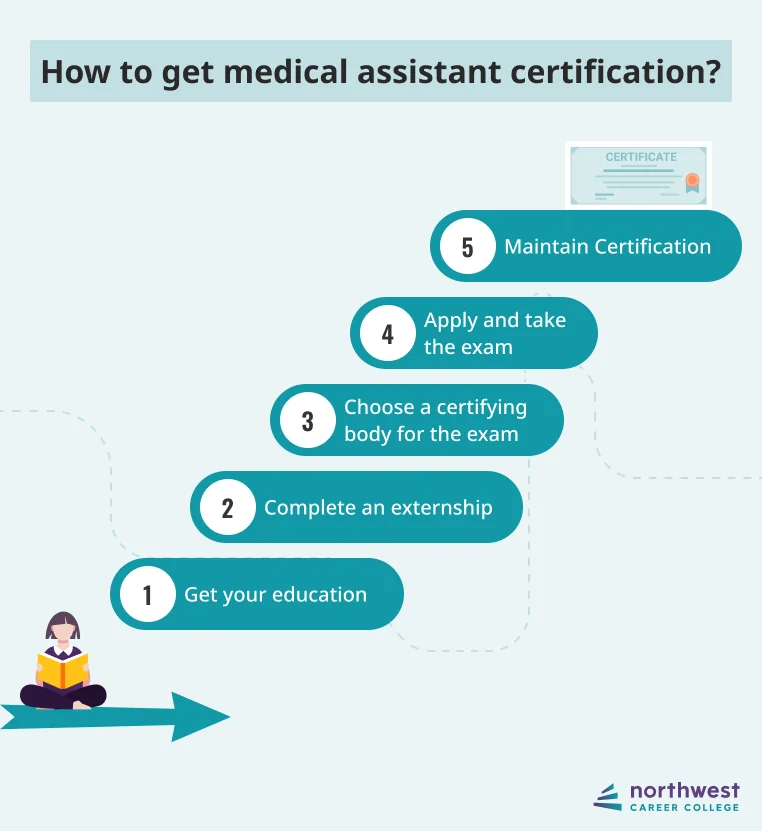
Here are the 5 steps to get medical assistant certification.
1. Get your education
Enroll in a CAAHEP- or ABHES-accredited Medical Assistant program to earn a diploma, certificate, or associate degree. Candidates with 3 to 5 years of verified experience may qualify through an approved alternative pathway.
2. Complete an externship
Get hands-on experience by completing a supervised clinical internship, such as 160 hours for CMA and RMA, and 80–160 hours for CCMA. Practical training through externships helps you apply learned knowledge in a real-world environment, such as patient care, clinical and administrative practical skills, etc. High-quality and accredited programs often integrate hands-on training to prepare you for national-level exams, including CMA, RMA, CCMA, or NCMA.
3. Choose a certifying body for the exam
Choose the exam that aligns with your career goals and training. The Certified Clinical Medical Assistant (CCMA) exam from the National Healthcareer Association (NHA) is a strong entry-level option because it focuses on high-demand clinical skills such as phlebotomy, EKG, and injections. CCMA suits students who want faster entry into outpatient clinics and hands-on patient care roles.
The Certified Medical Assistant (CMA) exam is often selected by graduates of CAAHEP- or ABHES-accredited programs who plan to pursue long-term hospital or administrative career paths. The Registered Medical Assistant (RMA) credential offers flexibility and may benefit experienced or military-trained candidates.
4. Apply and take the exam
Create an online account through the official portal of the certifying body to submit your formal application. You will need to upload some other official documents as follows.
- Transcripts from the accredited program
- A signed verification of your clinical externship hours
- Notarized employment verification form or Letter of Attestation from the supervisor (for applicants of the experience route)
Remit a non-refundable examination fee to confirm your application, which typically ranges from $119 to $250, depending on the specific credential and your membership status with the organization.
Upon approval of your application, you will receive an Authorization to Test (ATT) letter via email. The letter will contain information about your sitting schedule, candidate ID, instructions, etc. The exams are held within 90 days, and mostly are administered through third-party proctoring services like PSI or Pearson VUE. You can choose to take the exam directly or through Live Remote Proctoring (LRP). Remote options require you to meet the following requirements.
- A stable internet connection
- A functioning webcam for a 360-degree room scan
- A private, quiet space to ensure the integrity of the testing process.
To physically attend the exam, take a valid, government-issued photo ID matching your application. Successfully passed candidates will receive an official scaled score and formal certificate through their digital portal within 2 to 10 business days, ready to join the workforce with competence and a professional title.
Unsuccessful candidates can retake the exam as per the following schedules.
| Exam name | Lifetime Attempts | Reapplication |
| CMA (AAMA) | Maximum 3 | Immediately after the first 2 failures |
| RMA (AMT) | Maximum 4 | A mandatory 45-day wait for each application |
| CCMA (NHA) | No | 30 days after the first 2failures and 1 year after a 3rd failure |
| NCMA (NCCT) | Maximum 4 | 30 days after the 1st 2 failures and 90 days after a 3rd failure |
5. Maintain Certification
Maintain the certification you have acquired to keep the active status or to validate that your knowledge is updated. Follow these specific renewal cycles to maintain your credential after certain periods.
- The CMA (AAMA) stays valid for 5 years, requiring 60 CEUs or an exam. Renewal fee: $65 (Members) / $130 (Nonmembers) via CEUs.
- The RMA (AMT) requires an annual $75 fee and 30 points every 3 years.
- The CCMA (NHA) lasts 2 years, requiring 10 CE credits and a $185 fee.
- The NCMA (NCCT) requires annual renewal with 14 contact hours and a $89 fee to remain active.
An infographic showcases the steps to get a medical assistant certification below.
Does a medical assistant diploma expire?
A Medical Assistant diploma does not expire as it serves as a permanent academic record of completed coursework and training. Professional certifications, such as CMA, CCMA, or RMA do expire and must be renewed every 1 to 5 years through continuing education (CEUs) or retaking the exam to remain valid. Certification renewal maintains employer standards, strengthens competitiveness, and validates updated clinical and administrative skills.
Which medical assistant certification is the best?
The Certified Medical Assistant (CMA) credential awarded by the American Association of Medical Assistants (AAMA) is generally considered the best medical assistant certification. It is deemed the gold standard in the global healthcare industry because of its long-term career stability, higher earning potential, and competitive edge in specialized healthcare and medical environments. According to a 2025 data analysis by the National Healthcare Association titled Exclusive Trends About In-Demand Allied Health Professions, 85% employers prefer to have candidates with nationally recognized certifications, making CMA certification more desirable.
Other reasons why CMA is considered the best are as follows.
- Requires 9 to 24 months of accredited curriculum for professional credibility.
- Meets the strict service quality and compliance benchmark that candidates require to work.
- Provides access to employment opportunities with competitive starting salaries and enhanced benefits upon passing the exam.
- Allows candidates to seek roles such as Clinical Team Lead, Health Records Specialist, or Patient Care Coordinator.
Other certifications are also best suited to fulfill specific needs, depending on a candidate’s training path as follows.
- CCMA best suits individuals who want faster workforce entry, hands-on patient care roles, and long-term advancement in ambulatory and specialty career pathways. It is the best choice for entering the healthcare industry.
- RMA offers more flexibility; however, it is the best choice for military veterans or experienced workers without having an accredited program.
- NCMA is also best for candidates who want to qualify through work experience (1 year) or military service.
Are the medical assistant certification exams hard?
Yes, the Medical Assistant Certification exams are moderately challenging but easy and passable for examinees who have completed their accredited MA programs and are well-prepared through dedicated study. The certification examination’s difficulty level varies based on certain factors such as exam format, students’ prior knowledge and preparation, and the exam’s topic coverage. Questions mostly cover clinical procedures, anatomy, and administrative laws, which accredited programs cover by teaching theoretical knowledge and hands-on training.
Do you need certification to be a medical assistant?
No, you don’t need certification to be a medical assistant by law. Most U.S. states, including Nevada, do not require certification to work as a Medical Assistant. Employers prefer certification because it proves job-related knowledge and competency.
Lack of certification can limit hiring opportunities and reduce earning potential. Healthcare systems recognize Medical Assistant certification as proof of professional standards. MA certification increases earning potential, expands job scope, and supports long-term career advancement.
You can be a certified medical assistant by finishing an accredited, certificate or associate degree program, followed by passing a national exam such as CCMA, CMA, or RMA.
Is it possible to get your medical assistant certification online?
Yes, it is possible to get your medical assistant certification online, with many offering fast-tracked, 8 weeks to 12 month courses designed for the National Healthcareer Association (NHA) Certified Clinical Medical Assistant (CCMA) exam. Online MA certification programs lack the practical experience that most clinical positions require in the long term. It is wise to enroll in a hybrid medical assistant program that teaches administrative, clinical, and interpersonal skills under experienced instructors and established practitioners
Is a medical assistant license required?
A medical assistant license is not required in most U.S. states. However, employers prefer certified candidates, such as those with CMA, RMA, or CCMA credentials, as certification shows proven knowledge and job-ready training. Earning a medical assistant certification is a strong advantage when applying for MA roles.
How long does a medical assistant certification take?
It takes 8 weeks to 2 years to complete a medical assistant certification, depending on the program type. A certificate program takes 8 weeks to 9 months with basic knowledge, an accredited diploma program will take 9 to 12 months, with theoretical and practical knowledge of both administrative and clinical skills, and an associate degree program takes 18 to 24 months to complete.
How much does a medical assistant certification cost?
A Medical Assistant certification involves program costs between $1200 to $40,000, depending on the chosen program; a short certification program costs $1200 to $7500, a diploma program costs $12,000 to $25,000, and an associate degree will cost over $20,000 to even $40,000, from enrollment until the exam. Medical assistant certification costs vary depending on the type of institution (public/private), online or in-person course, location, and living expenses. The MA certification exam costs vary between $119 to $250.