What Jobs Can You Get with a Medical Assistant Diploma, Degree, and Certificate?
- Medical Assistant
-
 Authored by
Denisse Adams
Authored by
Denisse Adams
-
 Reviewed by
Dr. Thomas Kenny
Reviewed by
Dr. Thomas Kenny
- Updated August 21, 2026
- 2.1k views
The jobs you can get with a medical assistant diploma, degree, or certificate include Medical Assistant, Medical Office Assistant, Medical Records Technician, Phlebotomy Technician, and Medical Records Assistant, depending on the level of education and training.
The Medical Assistant (MA) certification is a powerful asset with which you can pursue advanced credentials for higher clinical and administrative tasks. It helps you enter the healthcare field quickly with essential foundational knowledge in medical terminology, anatomy, and HIPAA compliance, and also expands to explore other relevant careers. Field-level experience through training prepares you to sit for profession-specific exams and become a certified medical assistant.
Here’s a list of medical assistant jobs you can get with a medical assistant diploma, degree, and certificate.
1. Medical Assistant
2. Medical Office Assistant (Medical Administrative Assistant)
3. Phlebotomy Technician (Phlebotomist)
4. EKG Technician
5. Medical Claims Examiner
6. Medical Records Technician (Medical Records Specialist)
7. Medical Office Manager
8. Medical Records Assistant
9. Patient Services Representative
10. Home Health Aide
11. Nursing Assistant

1. Medical Assistant
A Medical Assistant (MA) is a skilled professional who manages the daily operations of clinics and medical practices, assists patients and doctors in a medical office, hospital, or clinic. Their work is classified into administrative procedures and clinical methods to care for patients’ needs and comply with official regulations.
Key facts about medical assistants are as follows.
- Average Salary: According to ZipRecruiter (2025), The salary of a Medical Assistant in the United States is $41,370/year, and in Las Vegas, $39,694/year.
- Occupational Growth Prospects: According to the U.S. Bureau of Labor Statistics (BLS), the projected occupational growth (2024–2034) for Medical Assistants is 12%.
- Required Certification: National certification requires candidates to pass one of the following exams: Certified Clinical Medical Assistant (CCMA) from the National Healthcareer Association (NHA), Certified Medical Assistant (CMA) from the American Association of Medical Assistants (AAMA), or Registered Medical Assistant (RMA) from American Medical Technologists (AMT).
- Medical Assistant Duties: The duties of a medical Assistant are put to use in 2 major categories, clinical duties and administrative duties. Clinical duties include patient vitals, health documentation, physician support, lab work, sanitization. Administrative duties include EHR management, scheduling, patient intake, financial tasks, logistics, etc.
- Skills Required: Equipment familiarity, empathetic care, clear communication, and adaptability.
- Career Prospects: EKG Technician, Sterile Processing Technician, EKG Technician, Medical Records Specialist (Health Information Specialist), and Health Unit Coordinator (HUC).
2. Medical Office Assistant
A Medical Office Assistant (MOA), also known as a Medical Administrative Assistant (MAA), is a responsible professional who stays in the front office to ensure an organized and compliant workflow for the hospital and healthcare facility. As this profession requires a candidate’s medical and organizational knowledge, holding a medical assistant diploma or degree, you gain the necessary knowledge and focus to perform administrative and financial aspects.
Key facts about medical office assistants are as follows.
- Average Salary: According to ZipRecruiter (2025), the average salary of a Medical Office Assistant in the United States is $40,284/year, and in Las Vegas (Nevada), $36,651/year.
- Occupational Growth Prospects: According to the U.S. Bureau of Labor Statistics (BLS), the projected occupational growth (2024–2034) for Medical Assistants is 12%.
- Required Certification: A diploma or degree certificate qualifies you to work as a medical office assistant. A Certified Medical Administrative Assistant (CMAA) credential strengthens your job prospects. The CMAA exam from the National Healthcareer Association (NHA) validates your skills in HIPAA compliance, record management, and related administrative tasks.
- Medical Office Assistant Duties: Communication hub, financial coordination, EHR & compliance, patient liaison, and office logistics.
- Skills Required: Dynamic multitasking, technological proficiency, and professional communication.
- Career Prospects: Medical Biller and Coder, Patient Accounts Representative, Medical Office Manager, Medical Communications, Senior Office Assistant.
3. Phlebotomy Technician
A Phlebotomy technician is a healthcare specialist who draws blood for testing, transfusions, or donations. This is a core clinical skill medical assistant programs learn. Many medical assistant degree or diploma-certified individuals choose to become a phlebotomist due to the nature of this fast-paced job and its high demand.
Key facts about phlebotomy technicians are as follows.
- Average Salary: According to ZipRecruiter (2025), the average salary of a Phlebotomy technician in the United States is $39,658/year, and in Las Vegas (Nevada), $38,051/year.
- Occupational Growth Prospects: According to the U.S. Bureau of Labor Statistics (BLS), the projected occupational growth (2024–2034) for Phlebotomists is 6%.
- Required Certification: The role requires a Certified Phlebotomy Technician (CPT) credential obtained through the CPT exam from the National Healthcareer Association (NHA) or the American Society for Clinical Pathology (ASCP). The State of Nevada requires applicants in Las Vegas to obtain a license from the Nevada Division of Public and Behavioral Health (DPBH).
- Phlebotomy Technician Duties: Patient identification & care, technical collection, specimen integrity, etc.
- Skills Required: Empathetic professionalism, dexterity, precision, meticulous safety.
- Career Prospects: Phlebotomy Supervisor, Certified Phlebotomy Technician, and Laboratory Assistant, among others.
4. EKG Technician
An EKG Technician is a healthcare specialist who performs an electrocardiogram (EKG or ECG) test to measure and record the electrical activity of the heart. With a medical degree, you will get training for this crucial diagnostic skill and work with physicians to identify patients’ conditions, such as arrhythmias (irregular heartbeats), heart disease, or damage from a heart attack.
Key facts about EKG technicians are as follows.
- Average Salary: According to ZipRecruiter (2025), the salary of an EKG Technician in the United States is $49,724/year, and in Las Vegas, $45,939/year.
- Occupational Growth Prospects: According to the U.S. Bureau of Labor Statistics (BLS), the projected occupational growth (2024–2034) for Cardiovascular Technologists and Technicians is 3%.
- Required Certification: The role requires candidates to pass the Certified EKG Technician (CET) exam from the National Healthcareer Association (NHA), as specialized positions in hospitals or cardiology departments often require the CET credential and offer higher pay, even though Medical Assistants can perform basic EKGs.
- EKG Technician Duties: Patient care & education, physical preparation, standard 12-lead setup, technical operations, advanced monitoring
- Skills Required: Clinical precision, analytical observation, stress management, and technological troubleshooting.
- Career Prospects: EKG Nurse, Holter Technician, Electrocardiogram Technician, EKG Technician, EKG ECG Technician, Electrocardiogram Technician, etc.
5. Medical Claims Examiner
A Medical Claims Examiner/Health Claims Examiner/Claims Adjuster is a professional who works for the administration section and reviews and adjudicates medical claims submitted by healthcare providers. They determine if the services are covered by the patient’s policy and how much the insurer must pay.
Key facts about medical claims examiners are as follows.
- Average Salary: According to ZipRecruiter (2025), the salary of a Medical Claims Examiner in the United States is $43,917/year, and in Las Vegas, $41,945/year.
- Occupational Growth Prospects: According to the U.S. Bureau of Labor Statistics (BLS), the projected occupational growth (2024–2034) for Claims Adjusters, Appraisers, Examiners, and Investigators is -5%.
- Required Certification: Completion of a Medical Assistant program provides foundational knowledge in medical terminology, anatomy, and HIPAA compliance that strengthens eligibility for a Medical Claims Examiner role.
Qualification for advanced positions requires passing certifications such as the Certified Professional Coder (CPC) or Certified Professional Biller (CPB) from the American Academy of Professional Coders (AAPC), and certain states require a Claims Adjuster license for specific roles.
- Medical Claims Examiner Duties: Analyzing claims against insurance policies, reviewing medical documentation and codes (ICD-10, CPT) for medical necessity, approving or denying payments, and referring suspicious claims for fraud investigation.
- Skills Required: Spotting discrepancies, research ability, coding proficiency (ICD-10, CPT, HCPCS), and accuracy.
- Career Prospects: Senior Claims Examiner, Workers Comp Claims Examiner, Quantum Analyst, Appeals/Grievance Specialist, etc.
6. Medical Records Technician
A Medical Records Technician, known as a Medical Records Specialist or Health Information Technician, is an administrative professional who manages and safeguards patient health information. This professional works for data accuracy, security, and compliance with privacy laws for billing, research, and continuity of care.
Key facts about medical records technicians are as follows.
- Average Salary: According to ZipRecruiter (2025), the salary of a Medical Records Technician in the United States is $44,324/year, and in Las Vegas, $40,576/year.
- Occupational Growth Prospects: According to the U.S. Bureau of Labor Statistics (BLS), the projected occupational growth (2024–2034) for Medical Records Specialists is 7%.
- Required Certification: A Medical Assistant program provides foundational knowledge in medical terminology, anatomy, and HIPAA compliance necessary to enter the medical records field in Las Vegas. Graduates can enter the workforce in entry-level roles.
Major healthcare organizations require national certification, such as the Certified Electronic Health Records Specialist (CEHRS) from the National Healthcareer Association (NHA), for technician or specialist positions. Healthcare employers prefer CEHRS certification when hiring candidates for technical roles.
- Medical Records Technician Duties: Managing and filing patient health documents, processing Release of Information (ROI) requests for legal or insurance purposes, and auditing records.
- Skills Required: Technical proficiency in various Electronic Health Record (EHR) systems, precision in data entry and filing, and a deep working knowledge of HIPAA and healthcare data security laws.
- Career Prospects: Medical And Clinical Laboratory Technicians, Electrocardiography Technician, Medical Equipment Technician, Electrocardiogram Technician, etc.
7. Medical Office Manager
The Medical Office Manager (MOM) is a senior leadership position in a healthcare facility who is responsible for the overall business and administrative success of a medical practice, clinic, or hospital department. The MOMs handle the administrative medical assisting work, strategic oversight, staff management, etc.
Key facts about medical office managers are as follows.
- Average Salary: According to ZipRecruiter (2025), the salary of a Medical Office Manager (MOM) in the United States is $56,076/year, and in Las Vegas, $51,019/year.
- Occupational Growth Prospects: According to the U.S. Bureau of Labor Statistics (BLS), the projected occupational growth (2024–2034) for Medical and Health Services Managers is 23%.
- Required Certification: The MA diploma provides prior essential knowledge of administrative procedures, billing, and HIPAA compliance. But working in management requires significant professional knowledge, which is why it is recommended to obtain the Certified Medical Office Manager (CMOM) credential through the Practice Management Institute (PMI) to demonstrate expertise.
- Medical Office Manager Duties: Recruiting and training administrative staff, optimizing billing/coding for maximum reimbursement, overseeing budgets and payroll, enforcing HIPAA and OSHA compliance, and managing facility maintenance and inventory.
- Skills Required: Leadership, team management, budgeting and financial reporting, and regulatory knowledge in healthcare law, and risk management.
- Career Prospects: Medical Manager, Insurance Office Manager, Medical Office Staff, Hospital Administrator.
8. Medical Records Assistant
A Medical Records Assistant, also called a Medical Records Clerk or Health Information Clerk, is a professional responsible for the crucial task of compiling, processing, and accurately maintaining and securing patient health information. It is a specialized administrative role where data integrity and compliance are a top priority.
Key facts about medical records assistants are as follows.
- Average Salary: According to ZipRecruiter (2025), the salary of a Medical Records Assistant in the United States is $36,159/year, and in Las Vegas, $34,560/year.
- Occupational Growth Prospects: According to the U.S. Bureau of Labor Statistics (BLS), the projected occupational growth (2024–2034) for Medical Records Specialists Managers is 7%.
- Required Certification: Medical Assistant training provides foundational knowledge in medical terminology, anatomy, and HIPAA compliance. This knowledge prepares students for specialized training in Electronic Health Records (EHR) systems. This preparation supports eligibility for the Certified Electronic Health Records Specialist (CEHRS) exam offered by the National Healthcareer Association (NHA).
- Medical Records Assistant Duties: Compiling and filing health documents, processing record requests with strict HIPAA compliance, auditing charts for completeness, and scanning physical documents into the Electronic Health Record (EHR) system.
- Skills Required: Precision in data categorization, expert mastery of HIPAA confidentiality and release-of-information protocols, and high-speed proficiency in EHR navigation and data entry.
- Career Prospects: Payroll Data Entry Clerk, Electronic Medical Records Clerk, Scanning Clerk, Clinical Data Abstractor.
9. Patient Services Representative
The Patient Services Representative (PSR) is a skilled healthcare professional who works in the frontline administrative and customer service section as the primary point of contact for patients. The PSR manages front office operations to keep patient services organized and ensure smooth patient experiences.
Key facts for patient services representatives are as follows.
- Average Salary: According to ZipRecruiter (2025), the salary of a Patient Services Representative (PSR) in the United States is $39,924/year, and in Las Vegas, $38,107/year.
- Occupational Growth Prospects: According to the U.S. Bureau of Labor Statistics (BLS), the projected occupational growth (2024–2034) for Customer Service Representatives is -5%.
- Required Certification: A Medical Assistant program provides a strong advantage for candidates pursuing a Patient Services Representative (PSR) role. The program teaches medical terminology, billing fundamentals, and HIPAA compliance. This training prepares candidates to take the Certified Medical Administrative Assistant (CMAA) exam offered by the National Healthcareer Association (NHA).
- Patient Services Representative (PSR) Duties: Intake & documentation, financial coordination, logistics and authorization, compliance, etc.
- Skills Required: Interpersonal excellence, insurance literacy, operational efficiency, technological proficiency, etc.
- Career Prospects: Patient Engagement, EMR Support Specialist, Patient Care Specialist, Patient Financial Specialist, Patient Access Intake Specialist.
10. Home Health Aide
A Home Health Aide (HHA) is a healthcare professional who provides care to elderly, disabled, or chronically ill patients in their homes. The HHA monitors activities of daily living (ADLs) and supports patients with personal care needs. The HHA works independently in the home setting under the supervision of a Registered Nurse (RN).
Key factors about home health aide are as follows.
- Average Salary: According to the 2025 ZipRecruiter, a Home Health Aide’s salary in the United States is $33,585/year, and in Las Vegas, $33,017/year.
- Occupational Growth Prospects: According to the U.S. Bureau of Labor Statistics (BLS), the projected occupational growth (2024–2034) for Home Health and Personal Care Aides is 17%.
- Required Certification: Home Health Aide (HHA) and Certified Nursing Assistant (CNA) roles require completion of a state-approved training program that includes at least 75 hours of instruction and 16 clinical hours, followed by passing a competency exam. The Nevada State Board of Nursing oversees this process in Nevada and requires candidates to complete mandated training hours and pass a state-specific exam for registry listing. Other states follow different requirements, as California often requires a CNA certificate before HHA certification and New Jersey requires a Certified Homemaker-Home Health Aide (CHHA) credential.
- Home Health Aide Duties: Assisting with Activities of Daily Living (ADLs), recording vital signs and reporting health changes, household support, and timely medication reminders.
- Skills Required: Compassion and patience for personal care and aging challenges, observational skills to notice subtle changes in health or mental status, reliability, and self-management.
- Career Prospects: Vitas Representative, Atomic Transport, School Health Aide, Licensed Practical Nurse (LPN), etc.
11. Nursing Assistant
A Nursing Assistant (NA) is a healthcare professional who provides basic patient care under the supervision of a Licensed Practical Nurse (LPN) or Registered Nurse (RN). The Nursing Assistant supports patients with daily physical needs and comfort. The role plays a vital part in long-term care settings.
Key facts about nursing assistants are as follows.
- Average Salary: According to the 2025 ZipRecruiter, a Nursing Assistant in the United States is $37,838/year, and in Las Vegas, $36,139/year.
- Occupational Growth Prospects: According to the U.S. Bureau of Labor Statistics (BLS), the projected occupational growth (2024–2034) for Nursing Assistants and Orderlies is 2%.
- Required Certification: A medical assistant diploma or degree provides the necessary knowledge to prepare for the Certified Nursing Assistant (CNA) state exam, but Naveda has an additional legal requirement. Successful candidates are to attend a state-approved 75-hour training program overseen by the Nevada State Board of Nursing. After that, they are to pass the state competency exam (both written and manual skills evaluation) to legally work in the state.
- Nursing Assistant Duties: Assisting with hygiene, mobility, and repositioning, vital sign monitoring, and meticulous clinical documentation.
- Skills Required: Physical stamina and proper body mechanics, patience and empathy, and sharp observational skills.
- Career Prospects: Medication Aide, Home Health Aide, Patient Care Technician, Certified Benefits Professional.
Where can a medical assistant work?
A Medical assistant can work in any setting, from physical to virtual, in the position of non-emergency patient care. With a medical assistant certificate, degree, or diploma, the majority of MAs perform in physicians’ offices, clinics, and other outpatient care facilities such as ambulatory health care services, chiropractors’ offices, family medicine practices, health centers, etc.
A medical assistant works in non-emergency patient care settings, including both physical and virtual environments. About 57% to 60% MAs are employed in physician offices, clinics, and outpatient care facilities such as ambulatory health care services, chiropractors’ offices, family medicine practices, and health centers. They provide both clinical and administrative support.
Here is a list of positions where a medical assistant can work with his/her certification.
- Ambulatory health care services: Tasks include patient triage and intake, rapid lab testing, patient flow management, etc.
- Chiropractors’ offices: Tasks include billing and insurance, therapy assistance, and administrative support.
- Family medicine practices: Job role covers clinical preparation and vitals, vaccination and injections, preventative care coordination, etc.
- Health centers: Job includes resource and enrollment assistance, immunization clinics, health screening, etc.
- Health care practitioner offices/Medical offices: Work includes front/back office hybrid, patient intake and history, and procedure assistance.
- Hospital facilities: Job role requires working on EKG and testing, patient transport and logistics, documentation, and flow.
- Medical laboratories: Duties involve phlebotomy and specimen collection, sample processing, and inventory and sterilization.
- Medical offices: Job role requires performing patient vitals and basic assessment, administrative scheduling, lab specimen collection, etc.
- OB/GYN practices: Job role extends to exam preparation, urine/lab collection, and sensitive patient support, among others.
- Outpatient care facilities: Requires skill in specialized procedure setup, diagnostic test administration, and patient education.
- Physicians’ offices: Work involves medication administration, patient education, referral & authorization management, etc.
- Podiatrists’ Offices: Tasks involve sterilization & setup, wound care, patient positioning, etc.
- Walk-in clinics: Job includes triage and prioritization, basic wound care, and in-house testing.
- Medical Offices / Physicians’ Offices / Medical Offices, Clinics, and Other Facilities: Tasks include patient history, assisting with procedures, and appointment management.
- Offices of physicians, hospitals, and other healthcare facilities: Tasks include Electronic Health Record (EHR) integrity, inventory and supply management, maintaining communication with patients, pharmacies, external labs, etc.
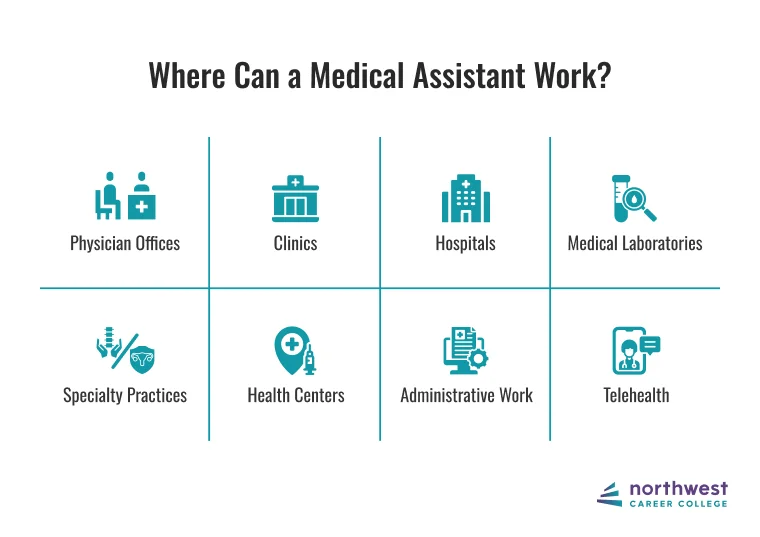
The infographic below highlights common work settings for medical assistants, including physician offices, clinics, hospitals, medical laboratories, specialty practices, health centers, administrative roles, and telehealth environments.
What are the differences between a medical assistant diploma, degree, and certificate?
The differences among a medical assistant diploma, degree, and certificate depend on the program length, academic depth, and long-term career focus. The length to become a medical assistant ranges from 8 weeks to 2 years, depending on the type of program. Both diplomas and certificates are shorter than degree programs. A degree takes 18 to 24 months, whereas a diploma takes only 9 to 12 months to complete. A certificate is shorter than a diploma, which takes 4 to 12 months to complete; it only includes the essentials.
Other differences among a diploma, a degree, and a certificate are as follows.
| Feature | Diploma | Degree | Certificate |
| Duration | 9 to 12 Months | 18 to 24 Months | 4 to 12 Months |
| What it does | Fast joining to employment, shorter than a degree, with clinical mastery. | Longer commitment, but may open doors to higher-level roles later. | Fast preparation for the workforce completes basic knowledge. |
| Curriculum Depth | Vocational training with advanced clinical and admin tasks. | Includes liberal arts and general science, providing a more well-rounded education. | Covers only the bare and specific essentials. |
| Primary Focus | Focuses on core MA clinical and admin skills. | Comprehensive, including MA skills plus general education (Math, English, etc.). | Focuses on a fast-paced overview. |
| Career Advancement | Strong foundation for MA work; great for an immediate career start. | Offers the best potential for supervisory roles or transferring credits for a Bachelor’s degree. | Fixed and limited advancement; promotion or career switch requires further training/certificates. |
Why is medical assistant certification needed?
Medical Assistant certification is needed for high employability, salary potential, and job security, as a recommendation and a professional requirement in 2026. As hospitals and healthcare centers have increasing regulatory demands, holding an medical assistant certification proves that you meet the clinical and administrative skills essential for the national standard.
Though it’s possible to get Medical Assistant jobs without certification, employers and recruiters prefer candidates who completed an accredited medical assistant program and medical assistant certification as a validation for readiness to job. So, it is better to choose programmatic accreditation or institutional accreditation certification, get a job while preparing for the CCMA, CMA, or RMA certification.
Can you work part-time as a medical assistant?
Yes, you can work part-time as a Medical Assistant. Many hospitals, clinics, and urgent patient care facilities hire part-time MAs to support workloads and patient management. As a certified medical assistant, you can work at flexible hours, balancing work and family.
Can you work as a medical assistant remotely?
Yes, you can work as a Medical Assistant remotely when handling administrative roles and virtual patient support tasks such as coding, medical billing, patient scheduling, insurance verification, electronic health records (EHR), and telehealth visits. Most positions require MA certification (CCMA, CMA, etc.) and experience. Opportunities for Virtual Medical Assistants are growing due to the rise in telehealth.
Can you use your ma certificate in any state?
Yes, you can use your MA certificate in any state, with some states having specific laws. For example, Las Vegas, Nevada, employers prefer MA accredited certification, but it is not state-mandated. But Washington wants state registration (MA-C), New Jersey mandates certifications for injections, and California asks for specific training on blood draws.
What jobs can you get as a certified medical assistant?
The jobs you can get as a certified medical assistant include medical assistant, phlebotomy technician, and medical office assistant. Medical assistant skills are in high demand at physicians’ offices, clinics, hospitals, urgent care centers, etc.
What jobs can you get as a certified clinical medical assistant?
The jobs you can get as a Certified Clinical Medical Assistant include medical assistant, EKG technician, patient care technician, etc. As these roles require in-person presence, they are mostly in demand in hospitals, cardiology, surgery, and specialized medical centers.
What jobs can you get with a medical administrative assistant certification?
The jobs you can get with a medical administrative assistant certification include medical office assistant, patient scheduler, and medical biller. These roles are vital for front-office settings, telehealth services, centralized billing departments, etc.