How New CPR Tools Improve Patient Survival Rates in Hospitals
- CPR
-
 Authored by
Dr. Thomas Kenny
Authored by
Dr. Thomas Kenny
- Updated January 14, 2026
- 689 views
In the United States, a heart attack happens every two minutes, and less than a third of bystanders know how to perform CPR. Nowadays, it is not an excuse to learn this lifesaving technique. With the advancement in technology, most of us can now get access to better tools to learn CPR.
Northwest Career College is committed to equipping individuals with CPR training so that they can make a real difference in emergencies and save lives. Our classes are affordable and accessible, and we strive to encourage all members of the community to learn these necessary skills to save lives.
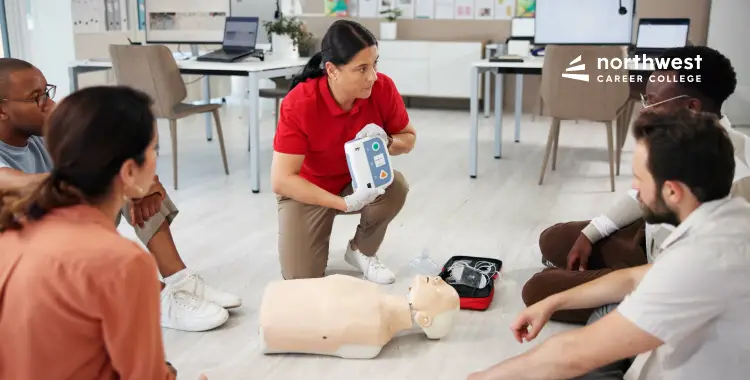
Table of Contents
What Is CPR?
Cardiopulmonary Resuscitation (CPR) is a type of emergency procedure that helps maintain the circulation of blood and oxygen into the body when a person stops breathing or when the heart stops beating. It is a procedure that consists of chest compressions, usually with rescue breaths, to maintain the brain and other vital organs with oxygen until emergency medical services arrive.
Traditional CPR Techniques and Their Limitations
Traditional cardiopulmonary resuscitation (CPR) has been around for decades and is the standard first step in helping someone whose heart has stopped beating. It is the combination of two primary actions, including chest compressions and rescue breathing.
This approach has saved a significant number of lives, but it also has some definite boundaries. Manual compressions are exhaustive and require considerable energy and strength, particularly when several minutes of continuous chest compression are needed.
The fact that manual CPR relies more on the individual doing it is another problem. There are chances of some rescuers pressing and others being unable to maintain the appropriate rhythm. The slightest variations may diminish the effectiveness of the procedure. Due to this reason, the survival rates of patients tend to differ.
Mobile CPR kiosks
Mobile CPR kiosks teach people how to perform CPR correctly. You can find these interactive machines in places like hospitals and airports. They show you where to put your hands and how fast to press on the chest. They give real-time feedback, telling you if you push too hard, too soft, too fast, or too slow.
Hospitals use them to train more people and spread awareness. When more people know CPR, more lives get saved, especially in the critical minutes before help arrives.
Automated Chest Compression Devices
Automated chest compression devices deliver steady and effective chest compressions during CPR. Machines like the ZOLL AutoPulse Resuscitation System and the LUCAS 3 use a band or piston to press on the chest with the correct depth and speed every time. People find it hard to keep this consistency by hand, especially when they get tired.
These devices work well when moving a patient or in challenging situations where maintaining steady compressions is difficult. Hospitals use these machines to give patients quality CPR without stopping. This helps improve survival chances because the heart and brain get better blood flow during the emergency.
Real-Time Feedback Tools
Real-time feedback tools help CPR providers improve their CPR skills. Hospitals use advanced manikins with audiovisual feedback systems. These manikins show you if you press deep enough, press at the right speed, and place your hands correctly during chest compressions.
Some tools also include metronomes or sounds that keep you pushing at the right rhythm.
These features help you stay on track while practicing CPR and improve your skills. When you use these feedback tools, they give you clear guidance that enables you to perform CPR more effectively in real emergencies.
Extracorporeal Membrane Oxygenation (ECMO)
Extracorporeal Membrane Oxygenation, or ECMO, helps patients when their hearts or lungs cannot work correctly on their own. ECMO machines pump blood and add oxygen outside the body. This process lets the patient’s heart and lungs rest and heal.
Why Learning CPR Matters to You
If someone near you stops breathing or their heart stops, you can act quickly to save their life. Doctors and nurses are not the only ones who can do CPR. Anyone can learn.
With more advanced tools and training methods available, you can master CPR confidently. Enrolling in a CPR class not only equips you with essential skills but also empowers you to save lives when it matters most.
Learn the skills that can save lives, maybe even your own or someone you care about. Enroll now in the Northwest Career College CPR Course!